Classic 30s Movie: “The Women”
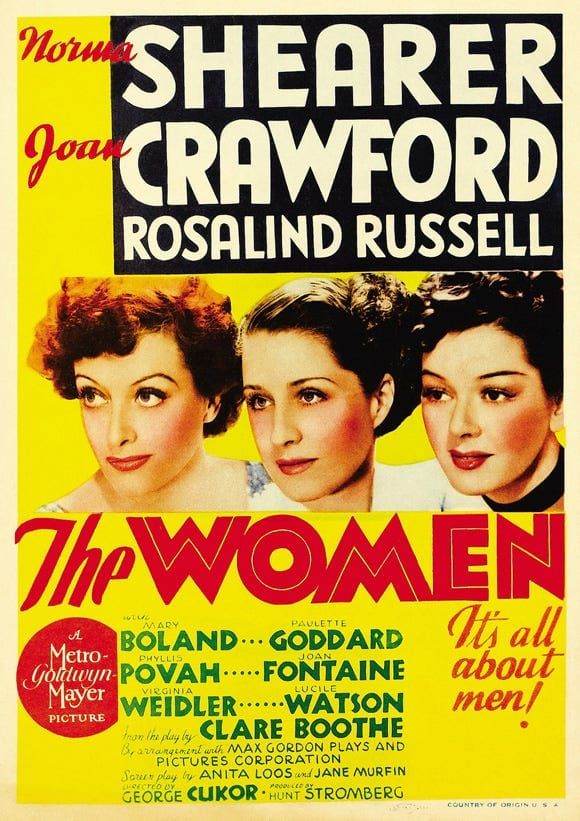
May is classic 30s movie month. Today’s guest post comes from Liz Clarke.
Title: The Women
Year: 1939
Writers: Anita Loos, Jane Murfin, Clara Booth Luce (Stage Play), F. Scott Fitzgerald (Uncredited)
Stars: Norma Shearer, Rosalind Russell, Joan Crawford
Director: George Cukor
IMDb Plot Summary: A study of the lives and romantic entanglements of various interconnected women.
Why I Think This Is A Classic 30s Movie
The Women is a great example of a “post-code” era film. While censorship had been looming from the mid-1910s onward, in 1934 the Hollywood studios agreed to a strictly enforced production code that changed how sex, crime, and drugs could be represented on screen for the next couple of decades. While films of the early 1930s valorized women’s sexuality, after 1934 romance was largely contained within the confines of marriage-driven narratives. The Women is about marriage, adultery, divorce, and remarriage — the couple must reunite to satisfy post-code narrative conventions. However anti-divorce the overall narrative is, when broken down into smaller pieces, the film offers a fascinating portrayal of women’s attitudes toward marriage and women’s roles in the 1930s. In particular, much of the dialogue and narrative is driven by an understanding that many of the women are having or have had sex outside of marriage — though, the main protagonists are firmly in marriages. When viewed with the knowledge that there were so many restrictions on what could be represented on screen because of the production code, the film’s screenplay is more fascinating. The two credited screenwriters, Jane Murfin and Anita Loos, as well as the original playwright, Clara Booth Luce, crafted a film that both toes the line of acceptable representation of women’s sexuality, while making subtle jabs at that understanding of what women are expected to be. Most likely Loos’ contribution, the dialogue is witty and creative, making each scene dynamic and continually destabilizing the women’s roles and their attitudes toward their roles. The overall structure of the film has an interesting flow, which includes a sequence that takes place in Nevada so that Mary Haines (Norma Shearer) can get “Reno-vated,” a term coined because quick divorce was legal in that state at the time. As such, there are enough varied sequences throughout the film to keep it interesting during its 2 hour and 13 minute run time. Overall, it is the balance between representing a conservative view of women and marriage according to production code rules and the way the writing of the film subtly undermines these codes that makes this film a fascinating example of 1930s filmmaking.
My Favorite Moment In The Movie
The majority of the film is black and white, however, there is one sequence filmed in Technicolor. A fashion show attended by the main characters is shown in color to highlight the society fashion trends of 1939. The entire movie balances between a satire and an indulgent glimpse into these women’s lives. The extended Technicolor sequence that focuses on the fashion, halting the narrative for several minutes, emphasizes this link between film, wealth, and fashion for audiences and fans.
My Favorite Dialogue In the Movie
The dialogue in this film is particularly delightful. Rosalind Russell (who plays Sylvia Fowler) was excellent at fast-talking quips (she is well-known for the screwball comedy His Girl Friday). The first ten minutes of the film has such a frantic pace in dialogue alone that it is almost incomprehensible, while remaining a joy to witness. The speed at which the dialogue is delivered, and the subtle jabs that the friends and enemies deliver to each other makes almost every line of dialogue fascinating. It’s also interesting to remember that after the production code came into effect, writers had to be more creative in the way they crafted insults and sexual innuendo in their dialogue.
Crystal Allen: “There’s a name for you ladies, but it isn’t used in high society… outside of a kennel. So long, ladies!”
Miriam Aarons: “A woman’s compromised the day she’s born.”
Exercise Instructor: “Let’s begin with posture. A lady always enters a room erect.” / Sylvia Fowler: “Most of my friends exit horizontally.”
Key Things You Should Look For When Watching This Movie
This movie features no male actors (there are rumors that even the animals were all female). The most exciting part about watching this film — the narrative is entirely about the women’s relationships with men — is to marvel at the ways scenes were written to exclude men entirely. One key example is during the argument between Mary (Norma Shearer) and Stephen. The audience never witnesses their argument but, instead, views a maid spying at the door and then relating the conversation back to another woman. Another example, in one of the final scenes, many of the characters attend a formal gathering, husbands included. However, the scene plays out in the lobby, near the women’s washroom, with characters coming and going from the room, with the men continually absent. The film is so well constructed that none of these scenes feel forced. Recalling the film after watching it you imagine that there must have been men in the cast, their presence is so strongly implied and yet not obviously missing.
Thanks, Liz!
To show our gratitude for your guest post, here’s a dash of creative juju for you. Whoosh!
We already have a set of classic 40s movies, 5os movies, 60s Movies, 70s movies, 80s Movies and 90s Movies. This month, we’re working on 30s movies. And thanks to the GITS community, we’ve got at least 22 movies in the works and hopefully!
Those who I put in bold have already sent me their posts. If you haven’t sent yours to me, please do so as soon as you can!!!
All Quiet on the Western Front — Michael Waters
Bride of Frankenstein — Marija Nielsen
Bringing Up Baby — Melinda Mahaffey
Captain Blood — John Arends
City Girl — Adam Westbrook
Dracula — Sheila Seaclearr
Duck Soup — David Joyner
Gone With The Wind — W. H. Morris
Gunga Din — Steve Huerta
It Happened One Night — Joni Brainerd
Make Way for Tomorrow — Susan Winchell
Mr. Smith Goes to Washington — Amber Watt
Rebecca — Katha
Snow White and the Seven Dwarves — Will King
Sabotage — Jeff Xilon
Stagecoach — Thenewlight
The 39 Steps — Felicity Flesher
The Adventures of Robin Hood — Clay Mitchell
The Petrified Forest — Rachel Sheridan
The Women — Liz Clarke
Topper — Wayne Kline
Trouble in Paradise — Vincenzo
Vampyr — Megaen Kelly
I am still looking for volunteers. If there’s a 30s movie you’d like to write about, please post your suggestion in comments or contact me via email.
Comment Archive