Classic 30s Movies: “Make Way for Tomorrow”
May is Classic 30s Movie month. Today’s guest post comes from Susan Winchell.
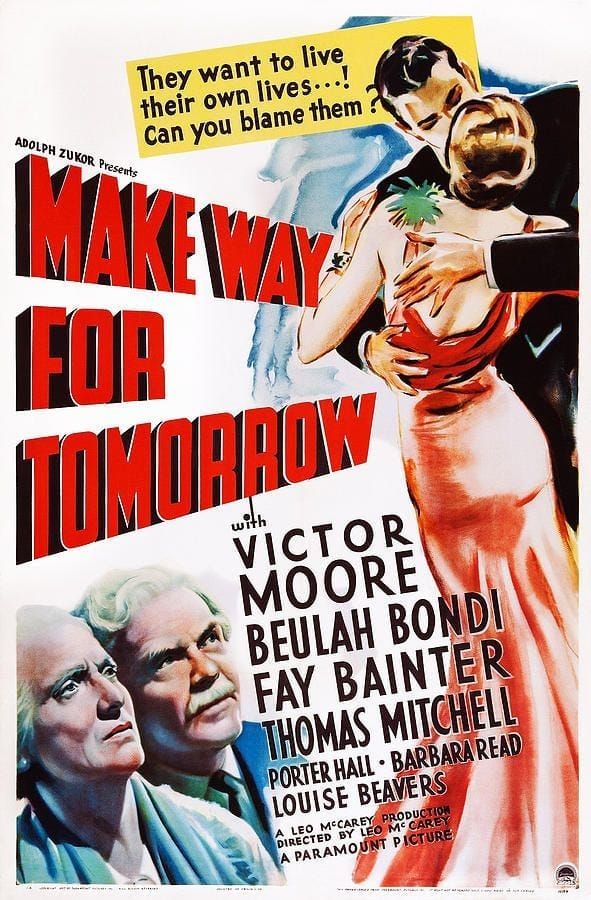
Movie Title: Make Way for Tomorrow
Year: 1937
Writers: Veña Delmar, based on play by Helen and Nolan Leary, based on a novel by Josephine Lawrence
Lead Actors: Beulah Bondie, Victor Moore, Fay Bainter, Thomas Mitchell
Director: Leo McCarey
IMDb Plot Summary: An elderly couple is forced to separate when they lose their house and none of their five children will take both parents in.
Why I Think This Is A Classic 30s Movie
There is agreement among critics and filmmakers (including Roger Ebert, Orson Welles, and Peter Bogdanovich) that Make Way for Tomorrow is a great unsung film of the 30’s. Even Leo McCarey alluded to this. In accepting he 1937 Best Director Oscar for The Awful Truth, McCarey is reported to have said something like “Thanks, but you have given this to me for the wrong film.”
Frank L. Nugent, in his New York Times review, points out that the film has “has three qualities rarely encountered in the cinema: humanity, honesty, and warmth.” I would add that it also has humor.
It is, possibly, cinema’s finest tearjerker, but without melodrama or sentimentality. It offers an unflinching and emotionally honest look at how a family handles the displacement of elderly parents. The audience cringes at moments that seem both naked and familiar. Yet, while some characters are less likeable than others, all are understandable. Roger Ebert observes, “What’s so powerful about the film is its level gaze. It calmly, almost dispassionately, regards the situation and how it plays out. No spin. …The most powerful films often simply show you events without instructing you how to feel about them. It is remarkable that a film this true and unrelenting was made by Hollywood in 1937.”
The last third of the film provides a wonderful arc showing the deep warmth of the relationship between Lucy and Bark Cooper, the elderly couple at the center of the story. There is no happy ending here. Orson Welles remarked that Make Way for Tomorrow is the saddest film ever made, and would “cause a stone to cry.” Roger Ebert observed, “Entertainment is about the way things should be. Art is about the way they are. The closing passages of Make Way for Tomorrow depend on deep empathy between the filmmakers and the characters. They respect them. These two people have spent a lifetime together, raised a family and lived in their own home until Bark got laid off. They’ve maintained a mutual dignity and they’re not about to turn sappy now.”
I also think this is an important film because of the universality of theme. Many reviews and the commentary refer to Make Way for Tomorrow “depression-era story.” I found this interesting in part because I recently discovered letters that my grandmother and her brother wrote to each other in the 1930s and 1940s about what to do about their father, who had lost everything in the Depression. And while it is true that we now have Social Security as a social safety net for older Americans, many still face an array of unattractive options for parents and grandparents who can no longer live by themselves at home (one need look no further than Atul Gawande’s wonderful recent book, Being Mortal, to see that we have not come very far in the last 80 years.) Peter Bogdanovitch, in his commentary to the Criterion Collection release of the film, said he believes the situation for elderly Americans has gotten worse since the film was made.
Lastly, in 2010, Make Way for Tomorrow was selected for preservation in the United States National Film Registry by the Library of Congress as being “culturally, historically, or aesthetically significant”.
My Favorite Moment In The Movie
There are a lot of wonderful moments in this film, and I have discovered new ones with each viewing. But for this purpose I will offer the one that struck me the hardest in my first go-round. In the last part of the film, while Lucy and Bark are visiting for an afternoon before Bark gets on a train and leaves for California, they are sitting at a bar in the hotel where they celebrated their honeymoon 50 years earlier. They are in a conversation with the hotel manager and having disagreement about whether they were married on a Tuesday or a Wednesday. The banter shows everything about the deep familiarity, warmth, and durability of this long marriage in only a few moments, and put a huge smile on my face.
My Favorite Dialogue In the Movie
Rhoda Cooper: Why don’t you face facts, Grandma?
Lucy Cooper: Oh, Rhoda!
Pats her hand.
Lucy Cooper: When you’re seventeen and the world’s beautiful, facing facts is just as slick fun as dancing or going to parties, but when you’re seventy… well, you don’t care about dancing, you don’t think about parties anymore, and about the only fun you have left is pretending that there ain’t any facts to face, so would you mind if I just went on pretending?
Key Things You Should Look For When Watching This Movie
Structure: Make Way for Tomorrow would be considered unusual today. The “inciting incident” happens in the first few minutes — there is very little “opening” before the “hook.” We see the depth and warmth of the relationship between the two main characters in the last third of the film. And this is necessary to set up the end in the most emotionally impactful way possible. I’m not knocking the structure — it really works — just observing that it does not comport with the general story structure we see today in Hollywood films. And maybe this is a good lesson!
Emotional transitions: McCarey, known for his work in comedy, skillfully shifts from lighthearted to serious and back, to great effect — so the film engages the audience in a powerful emotional journey.
Humor: While this film is very sad, it is also very funny. Watch for the humor, it is sly sometimes.
Hero: I think Lucy is the hero in this story. Keep your eye on her, she will surprise you.
Peter Bogdanovich on Make Way for Tomorrow:
Thanks, Susan!
To show our gratitude for your guest post, here’s a dash of creative juju for you. Whoosh!
We already have a set of classic 40s movies, 5os movies, 60s Movies, 70s movies, 80s Movies and 90s Movies. This month, we’re working on 30s movies. And thanks to the GITS community, we’ve got at least 22 movies in the works and hopefully!
Those who I put in bold have already sent me their posts. If you haven’t sent yours to me, please do so as soon as you can!!!
All Quiet on the Western Front — Michael Waters
Bride of Frankenstein — Marija Nielsen
Bringing Up Baby — Melinda Mahaffey
Captain Blood — John Arends
City Girl — Adam Westbrook
Dracula — Sheila Seaclearr
Duck Soup — David Joyner
Gone With The Wind — Mark Twain
Gunga Din — Steve Huerta
It Happened One Night — JoniB22
Make Way for Tomorrow — Susan Winchell
Mr. Smith Goes to Washington — Amber Watt
Rebecca — Katha
Snow White and the Seven Dwarves — Will King
Sabotage — Jeff Xilon
Stagecoach — Thenewlight
The 39 Steps — Felicity Flesher
The Adventures of Robin Hood — Clay Mitchell
The Petrified Forest — supergloss
The Women — Liz Clarke
Topper — Wayne Kline
I am still looking for volunteers. If there’s a 30s movie you’d like to write about, please post your suggestion in comments or contact me via email.
Thanks to everyone who steps up for this ongoing project!
For the original post explaining the series, go here.
For all of the 30s movies featured in the series, go here.
Click REPLY and see you in comments about today’s classic 30s movie!