Classic 50s Movie: “A Place in the Sun”
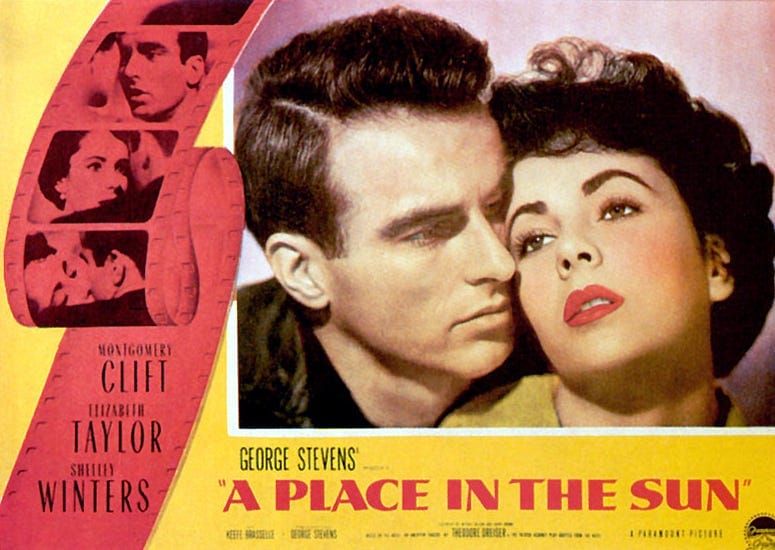
May is Classic 50s Movie month. Today’s guest post comes from Zach Jansen.
Movie Title: A Place in the Sun
Year: 1951
Writers: Based on the novel An American Tragedy by Theodore Dreiser and the Patrick Kearney play adapted from the novel; Screenplay by Michael Wilson and Harry Brown (winners of Academy Award for Best Screenplay — what’s now Adapted Screenplay)
Lead Actors: Montgomery Clift, Shelley Winters, Elizabeth Taylor, Raymond Burr, Anne Revere, Herbert Heyes
Director: George Stevens (winner of Academy Award for Best Direction)
IMDb Plot Summary: A poor boy gets a job working for his rich uncle and ends up falling in love with two women.
Why I Think This Is A Classic 50s Movie: To be honest, this is a classic movie for the ages. Almost 65 years after its release, it still plays so powerfully, so emotionally. What really keeps coming back to the film are the performances: the honesty and rawness of Montgomery Clift, the innocent maturity of Elizabeth Taylor, the always-down-on-her-luckness of Shelley Winters, and even the judicial passion of Raymond Burr (a prelude to his Perry Mason days). The three leads were big stars before the film’s release, but as great actors do, they make you forget their other films and you truly believe that Clift is George Eastman, Taylor is Angela Vickers, and Winters is Alice Tripp.
Of course, great performances are nothing without a well-written, well-told story. And Wilson and Brown’s script is air-tight and pulsing with tension (and foreshadowing) in every scene. Each scene hits upon the theme of class and society and the longing to achieve the American Dream. These themes are epitomized — as they should be — through George and his journey. He’s forever the outsider, always lost (figuratively and literally) in his scenes. Even when he seems right where he belongs (working on the factory floor, with Alice), he’s searching for the steps to take to better his position, whether at the plant or in life.
But the film would be nothing without George Stevens’ deft hand. No shot is too long or too short. No shot lacks importance or meaning. Books could (and should) be written about what Stevens accomplished as a director with A Place in the Sun, so assured was his direction. After all, there’s a reason Mike Nichols once said you can learn everything about moviemaking from A Place in the Sun:
My Favorite Moment in The Movie: With every scene so intrinsically connected to each other, it’s difficult to nail just one (or even two or three) moment that stands out — how can you point to, for instance, the George and Alice’s boat scene without referencing the news broadcast about drowning and Angela’s story about the previous drowning on Loon Lake.
But it starts with that opening shot: Franz Waxman’s score full of epic promise yet hinting at intimacy, George’s backing up to us as he hitchhikes (which is wonderfully bookended with his final walk at the end of the film when he bravely faces what’s to come), the subtle introduction of Angela (listen for her car horn)… Really, it’s a fantastic beginning to any film.
The courtroom scene when George trips over the boat’s rope (thus providing the reason he couldn’t save Alice) is a great moment that’s just passed over in the film as incidental. But as viewers, it turns the entire third act on its head and returns our sympathies to George, makes him that much more forgivable as a young man whose lack of education and abundance of ambition just got the better of him.
Another moment that stands out for me is the juxtaposition of George and Angela revealing their love one another with a passionate kiss followed by George and Alice, walking abreast without even holding hands or any initiation of physical contact, heading to the doctor looking to get an abortion. The high and low of George’s complex life expressed visually in under a minute.
My Favorite Dialogue in the Movie:
I love this exchange. So loaded with relevance:
ANGELA: Did you promise to be a good boy? Not to waste your time on girls?
GEORGE: I don’t waste my time.
And this line, which essentially sums up the feeling of being away from someone you truly, deeply love:
ANGELA: Goodbye, George. Seems like we always spend the best part of our time just saying goodbye.
Key Things You Should Look For When Watching This Movie: The most wonderful aspect of A Place in the Sun is how every scene sets up the next scene (and sometimes even a few scenes down the road). Nothing in the film happens without consequence; this is, of course, more noticeable upon subsequent viewings, but there are so many movies in which a scene or two (or more…) doesn’t affect the plot or story in any substantial way. Brown and Wilson’s script does explore subplots, to be sure, but those subplots always support the main through line of the film; they always hit upon the fact that George is always looking for acceptance and success. It is a master class in writing and filmmaking all of its own.
And while it might be obvious, I love the symbolism of the three main characters’ names: George EASTman, who’s looking for a new beginning (after all, every day begins with the sun rising in the east) and his own place in the sun; Alice TRIPp, who’s the obstacle in George’s path to higher society and a better life; and ANGELa Vickers, who swoops in as George’s potential salvation. Angela’s symbolic name also plays into George’s past and his apprehension about religion (at least his religious upbringing), and how she initial appears as George’s hope but then becomes the reason for his life taking a terrible turn.
Honestly, I could on and on about the talent and skill showcased in A Place in the Sun. I hadn’t seen the film in a few years, but revisiting it has me re-examining how I approach writing and filmmaking. Seeing it with an experienced screenwriter’s eyes brought new layers to every aspect of the film. It truly is a master class in filmmaking (and now it’s on to test: applying those lessons to my own work).
Thanks, Zach! To show our gratitude for your guest post, here’s a dash of creative juju for you. Whoosh!
Twitter: @WriterZach.
We already have a set of classic 60s Movies, 70s movies, 80s Movies and 90s Movies. This month, we’re working on 50s movies.
Here is an updated list of 29 fine folks who have already volunteered [those who I put in bold have already sent me their posts]:
12 Angry Men — Ipsita Barik
A Place in the Sun — Zach Jansen
A Star is Born — Melinda Mahaffey
A Touch of Evil — David Joyner, Vincent Martini
All About Eve — Ricardo Bravo
American in Paris — stefani1601
Cat on a Hot Tin Roof — uncgym44
File on Thelma Jordon, The — David Joyner
Harvey — Felicity Flesher
High Noon — Jeff Messerman
Invasion of the Body Snatchers — Rick Dyke
Kiss Me Deadly — John Henderson
Marty — jetwillie69
Night of the Demon — David Hutchison
Night of the Hunter — Mark Twain
On the Waterfront — Bilbo Poynter
Pickpocket — Zach Jansen
Pick Up on South Street — Vincent Martini
Quiet Man, The — Traci Nell Peterson
Rear Window — Roy Gordon
Rebel Without a Cause — Jack McDonald
Searchers, The — mkm28
Seven Samurai, The — Paul Graunke
Singin’ in the Rain — Maegan Kelly
Some Like It Hot — Will King
Stalag 17 — James Schramm
Sunset Blvd. — Lisa Byrd
Tokyo Story — Jeff Messerman
Vertigo — Jason Pates
I’m looking for 31 guest posts, one for each day of May. Why not pitch in to help add to this online resource to inspire writers to learn about and — most importantly — watch great movies.
If you have a classic 50s movies on which you’d like to do a writeup, please either post in comments or email me.
Thanks in advance!
For the original post explaining the series, go here.
For all of the 50s movies featured in the series, go here.