Classic 50s Movie: “A Star Is Born”
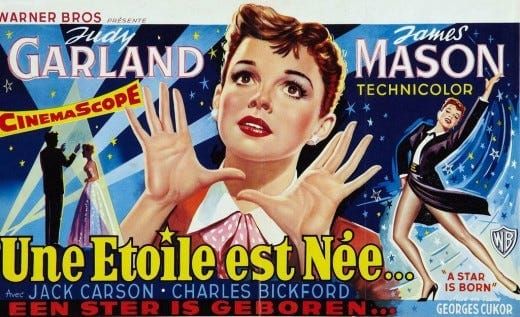
May is Classic 50s Movie month. Today’s guest post comes from Melinda Mahaffey Icden.
Movie Title: A Star Is Born
Year: 1954
Writers: 1954 screenplay by Moss Hart, based on the 1937 film’s screenplay by Dorothy Parker, Alan Campbell, and Robert Carson with story by William A. Wellman and Robert Carson
Lead Actors: Judy Garland and James Mason (Both were nominated for lead actor Oscars; Groucho Marx telegrammed Garland that her surprise loss to Grace Kelly was “the biggest bank robbery since Brink’s.”)
Director: George Cukor
IMDb Plot Summary (adapted): Film star Norman Maine (ne Ernest Gubbins) helps young singer Esther Blodgett find fame, even as age and alcoholism send his own career on a downward spiral.
Why I Think This Is A Classic 50s Movie: Judy Garland is absolutely fantastic in this film — her talent shines through, whether she’s belting out tunes like “The Man that Got Away” in an after-hours jam session or hiding her character’s relationship troubles during the in-film filming of the cheerful “Lose That Long Face” musical number.
A Star Is Born and Singing in the Rain are often cited as two of the greatest musicals ever made, but the two films — made just two years apart — couldn’t be more different. They’re both films about the inner workings of Hollywood, but A Star is Born is a much more serious, character-driven piece. It’s ultimately about these two people (Esther Blodgett and Ernest Gubbins) trying to balance their real selves with the famous personas (Vicki Lester and Norman Maine) created for them by the Hollywood machine.
Ironically, Esther’s star continuously rises, but Judy Garland herself was struggling, with a personal story more like that of Norman Maine’s. This was her first film in four years and was seen as her Hollywood comeback. Over the years, she had personal problems and struggled with dependencies on alcohol and prescription drugs, said to stem from studio criticisms that she wasn’t tall, skinny or pretty enough.
My Favorite Moment In The Movie: After Esther and Norman secretly get married, they slip away to a motel for a quiet honeymoon. Norman turns on the radio, and Esther’s song is on — it’s her first #1 hit, and she’s accomplished her long-ago-stated goal. They begin listening to the radio, but he quickly shuts it off and asks her to sing it for him — because he’s got the original in front of him. Fittingly, the song is “It’s a New World.”
My Favorite Dialogue In the Movie:
Esther: I’m quitting the band, Danny. I’m not going on to Frisco in the morning.
Danny: Are you crazy or something?
Esther: Maybe. Maybe, but I’m quitting.
Danny: Why? What happened?
Esther: Norman Maine is going to get me a screen test.
Danny: Go on back to bed, will you, Esther?
Esther: Well, it’s true.
Danny: You been drinking with him?
Esther: Of course not.
Danny: Okay, then when we get to Frisco, I’ll take you to a doctor and have your head examined. What’s the matter with you, Esther? He was making a conventional pass, that’s all.
Esther: No. No, it wasn’t that, Danny.
Danny: What else is it then? He just follows bands around and gives singers screen tests? What’s got into you?
Esther: He gave me a look at myself I’ve never had before. He saw something in me nobody else ever did. He made me see it, too. He made me believe it.
Danny: Believe what? It’s taken all these years for you to get with a big name outfit like this. You gonna toss it all in the ashcan? And for what?
Esther: For a chance at being something…something bigger than I ever dreamed of. And I’m not going to turn back now. Ever.
Key Things You Should Look For When Watching This Movie:
When the film premiered, theater owners felt it was much too long at 181 minutes, so Warner Brothers shortened it by nearly half an hour, and without consulting the director. The film was restored in 1983 to recreate the original version (which included the restoration of two musical numbers). However, they weren’t able to find all of the footage, so production stills have been used in some places, creating a somewhat disjointed film-watching experience.
The film makes interesting use of darkness and light. Most scenes are very brightly lit, but there are a couple of noticeable spots where a lighting choice is used to underscore thematic points. When Esther comes to tell Danny she’s quitting the band, she walks up the exterior stairs in the darkness of night, but she leaves his room to a glorious sunrise. When Norman and Esther part for the final time and they’re standing in the hallway, she stands in the light and he’s in darkness.
Also notice how the ocean is reflected in the house’s floor-to-ceiling windows at the end of the movie, as Esther tells studio head Oliver Niles that she’s giving up her career in order to take care of Norman full time. When Norman emerges from the bedroom, he “walks” into the superimposed waves (the hallway is fronted by the same windows). These waves are onscreen for quite awhile (5 minutes? 10 minutes?) and begin to feel relentless — making the ending seem almost inevitable.
Thanks, Melinda! To show our gratitude for your guest post, here’s a dash of creative juju for you. Whoosh!
We already have a set of classic 60s Movies, 70s movies, 80s Movies and 90s Movies. This month, we’re working on 50s movies.
Here is an updated list of 24 fine folks who have already volunteered [those who I put in bold have already sent me their posts]:
12 Angry Men — Ipsita Barik
A Place in the Sun — Zach Jansen
A Star is Born — Melinda Mahaffey
All About Eve — Ricardo Bravo
American in Paris — stefani1601
File on Thelma Jordon, The — David Joyner
Harvey — Felicity Flesher
High Noon — Jeff Messerman
Invasion of the Body Snatchers — Rick Dyke
Kiss Me Deadly — John Henderson
Marty — jetwillie69
Night of the Demon — David Hutchison
Night of the Hunter — Mark Twain
On the Waterfront — Bilbo Poynter
Quiet Man, The — Traci Nell Peterson
Rear Window — Roy Gordon
Rebel Without a Cause — uncgym44
Searchers, The — mkm28
Seven Samurai, The — Paul Graunke
Some Like It Hot — Will King
Stalag 17 — James Schramm
Sunset Blvd. — Rick Dyke
Tokyo Story — Jeff Messerman
Vertigo — Jason Pates
I’m looking for 31 guest posts, one for each day of May. Why not pitch in to help add to this online resource to inspire writers to learn about and — most importantly — watch great movies.
If you have a classic 50s movies on which you’d like to do a writeup, please either post in comments or email me.
Thanks in advance!
For the original post explaining the series, go here.
For all of the 50s movies featured in the series, go here.