Classic 50s Movie: “Seven Samurai”
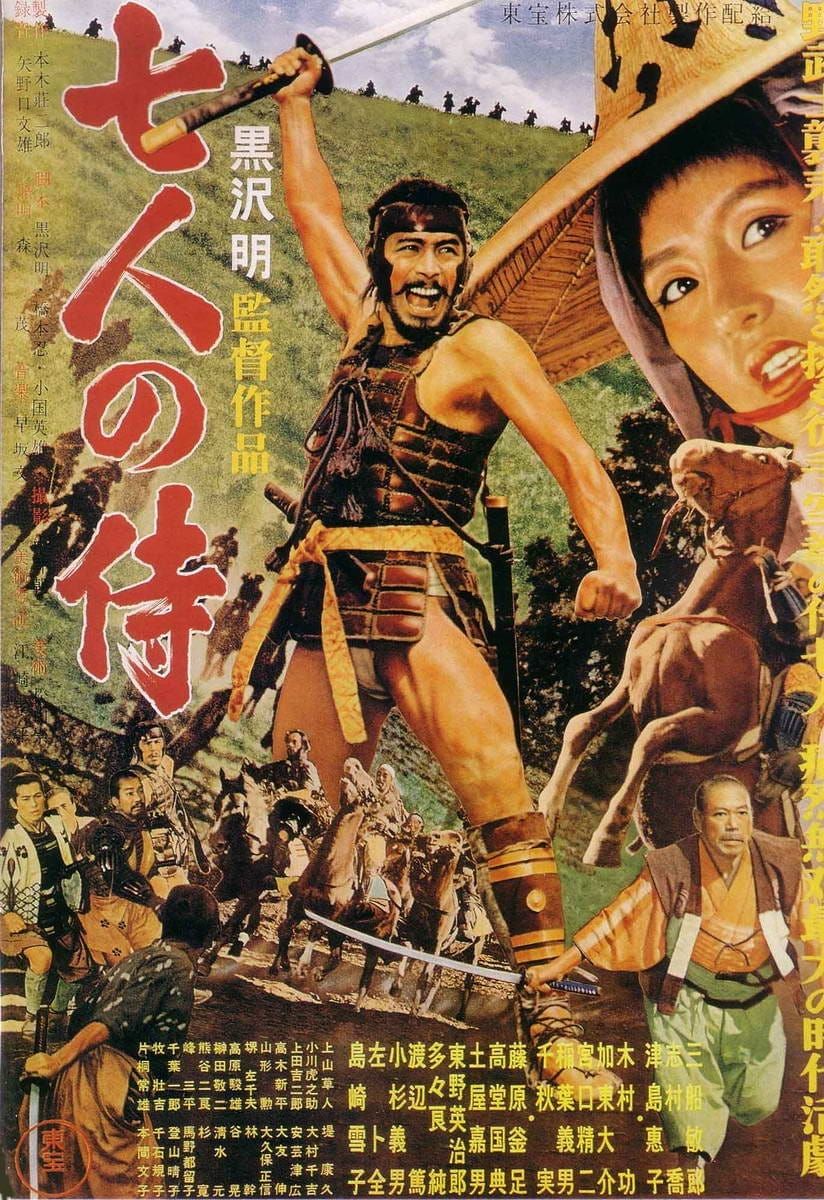
May is Classic 50s Movie month. Today’s guest post comes from Paul Graunke.
Movie Title: Seven Samurai
Year: 1954
Writers: Akira Kurosawa, Shinobu Hashimoto, Hideo Oguni
Lead Actors: Toshirô Mifune, Takashi Shimura, Keiko Tsushima
Director: Akira Kurosawa
Plot Summary: In era of chaos and civil war, a desperate village hires seven unemployed samurai to protect it from bandits.
Why I Think This Is a Classic 50’s Movie:
The film is Akira Kurosawa’s masterpiece and probably the most influential Japanese film ever made. Kurosawa’s use of narrative, the way he choreographed the actions sequences, the cinematography, and the editing not only revitalized and redefined the samurai genre in Japan, it had a major impact on action genres in the West, particularly the American western. “The Magnificent Seven” (1960) is a tribute-knock-off of the film.
The first time I saw the movie was in a revival theater in Los Angeles. The film was a bad copy, mutilated with missing and damaged frames, missing scenes, missing sound, missing captions. And I was too young and unaware of Japanese culture to appreciate the importance of the dress, styles, and mannerisms of the characters.
It didn’t matter. After thirty minutes I was fully engaged in the story. After an hour, I was enthralled.
My Favorite Moment in the Movie:
There are too many great moments in the movie for me to tag as my favorite. One favorite is duel that introduces the character of Kyuzo. Stoic, taciturn, stone-faced, he is a master swordsman. He is the embodiment of “Less is More”; he fights with a minimum of effort for maximum effect.
My Favorite Dialogue in the Movie:
It occurs in the last scene. The bandits have been vanquished: mission accomplished. So it’s time for a warm and fuzzy bonding scene where everyone celebrates, where the villagers express their gratitude to the surviving samurai, right?
Nope.
The peasants go back to their daily work, their seasonal grind of planting rice. They ignore the samurai who stand by the graveyard as outsiders.
Kambei (the group leader): “Again, we’re defeated. The winners are those farmers. Not us.”
The peasants have their land, their crops, their community. The three surviving samurai have nothing to show for their heroic effort. No thanks, no medals, no money, no jobs.
Key Things You Should Look For When Watching This Movie:
CHARACTERS AND CHARACTER DEVELOPMENT:
The story was originally conceived with only six samurai. But when Kurosawa realized that the six samurai were all relatively staid and earnest, he created a seventh, the buffoonish, Kikuchiyo. He added a Trickster character to the mix to liven up the group, add moments of comic relief, and stir up the plot.
Every samurai is introduced with a distinctive actions and conflict that clearly establish their personalities and skills.
The two samurai who initially “don’t get no respect” from the others, the buffoonish Kikuchiyo and the callow Katushiro have strong character arcs. Kikuchiyo comes from a peasant background and must prove to the others that he has the right stuff to be taken seriously as a samurai. Katushiro must prove he has the skills and maturity to be accepted as peer. And the adventure is his coming of age story, a loss of innocence in war and in love: his idol, Kyuzo, the swordsman is killed in the final battle. His romance with the village girl is doomed because it violates the cultural rules of their different classes.
PLOT CONSTRUCTION:
The plot has a clear setup, middle and conclusion with plenty of complications and reversals thrown into the path. The plot also includes an innovation. The film is one of the first to use the dramatic technique of recruiting a team by audition which has subsequently become a standard m.o in ensemble action genre films.
VISUALIZE, VISUALIZE, VISUALIZE, DRAMATIZE, DRAMATIZE, DRAMATIZE
Nothing is left to mere abstract dialogue. If it’s important enough to talk about, it’s important enough to SHOW with some concrete person, place or object. If it’s important enough to argue about, it’s important enough to DRAMATIZE, to augment the argument with physical conflict, gestures, props.
Thanks, Paul! To show our gratitude for your guest post, here’s a dash of creative juju for you. Whoosh!
We already have a set of classic 60s Movies, 70s movies, 80s Movies and 90s Movies. This month, we’re working on 50s movies.
Here is an updated list of 24 fine folks who have already volunteered [those who I put in bold have already sent me their posts]:
12 Angry Men — Ipsita Barik
A Place in the Sun — Zach Jansen
A Star is Born — Melinda Mahaffey
All About Eve — Ricardo Bravo
American in Paris — stefani1601
File on Thelma Jordon, The — David Joyner
Harvey — Felicity Flesher
High Noon — Jeff Messerman
Invasion of the Body Snatchers — Rick Dyke
Kiss Me Deadly — John Henderson
Marty — jetwillie69
Night of the Demon — David Hutchison
Night of the Hunter — Mark Twain
On the Waterfront — Bilbo Poynter
Quiet Man, The — Traci Nell Peterson
Rear Window — Roy Gordon
Rebel Without a Cause — uncgym44
Searchers, The — mkm28
Seven Samurai, The — Paul Graunke
Some Like It Hot — Will King
Stalag 17 — James Schramm
Sunset Blvd. — Rick Dyke
Tokyo Story — Jeff Messerman
Vertigo — Jason Pates
I’m looking for 31 guest posts, one for each day of May. Why not pitch in to help add to this online resource to inspire writers to learn about and — most importantly — watch great movies.
If you have a classic 50s movies on which you’d like to do a writeup, please either post in comments or email me.
Thanks in advance!
For the original post explaining the series, go here.
For all of the 50s movies featured in the series, go here.
Comment Archive