Classic 50s Movie: “Tokyo Story”
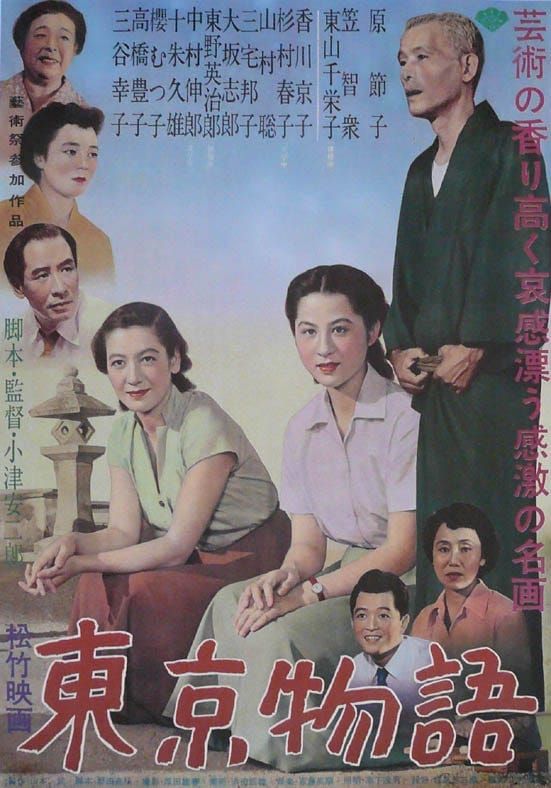
May is Classic 50s Movie month. Today’s guest post comes from Jeff Messerman.
Movie Title: Tokyo Story
Year: 1953
Writers: Kogo Noda and Yasujiro Ozu
Lead Actors: Chishu Ryu, Chieko Higashiyama, Setsuko Hara, Haruko Sugimura, and So Yamamura
Director: Yasujiro Ozu
Synopsis: An elderly couple leave their small fishing village to visit their children and grandchildren in the city but soon find themselves to be nothing more than a burden to their busy offspring.
WHY I THINK THIS IS A CLASSIC 50’s MOVIE: Not only do I find this to be a classic 50’s movie but also one of the greatest movies ever made. Granted, the story is certainly nothing terribly remarkable, almost soap opera in nature. The film, however, is made with such delicacy and gentleness and care that it never once devolves into cheap melodrama. Culturally, there may be a bit of a gap for a first time viewer of this or any of Ozu’s works but I would contend this film remains as relevant and important today as it was back in 1953.
In short, cultural quirks and mannerisms may change over time and from nation to nation, but the human condition is eternal.
MY FAVORITE MOMENT IN THE MOVIE: This is a tough one for me. The film is comprised of seemingly unremarkable life moments…a casual chat with a neighbor, a mother scolding her boys for not being polite to their recently arrived grandparents, a daughter manipulating events to be rid of the burdensome parents. It goes on and on. It’s what these small moments add up to that count in the end. So my “favorite moment in the movie?”
All of them.
MY FAVORITE DIALOGUE IN THE MOVIE: What you’ve heard is true. Ozu revels in the mundane, obviously feeling that it is in the casual exchanges where the real story is to be found. No Sorkin or Mamet style poetics here, just the poetry of real life. To lay out any patch of dialogue here would be to take it out of context and pretty much drain it of its power. Still, when seen in the framework of the film, this line by the mother to her children is, for me, particularly heartwrenching.
“Now that we’ve seen you all, no need to come down. even if something should happen to either one of us.”
A basic, simple line and yet one top loaded with meaning. Also, this exchange packs a quite punch:
“Life is disappointing.”
“Yes, it is.”
(Interestingly, I’ve seen a version where the subtitled response to that statement read, “Yes, very often,” which is almost divergently opposed to the first version. I guess it depends where you stand on that issue as to which reply works better…)
KEY THINGS YOU SHOULD LOOK FOR WHEN WATCHING: “Get in late, get out early.” Isn’t that the screenwriting adage that drives our craft these days? Ozu-san clearly would find that to be rubbish. We get in when the characters get in and we loiter, flies on the wall (though perhaps ‘flies on the floor’ is more accurate since Ozu shoots low, upwards at his actors), hearing every relationship nuance and subtlety, and we even linger in an empty room for a few moments after the characters have departed! He makes up for this “marinading of scenes” via what Ozu experts call his “ellipsoid style,” leaping forward in time, skipping what most of us would regard as key dramatic scenes…a character’s death, a conflict-filled exchange. As viewers, we are trained by Ozu to infer what occurred “while we were away.” It’s masterful storytelling that even to this day is nothing less than radical.
For me, as a screenwriter, no single director has opened my mind to the possibilities of character and story more than Yasujiro Ozu (er, for better or worse…). Check out this site for a nice springboard into his world. It is the humble opinion of this meager movie scribbler from America’s Dairyland that every practitioner of this craft should know the works of this master up, down, sideways, and backwards.
CLIPS: When it comes to supplying clips, I would truly be doing a disservice to ruin anything in this film by taking moments out of context. Thus I will do the next best thing. First, the haunting score that will remain with you for the remainder of your days:
And this. Someone collected a bunch of Ozu’s “pillow shots” (visual bumpers that establish the locale and break apart the scenes) that he became famous for. Go here to see the video.
Thanks, Jeff! To show our gratitude for your guest post, here’s a dash of creative juju for you. Whoosh!
We already have a set of classic 60s Movies, 70s movies, 80s Movies and 90s Movies. This month, we’re working on 50s movies. And thanks to the GITS community, we’ve got 31 movies in the works!
Those who I put in bold have already sent me their posts. If you haven’t sent yours to me, please do so as soon as you can!!!
12 Angry Men — Ipsita Barik
A Place in the Sun — Zach Jansen
A Star is Born — Melinda Mahaffey
A Touch of Evil — David Joyner
All About Eve — Ricardo Bravo
American in Paris — stefani1601
Bridge on the River Kwai — Tom Peterson
Cat on a Hot Tin Roof — uncgym44
Commando Cody: Sky Marshall of the Universe — J Nilsson-Acosta
File on Thelma Jordon, The — David Joyner
Harvey — Felicity Flesher
High Noon — Jeff Messerman
Invasion of the Body Snatchers — Rick Dyke
Kiss Me Deadly — John Henderson
Marty — jetwillie69
Night of the Demon — David Hutchison
Night of the Hunter — Mark Twain
On the Beach — Liz Warner
On the Waterfront — Bilbo Poynter
Pickpocket — Zach Jansen
Pick Up on South Street — Vincent Martini
Quiet Man, The — Traci Nell Peterson
Rear Window — Roy Gordon
Rebel Without a Cause — Jack McDonald
Searchers, The — mkm28
Seven Samurai, The — Paul Graunke
Singin’ in the Rain — Maegan Kelly
Some Like It Hot — Will King
Stalag 17 — James Schramm
Sunset Blvd. — Lisa Byrd
Tokyo Story — Jeff Messerman
Vertigo — Jason Pates
Thanks to everyone!
For the original post explaining the series, go here.
For all of the 50s movies featured in the series, go here.