Great Characters: Michael Myers (“Halloween”)
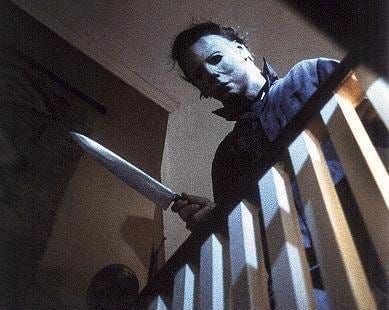
It’s one of my favorite horror movies, the 1978 classic Halloween. And the reason for the horror? The Nemesis character Michael Myers:
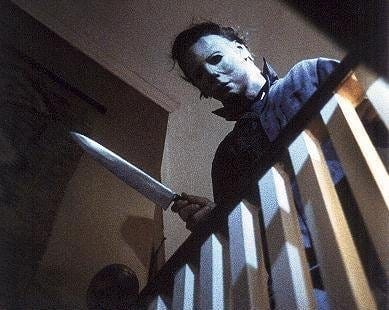
The screenplay, written by John Carpenter and Debra Hill, tells a backstory about Myers straight from some sort of Freudian nightmare. From Wikipedia:
Michael Myers is a fictional character from the Halloween series of slasher films. He first appears in John Carpenter’s Halloween (1978) as a young boy who murders his older sister, then fifteen years later returns home to murder more teenagers. In the original Halloween, the adult Michael Myers, referred to as The Shape in the closing credits, was portrayed by Nick Castle for most of the film, with Tony Moran and Tommy Lee Wallace substituting in during the final scenes. He was created by Debra Hill and John Carpenter. Michael Myers has appeared in ten films, as well as novels, a video game and several comic books.
Daniel Farrands, writer of The Curse of Michael Myers, describes the character as a “sexual deviant”. According to him, the way Michael follows girls around and watches them contains a subtext of repressed sexuality. Farrands theorizes that, as a child, Michael became fixated on the murder of his sister Judith, and for his own twisted reasons felt the need to repeat that action over and over again, finding a sister-like figure in Laurie who excited him sexually. He also believes that by making Laurie, Michael’s literal sister, the sequels took away from the simplicity and relatability of the original Halloween. Nevertheless, when writing Curse, Farrands was tasked with creating a mythology for Michael which defined his motives and why he couldn’t be killed. He says, “He can’t just be a man anymore, he’s gone beyond that. He’s mythical. He’s supernatural. So, I took it from that standpoint that there’s something else driving him. A force that goes beyond that five senses that has infected this boy’s soul and now is driving him.” As the script developed and more people became involved, Farrands admits that the film went too far in explaining Michael Myers and that he himself was not completely satisfied with the finished product.
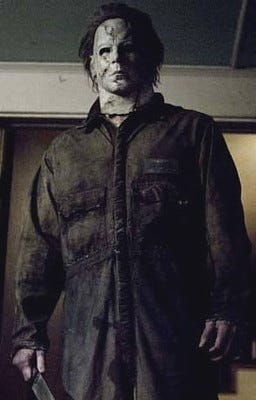
Boo!