Interview: David Turpin
My conversation with the writer of the Gothic horror movie The Lodgers.

My conversation with the writer of the Gothic horror movie The Lodgers.
I recently screened the Gothic horror movie The Lodgers, written by David Turpin, directed by Brian O’Malley, and starring Charlotte Vega, David Bradley, Eugene Simon, and Bill Milner. The movie debuted at the 2017 Toronto Film Festival to strong reviews. It’s a compelling, creepy story, well worth watching.
Here is an interview I conducted with David Turpin:
Scott Myers: You have an interesting background for someone to write a screenplay for a Gothic horror movie like The Lodgers, both as an academic and musician. Could you give us an abridged version of who David Turpin is and how you found yourself in a position to write a screenplay for The Lodgers?
David Turpin: Film is always the medium that I have been most interested in. Even since I was a small child, I guess it was the way that I had a lens to look at the world. I’m extremely shy, and so I guess I knew from an early age that I was never going to be able to shout down microphone at people, which is the image that a lot of people have of the filmmaking progress.
It’s inaccurate, of course, but that’s what I imagined growing up. Because of that, I guess I gravitated more towards music. Music was a way to create worlds, to create stories, to create themes, moods, atmospheres, all of the things that are part of film, but to do it in quite a quiet way, or a way that I could do alone.
Through working in music, gradually, I came back into contact with friends of mine who are working in film. It was mentioned to me by one of the producers of the film, that they were wondering if there were any interesting ghost stories. Something about it rang a bell for me, and I began it.
SM: Rumor has it, you came up with the pitch for The Lodgers in two days. Fact or fiction, and if the former, what are the details?
DT: It came to me fairly quickly. I sometimes think that the most interesting ideas are the ones where you can’t actually pinpoint the exact place they come from. They come from somewhere at the back of your subconscious that you don’t have full conscious access to.
I know that when I was a small child, we lived in an upstairs apartment. Then there was another apartment in the house below us. I also remember being a child and imagining that underneath my bedroom, there were forces that emerged and used the house. There were people that came out and used the house while I was asleep.
The people who lived below us were not [laughs] ghosts. They were lovely people. That idea of sharing the house was something that was always in my subconscious, because of growing up, sharing a house. I think it probably has something to do with that.
A lot of the elements of the story, particularly the stuff surrounding the amputation, I’m not 100 percent sure where that came from. I think that contrasting the characters who are haunted, and the young man who’s had a leg amputated, was something to do with trying to find a way of exploring the idea how something can be there and not there at the same time.
I can’t 100 percent explain the metaphor, which is why it needs to be a metaphor and not an academic paper or something.
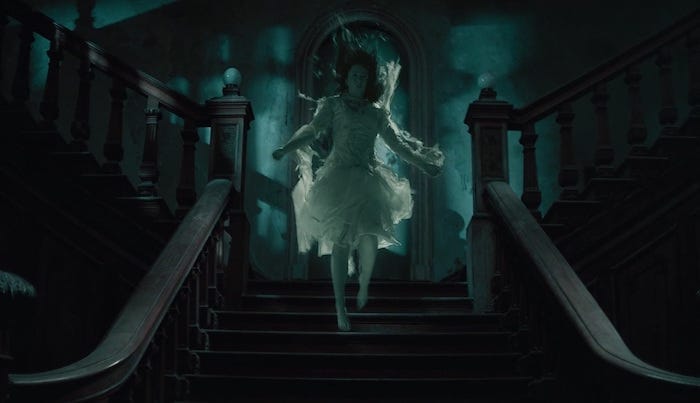
SM: Here is a summary of the plot for The Lodgers: A Gothic ghost story about orphan twins, Edward and Rachel, who share a crumbling manor in 1920 rural Ireland, but they are not alone. They share the house with unseen entities who control them with three absolute rules. As separate fates draw them apart, the twins must face the terrible truth about their family’s ghostly tormentors.
What came first, the twins, the manor, the setting, the dark spirits from the past to inhabit the manor’s basement? Could you give us some sense of the story’s development process?
DT: I think what came very, very first to me was the image of the door and the floor, and of there being something beneath the house that you were not allowed to look at. It came from that mythological image, like the Orpheus story where he goes into the underworld to retrieve his wife, and yet he’s not allowed to look at her.
The idea that there’s something below that you couldn’t look at. That was the very first thing. Out of that, the house seemed to flow naturally from that. Then the idea of the twins. Twins are a very interesting way to explore conflict, because you can show two people who are so intrinsically linked, going in two opposite directions.
There’s something very powerful about that, and I think that’s a wonderful metaphor for the way we can all feel within ourselves, torn between different impulses or different desires. I think the twins came after that, and then it just seemed, to me, natural that it had this period setting in 1920.
I think it came that way. I mean, stories for me tend to emerge out of a series of images or ideas, and then the story emerges around them. I’m not massively driven by classical story structure at the beginning of the process.
SM: One of the early funding entities for the project was the Irish Film Board. Given the fact that they have had a great run, especially recently, involved with notable movies, including Room, Sing Street, and Brooklyn, that must have been a big boost for The Lodgers.
DT: Yeah, it was. It was amazing for me, because I had never written a screenplay before. I had never submitted so much as a short film to the Irish Film Board before, for them to think about. They did show faith in me as a writer and in the idea from very early on, which I wouldn’t have expected. My background was so different to a lot of people writing features.
The script development process was actually very harmonious. I didn’t, at the time, have a frame of reference because I hadn’t written a film before. I’ve heard lots of stories about people who found developing scripts, in all kinds of contexts, a very difficult process, or a painful process, or a process with a lot of friction.
I didn’t have that experience with the Irish Film Board at all. I felt there was quite a clear sense of what the film was from the beginning, and they were supportive of it. It went through a lot of development. I think what was filmed is more or less the sixth draft of the script. I always felt that we were on the same side.
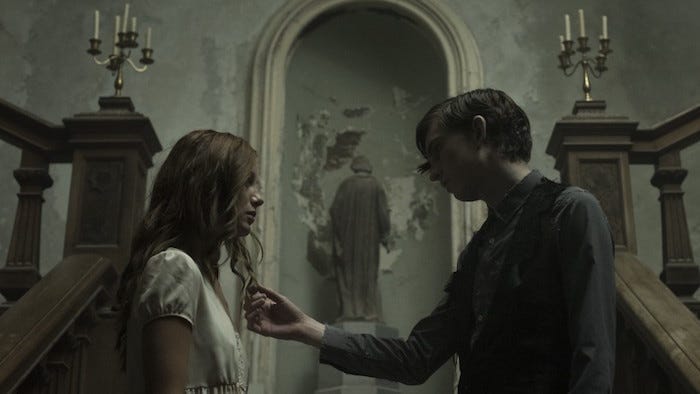
SM: There is definitely a sexual undercurrent to the story, Rachel’s desires and a rather twisted relationship with her brother, Edward, and Rachel’s relationship with Sean. What were you going for in the writing of the script in terms of exploring human sexuality?
DT: I’m not massively interested in horror as a genre in and of itself. I’m much more interested in the way that those slightly heightened genres like horror, like fantasy, like science fiction can give us a way to explore issues of human sexuality that are difficult for us to talk about. I mean, I don’t know about everyone else, but I find sex extremely difficult to talk about.
I’m grateful that there are metaphors in our folklore and in our film folklore that enable me to talk about that in an oblique way or a sidelong way. I suppose what I wanted to look at was ideas about desire. How can we control our desires, and do we permit our desires to control us?
For me, the haunting below the floor is itself a kind of metaphor for desire, because the twins, their lives are so controlled by the need to keep this thing under wraps. Of course, that ends up making their lives a horror, literally.
I think that happens with sexuality. We have to find a way to negotiate with our desires. We have to find a way to live with them, co‑exist with them, the same way the twins have to find a way to coexist with this haunting in their house.
We can either try to accept them, face them, and live our own lives, as Rachel does, or we can allow them to dominate and destroy us, as Edward does.
SM: Being a musician and academic, how did you go about learning the craft of screenwriting?
DT: I watched a lot of films, and I read a lot. I read a lot of scripts, more so than I read screenwriting manuals. I actually found the process came quite naturally to me. I’ve always found it quite hard to express myself in conversation with people, but I’m able to visualize scenes and conversations happening behind my eyes, I guess. I found it came quite easily to me.
Certainly, scene by scene, it flowed quite easily, and the writing of the dialogue flowed quite easily. What I did have to work at was the structure, issues of structure.
I think a lot of screenwriters face this, I guess, ambivalence within themselves where the process of screenwriting can be extremely standardized and extremely determined by the three‑act structure, or the five‑act structure, or the eight‑sequence outline, or whatever structure you’re using to guide your work.
I think a lot of screenwriters are torn between, I guess, self‑expression and then this need to fit into quite a programmatic form. If you compare a film to a novel, film is a much more structured form. Even in the simple fact of the running time, that most films run for more or less the same length of time where novels can be anything from 80 pages to 1,500 pages.
I guess I had to learn how to retain what was singular about what I was doing and yet make it work within a viable structure. Particularly, as The Lodgers is a genre film. Genre is about finding this really difficult balance between giving people exactly what they want, but also surprising people and giving them more than what they want, or giving them what they want in a way that they didn’t expect.
In a weird way, genre films are about following a set of rules. One of the rules is that you have to break the rules. That was, I guess, the work of writing the script was learning about structure.
SM: Could you describe your process of writing the script for The Lodgers?
DT: I’m quite simple‑minded, and I tend to begin in quite a simple way. I started at the beginning, and I wrote till the end, in sequence. At that point, the number of the sequences of the film were very crystallized in my mind when I started to write, and others weren’t.
I got a draft that I think had four or five very strong sequences in it, and the rest was connective tissue. The subsequent drafts were about getting that connective tissue up to the same level as those sequences.
SM: How long did it take between your original pitch and a signed‑off script for production?
DT: I can’t remember. I think that off and on, I was writing it for about a year before the director came with that, Brian O’Malley became attached to it. Then after he was attached, there was probably another six months or so of drafting. I think it was about an 18‑month process writing it.
I mean, I wasn’t writing 9:00 to 5:00 for 18 months, but I think the script came together over a period of about 18 months.
SM: What was that experience like, going from the original pitch to the signed-off script?
DT: It was interesting. I think that people go through different phases where you feel like you’re disappearing from it. Then you work through that, and you realize that that’s not the case. I enjoyed it.
I think the wonderful thing about screenwriting is that, yes, it is an act of self‑expression, but it’s also a very technical process. It’s not just an art, it’s also a craft.
There are times when it can be artistically frustrating. I think those are the times when you need to focus in on the craft. Then when the craft gets tiresome, there’s always the artistic dimension to keep pulling you through. I think because of the dual nature of it, it’s consistently interesting from start to finish. I find it so, anyway.
SM: What’s your favorite scene in The Lodgers?
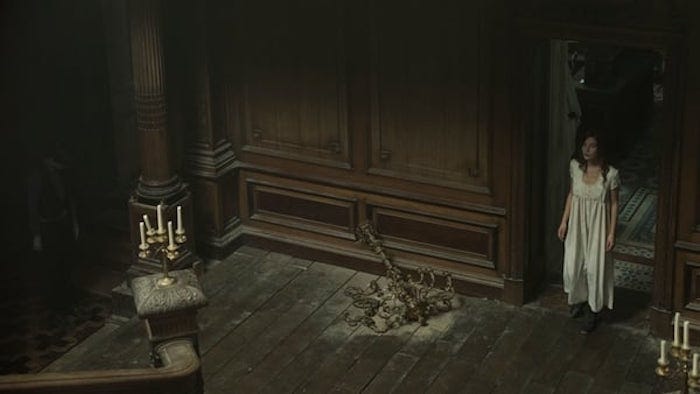
DT: My favorite scene is towards the middle of the film, where the character, Rachel and Sean, the boy that she’s become interested in, where she removes his artificial leg and, I guess, shows him that she is aware that his leg has been amputated, and that it doesn’t frighten her, that it fascinates her.
I’ve always been very interested in what’s called phantom limb syndrome. People who have lost a limb or an extremity and yet can still feel it there. I thought that was a lovely analogy for the idea of being haunted of something being there. You can feel it there, but objectively, it’s not there.
I think you have these two people from very different backgrounds. She’s very privileged, he is not. He lives in a very real world of flesh and blood. She lives in a very otherworldly world, but by this shared experience of something being there and not there at the same time, they are able to come together.
SM: The movie is premiering at the 2017 Toronto International Film Festival. Can you describe your feelings looking back on the journey from the original pitch to the film’s upcoming debut in theaters?
DT: The feeling? [laughs] I’m very happy that the first book that I’ve written has become a film, for a start. Secondly, that it’s going to be playing in Toronto, because Toronto is such a wonderful opportunity to have. I guess I feel very glad about it.
The other thing is that it’s my script, it’s my story, but it’s not my film. I’m just very happy that the script’s got into the hands of people who were able to take it where they took it. I’m really excited for everyone, not just because I was the origin of that, but because it was taken by so many people on this path.
SM: Is there one major lesson about screenwriting you have learned through The Lodgers journey you could share with other writers?
DT: I guess what I would say about screenwriting, in general, is that you can get an awful lot of guidance and an awful lot of help on how to structure your idea, and how to make your idea palatable, and how to make it work as a script.
It’s both great to be able to get all that advice and all that help. I think you have to hold on to that initial feed that came out of your subconscious, that comes out of your dream life. You have to hold on to that throughout the process while shaping it into a screenplay.
That’s what gives a screenplay texture. That’s what gives it character. It’s when it keeps that, be it ever so small, that one little grain of the inexplicable or the unexpected. You have to keep that through the formalizing process of writing a screenplay.
SM: Last question: What’s next creatively for David Turpin?
DT: I’m working at the moment on another screenplay with the same producers as The Lodgers, which is a more contemporary story. I also am working on a piece of speculative entity, which has to do with evolution. I’m working on a comedy, which is quite a change for The Lodgers. I have quite a lot of variety on the horizon, I think.
A trailer for the movie The Lodgers:
For more of my interviews with screenwriters, filmmakers, and industry insiders, go here.