Interview (Part 1): Craig Borten
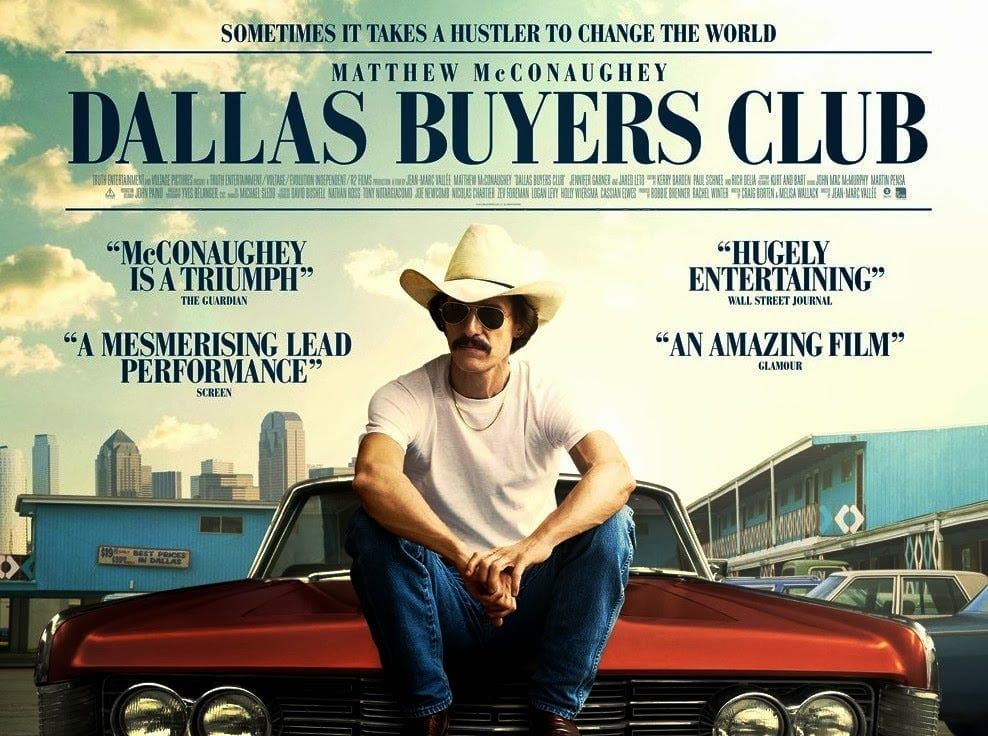
I first met Craig Borten at the 2014 Austin Film Festival where he was a panelist in a session I moderated. We discussed the movie he co-wrote and was nominated for an Academy Award: Dallas Buyers Club. Seeing as The 33 is coming out this week, another movie Craig co-wrote, I reached out to him for an interview and Craig agreed. We had a great one-hour conversation.
Today in Part 1, Craig talks about his background and what the genesis was for Dallas Buyers Club:
Scott Myers: You grew up in Pennsylvania.
Craig Borten: That’s correct.
Scott: Were you always a fan of movies?
Craig: Yeah, I love movies. My dad used to take me all the time.
Scott: What were some of the more memorable ones you remember from your childhood?
Craig: What are some of the ones my dad used to take me to? The Godfather, Some Like it Hot, all the Bond movies, stuff like that.
Scott: Do you remember the first time you ever thought, “Hey, there’s somebody who actually writes these things.”
Craig: Yeah. I thought about it a lot. Then as I was getting into college, a lot of my friends were in the film school at Syracuse, I started really following it a little bit more.
Scott: At Syracuse, did you study film there, or writing?
Craig: I did not. I studied Liberal Arts, but I was helping my friends make films. They were filmmakers or writers, so I was exposed to it then.
Scott: When did you actually start to think about writing screenplays?
Craig: When I was in school, I was thinking I wanted to get into the entertainment industry. I had a girlfriend at the time who was from Los Angeles who invited me to come out here for the summer. I came out and decided I was going to stay, and start taking classes.
I took some writing classes and some acting classes, AFI, UCLA, Robert McKee. That was when I decided I wanted to write. Then I got involved with the theater group and was writing some shorts for actors to perform in, and stuff like that.
Scott: What year is it we’re looking at when you moved out to LA?
Craig: I moved out to LA, then I was basically looking for something to write. I wrote a “Seinfeld” spec with a friend. Then another old girlfriend of mine sent me an article about Woodroof. That was around 1992.
Scott: That’s how you intersected with Ron Woodroof.
Craig: Yeah, and the Dallas Buyer’s Club. I thought it was a fantastic story. I related to it because my father had dealt with a terminal illness. He had lymphoma. Some of the things I learned during his illness were reflected in Ron Woodroof’s struggle for alternative medications, protocol, the protocols for getting access to alternative medications, the way the FDA worked, the NIH, stuff like that.
It spoke to my heart a little bit, his plight.
Scott: You get this article. You obviously don’t know Ron. How did you go about locating him and getting the approval from him to move forward with a screenplay adaptation?
Craig: I wrote him a letter. He didn’t respond, and then I called multiple times. One night, around seven or eight o’clock, he answered the phone.
We had a nice conversation, and he basically said, “If you can be here tomorrow, you can interview me.” I got in my car. I didn’t get there the next day, but I got there the following day. I drove to Texas.
I had no money. I slept in a AAA park in a tent. Then we spent three days together, and I tape recorded everything. He gave me the blessing to go write a movie about his life.
Scott: This is a script you co‑wrote, which in 2014 was nominated for Best Original Screenplay by both the Writer’s Guild of America and the Academy Awards, wins three Oscars including Best Actor for Matthew McConaughey and Best Supporting Actor for Jered Leto.
It’s about Ron Woodroof, from 1985, a Dallas electrician and hustler, had to work around the system to help AIDS patients get medication they needed after he himself was diagnosed with the disease.
You spent three days interviewing him, and you compile maybe 20 hours of taped interviews…
Craig: Maybe close to 30.
Scott: 30 hours. Ron didn’t survive much longer after you interviewed him.
Craig: Unfortunately he did not. We were going to go on a smuggling trip. He was going to take me to Mexico and I was going to go with him to smuggle some meds in, but unfortunately he died, I think October, November of ‘92.
Scott: You and I did a forum together at the Austin Film Festival last year. If memory serves me correct, did you make some sort of promise to him that you’d get the movie made?
Craig: I basically said something to him to the effect of, “I can’t really give you any money right now,” but I said, “I promise you I will get this film made.” I had no idea what I was promising, but I said to him, “I promise you I’ll get this story made. It’s so important.”
Because he said something to me that hit me on the deepest level. It spoke to me at the time, and it still speaks to me today. I asked him, “Why do you want a movie made about your life?” He said, “Because I think people should ask questions.”
I loved that.
Scott: Interesting.
Craig: Yeah.
Scott: Of all the answers he might come up with… “I think people should ask questions.”
Craig: Yeah. We take a lot for granted, we trust a lot of people, we trust our doctors, we trust our pharmacy, and we trust the medical industry, but until we’re hit with something, we don’t understand exactly how it works.
What we realize as we get older is that everything’s a business, fortunately or unfortunately, and you need to ask questions.
Scott: You said that you had this experience with your father. Didn’t you also have a stepfather who had died of a terminal illness as well?
Craig: I did, and they both went through the same horrible process.
Scott: And so a personal resonance to this material?
Craig: Yeah, very personal resonance to the material, having lost a father and a stepfather to cancer, and witnessing the medical industry up‑front. It’s a very personal movie.
Tomorrow in Part 2, Craig describes the labyrinthine path Dallas Buyers Club took to get produced.
Craig is repped by UTA.
The 33 opens in North America, Friday, November 13th.
The movie’s website here.
Twitter: @CraigBorten.
Comment Archive