Interview (Part 1): Robin Swicord
Prolific Hollywood screenwriter whose latest is Wakefield.
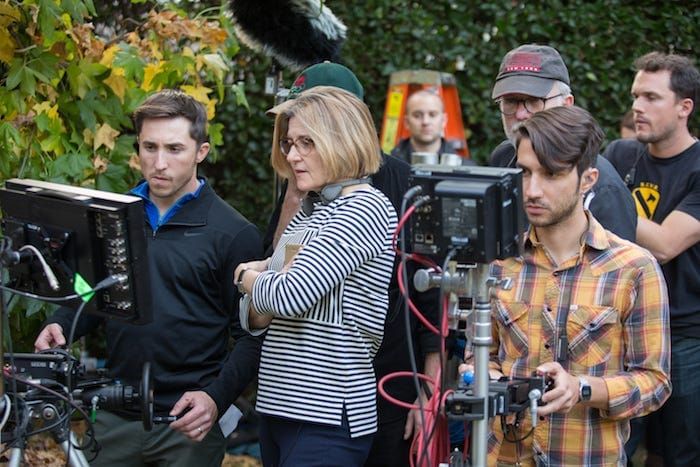
Prolific Hollywood screenwriter whose latest is Wakefield.
Robin Swicord is a writer, producer, and director whose movie credits include Little Women, Matilda, Memoirs of a Geisha, The Jane Austen Book Club, and The Curious Case of Benjamin Button. Her latest is Wakefield which Robin wrote and directed, and stars Bryan Cranston and Jennifer Garner. The movie premiered in New York this past Friday and rolls out to more theaters this week.
I have known Robin for many years as our children attended the same school in Los Angeles. In fact in 2013, I moderated an Austin Film Festival panel called “Deconstructing Dog Day Afternoon” in which Robin, screenwriter Peter Craig, and I broke down and analyzed that classic 1975 crime drama.
Recently I interviewed Robin about her lengthy and successful career in Hollywood. It was an hour-long conversation covering a wide range of subjects related to screenwriting and filmmaking. You will find Robin’s observations insightful, informative, and entertaining.
Today in Part 1 of this six-part series, Robin talks about how she discovered a passion for storytelling, eventually breaking into Hollywood by writing and selling a spec script.
Scott Myers: Let’s start with your background because it appears you and I have something in common. We’re both military brats.
Robin Swicord: Yeah, that’s right. My Dad was in the Navy, and his dad was in the Navy, and his grandfather was in the Civil War, so they’ve been going to war for a long time.
Scott: I have to say your stint in Barcelona, Spain trumps my four years in Minot, North Dakota.
Robin: Oh, golly. At least I had something to really be nostalgic for.
Scott: Did you do a lot of moving?
Robin: You know, we didn’t do as much as some families that I’ve met. We were stationed in Miami. Before I was born, my Mom had to travel around a bit, you know, San Francisco and places where my Dad was doing flight school and stuff like that.
I ended up being born in South Carolina while he was in the Korean War. Then we lived in Miami, when my dad was attached to military intelligence there. Then we got sent to Barcelona, because that was the nearest base to the hot spot of Greece, where there was Cold War stuff going on off of Crete.
Our next place, after a brief little stop in Haddonfield, New Jersey, was Panama City Beach, Florida, at what I think was euphemistically called the Mine Defense Lab. This part of the Panhandle was then a very tiny little resort area, with beautiful white beaches, a lot of natural beauty, not very developed. It had a remote feeling. That was where we landed after living in Barcelona.
Scott: Do you think growing up in a military family has had any impact on your writing and the stories you’re drawn to take on?
Robin: I think that there probably are a couple of things, if I really had to try and parse this out; unravel things a bit. I would say that I never had a sense of really belonging anywhere, because we were always the new people. We were perching places and not living there.
I didn’t know that Panama City would become my family’s home for the duration of my school years. I didn’t really fit in, in any way, with the people around me. I was really considered to be sort of odd.
To keep myself company, I did a lot of reading. That life of books, I think, made me want to be a writer.
Scott: Evidently, you developed an interest in writing early and then carried that with you to Florida State, where you double‑majored in English and theater. I take it you started writing plays before screenwriting.
Robin: Right. I was exposed to plays, because I was a theater major. I had friends who were taking a playwriting class, though I never took a playwriting class. It was offered through the School of Theatre, but I was on a tech track, I was part of the students who worked backstage. I was always interested in production.
I loved movies but I started writing plays because I could always get friends together to read a play aloud, whereas I didn’t really have the money to develop an entire film on my own. It’s different now, but at that time, you just tried to scrape together enough 16‑millimeter film to go shoot a few minutes of film, and then you tried to find an editing bay where you could edit your film together.
You had to take your film to a lab in Atlanta, out of northwest Florida, so that it could get developed. It was a very cumbersome process. Not designed to turn you into a director.
Florida State was just starting its film school then; I think it was in my senior year. So I didn’t get any kind of formal training in film. What I had was a lot of exposure to watching movies.
I had grown up in this unusual place, Panama City Beach, Florida, that had one local television station, very small, that you could tune into on your rabbit ears. Because our town was on the Gulf, no one bothered to beam their programming there, because it would just go out over the ocean.
The TV station wasn’t affiliated with a network, which meant that all programming had to be done in‑house. A guy named Earl Hadaway worked at that station, who was a cinephile. He’d had a dream of going to Los Angeles and being in the movie business when he got out of the service. Instead he came back home and he began programming for the TV station.
He would bring in 16‑millimeter prints of everything Hitchcock had ever done, everything Cukor had ever done, everything that John Ford had ever done. He’d cut commercials into them, and when you’d turn the television set on, you’d see a spot for the local dry cleaning company, then you would see 10 or 15 minutes of the Hitchcock movie. These movies ran all the time.
That was the beginning of my film education: Straight‑up 16‑millimeter copies of film classics. When I got to Florida State, I worked for a little newspaper in their darkroom, later shooting for them; and I had the job at night of printing everything that would be in the paper. I always had to wait for my prints to dry. This was before resin‑coated paper.
I would go downstairs to the theater where they were programming FSU’s student movie club; programmed, I believe, by FSU students.
I saw so much. Or I saw good chunks of so much. [laughs] Somewhere in there, watching a movie, I noticed in the film credits that the screenwriter was listed. That was the beginning of me thinking: “Oh, that’s one way I could make movies — I could be the writer.”
Scott: You did make some short films and had this interesting path to Hollywood ‑‑ an industrial filmmaker in Atlanta and a copywriter in New York City. You started a theater company. Was there an intentional thread through all of that, or was this just a case of you following what you were doing and seeing where it would take you?
Robin: I don’t think I knew enough then to be strategic. The thing that all of that had in common was survival and creative work. I didn’t come from a family that had money. I worked to put myself through school. I had a scholarship from Florida State and I had a job while I was a student.
When I got out, I had to just keep working. But I sought out jobs where I could continue to develop myself as a creative person. I didn’t get a job at the Xerox place doing mindless work so at night I could write. I tried to find a job where I would be doing something creative at work as well. I felt, if I didn’t do that, I would go a little crazy.
I did some freelance writing and shooting work for IBM General Systems in Atlanta. This was a division of IBM, pre-laptops, probably now defunct. Their ad agency saw some of the stuff that I’d been doing for them, and they offered me a job in New York.
I had been wanting to go either to New York or LA. I wanted to be where movies were made. I ended up going to New York and taking this advertising job, which I wasn’t trained for, or even that adept at. But during that year, I wrote my first play, and friends of mine put the play on. They worked in the theater. I guess you could say we started a theater company, but we really only did a couple of plays.
That was a beginning. Through that, I was able to get the attention of an agent, who then approached me and asked me if I would be interested in writing movies, and I gave her a screenplay that I had written.
Scott: Called “Stock Cars for Christ”?
Robin: That’s right.
Scott: Which I’m imagining is not a sequel to Will Ferrell’s movie, “Talladega Nights ‑‑ The Ballad of Ricky Bobby.”
Robin: No, mine would be the prequel.
Scott: [laughs] What was the story behind that script?
Robin: You’ve definitely done your homework here. You can see that there’s nothing strategic in my choices. My own belief is that it’s all one big jazz improvisation, that you just keep following the thing that looks like a path that could possibly open, and finally something possibly does open.
Scott: That script, “Stock Cars for Christ”, got set up at MGM.
Robin: Yeah, it got bought by Freddie Fields, who was at MGM. Or he was at Columbia, and then went over to MGM when he moved over with David Begelman. My script was actually recommended by a person who worked for him, who was from Orlando, Florida — Lynn Arost. If you read that screenplay now, it’s not terribly good, but there is a certain voice that you hear in it that Lynn, I think, responded to.
Tomorrow in Part 2, Robin provides background on several of her movie projects including Little Women, Memoirs of a Geisha, and The Jane Austen Book Club.
Go here to read a Los Angeles Times feature on Robin and her latest movie Wakefield.
I have seen Wakefield. It is an engrossing tale of a man deconstructing his life in a fascinating fashion. You may learn more about Wakefield here.
Declare Your Independents! See Wakefield in a movie theater near you!