Interview (Part 2): Marc Hofstatter, Indiegogo
Since the concept of crowdfunding has taken hold over the last few years, particularly in relation to movies, TV, and web content, I thought it would be a good idea to talk with Marc Hofstatter who is Head of Film at Indiegogo.
Today in Part 2 of a two-part series, Marc talks about some new Indiegogo initiatives and some keys to running a successful crowdfunding campaign.
Scott: I’ve seen these three buzzwords, disrupt, simplify, and empower. Could you talk about that?
Marc: Disrupt, we sort of addressed, where I think that removing the gatekeepers, the five people in the industry who say, “No”, and opening it up to 5 million or 10 million or 15 million. Actually, our website gets over 16 million unique visitors a month. So, you’re getting all of those individuals to look at what you’re doing and, “This is possible”.
We’re doing that even more so. For example, our partnership with Vimeo. A lot of filmmakers don’t know what to do with their film, after they were done, even after they got into the festival that they wanted to get into.
What’s next? If you go to any major film festival, be it Sundance or Tribeca or Toronto, only a small percentage of films get the actual distribution. We recognize that, when you created this amazing community on Indiegogo, you don’t want to let it go. So, what do you do?
You do digital distribution. We partnered up with what we believeis the best partner for it and Vimeo has created this million dollar creator fund, exclusive to Indiegogo, where they will match dollar for dollar, films that are funding on Indiegogo that they want on their platform.
It’s an amazing experience. It’s a peer‑to‑peer distribution model that favors the filmmaker in a 90/10 split. They’ve been a great partner and I think they will be a great partner for a lot of our filmmakers.
Simplify, the process is made easy. Why not raise funds in 30 days, rather than spending months upon end rather than trying to find that one private investor?
We have filmmakers who get $10,000 contributions on a routine basis from total strangers who simply loved their project and want to get involved.
Empower. Again, it goes back to putting the control of the situation, into the hands of the creator, whether it be the filmmaker or what have you. You’ve got to say that that’s pretty sexy, when someone has complete creative control, ownership of their IP, and direct interaction with people, who are going to watch, see, their films, as well as be advocates for their films, that’s definitely empowering.
Scott: One recent campaign that launched on Indiegogo was Orson Welles final film, “The Other Side of the Wind”. What can you tell us about that project?
Marc: That’s a prime example. Orson Welles had only one film, believe it or not, that he had final cut on, and that was “Citizen Kane”. After that, he never had final cut again. His second film, “Magnificent Ambersons”, was cut behind his back and the original footage was destroyed. His cut of that film does not exist.
“Touch of Evil” was heavily recut. It wasn’t until many years after his death, 20 plus years after his death, that they were able to go back to his notes and repair the film to his satisfaction or his perceived satisfaction. “Other Side of the Wind” is a film that he tried desperately to get financed and he shot the film, but he did not have the opportunity to finish editing it, because he ran out of money.
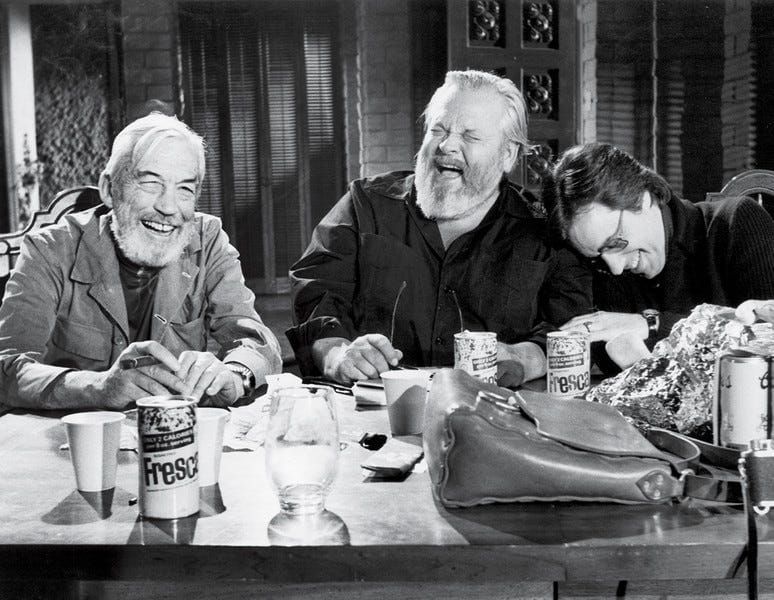
John Huston, Orson Welles and Peter Bogdanovich on the set of “The Other Side of the Wind”
It’s a long story, but it’s an amazing story. There’s actually a book about it right now. What he went through to get to the point where he was before he passed away, which was, he was almost done. But now, after years of litigation, the film is on its way to being finished, if only for the success of the crowd funding campaign on Indiegogo.
They’ve got several thousand individuals to be part of the process and be a part of the Orson Welles community. They’re on their way. I think that people will continue see what Orson Welles contributed to filmmaking society, from him as an auteur and both as an actor as well. This film, his last film, will be the great cap to an amazing legacy.
Scott: Is Indiegogo just focusing on crowdfunding, or is there some broader vision for what it could become?
Marc: As I said, we’re looking at, for Indiegogo, from my perspective, we’re not just a crowdfunding platform. We’re specifically looking at our film team. We are a team that’s dedicated to servicing our filmmakers, in whatever way they need, whether it’s introducing them to sales agents, introducing them to festival programmers, or introducing them to representatives, agents, and managers.
Each member of our team has come from different walks of life, producing, filmmaking, film sales, distribution. By each bringing our own relationships and knowledge to the table, we have a pretty good team to use to help our filmmakers achieve whatever they’re looking to do.
Scott: Why Indiegogo as compared to some of the other crowdfunding platforms?
Marc: That’s a good question. Why Indiegogo? Indiegogo, we started it off. We launched as a platform in 2008 at Sundance, creating the rewards based system for crowdfunding that you see today. We did that before anybody else. We’re the only global company. We’re available for filmmakers and other creative individuals to run and fund their projects anywhere in the world, not just in a limited amount of countries.
We are a much more flexible platform. We offer multiple ways that you can fund your project, multiple ways that you can get funded. Go back to what I said earlier, when filmmakers work with us, when they listen to us, we offer the best support that any platform can provide.
Scott: I know that you mentioned earlier that community building is one key to successful crowdfunding campaign. Are there some other important keys for a filmmaker to be thinking about when they’re thinking about doing crowdfunding?
Marc: Definitely don’t think about it as a money grab. If you’re thinking about it as a money grab, it’s going to hurt you. Aside from the community building element, take time to do your research, in the same way that you wouldn’t just hire a crew off the street to shoot your film. You would check references.
You would see who is good at what they do. Are they going to come in on budget? Are they going to show up on time? Is everything going to be in focus? Are they not going to break anything? You want to do the same thing for your crowdfunding campaign. Make sure that everything is aligned properly.
Do the research. Know who is going to be your core audience. But, also know who those other audiences and crowds are going to be, that are going to show up and support you, because if you rely on one particular demographic to support you and they don’t show up, you’re in trouble.
Scott: Finally, for those of us who love Indie films, such as myself. As recently as five or six years ago, there were people who were well seasoned in the field saying, “This is, with the death of DVD and foreign sales and all that, the decline in DVD sales and all that, the Indie films are going to go away”.
Now, there seems to be this resurgence. Do you feel optimistic about the future, in terms of Indie films?
Marc: I definitely do feel optimistic about the future of Indie film. It’s not going to be an easy one. When people look at distribution deals, as I said earlier, it’s easier to get distribution, but it’s also more difficult to be paid well for distribution.
That’s a tough thing. But, I think because the cost of filmmaking continues to go down, it’s going to be a balance, a fine balancing act between getting your film made, taking a shot that you can, using that success to build on it and continue to grow, as a film maker.
When you look at someone like Colin Trevorrow, for example, who makes a movie that costs less than a million dollars, Safety Not Guaranteed, and hits a homerun. He was approached, and they said to him, “What do you want to do?” He went in, he pitched on Jurassic World, and there he went.
Or, you look at Josh Trank and the Fantastic Four or any of these individuals who are sort of breaking new ground with these independent films, once you have that one success, you can write your own ticket.
I know it’s not easy, but if you take the time to invest in your own career, others will invest in you.
For Part 1 of the interview, go here.
Twitter: @TheOriginalHoff.
Indiegogo site: Here.