Interview (Part 2): Sam Regnier (2015 Nicholl Winner)
Sam Regnier wrote the original screenplay “Free Agent” which won a 2015 Nicholl Fellowship in Screenwriting and has been set up at CBS Films. Recently Sam and I had an excellent phone conversation in which we covered a lot of territory, his background and how he got into writing, a deep analysis of “Free Agent”, and a discussion about the writing craft.
Today in Part 2, we start to dig into Sam’s Nicholl winning script “Free Agent”:
Scott: I believe it was Scott Derrickson who said there’s a way of inverting that whole thing about getting on lists, essentially you’re branding yourself as a writer. If you’re a genre writer, in particular, you want to be known as an action writer or a comedy writer or a sci fi writer.
Sam: It can be really useful to brand yourself. I know in the back of my head that I have much broader ambitions or broader interests, and I am still committed to pursuing them, but we work in a business of creativity and ideas and things that are very ephemeral. If you’re going to have a conversation with someone about something that’s real and concrete, you need to ground that. It’s not always the best idea to tell them, “Yeah, I want to comedy, but I also want to do dramedy and I want to do a space opera, also. But also, I want to do a Marvel movie.” It’s not practical to talk about that in conversation. The easier way, when you’re starting out, is to say “These are the things that I’m interested in right now; this is the target that I’m hitting.” And ground that in real things that people understand.
It doesn’t have to be “I’m looking for high concept comedies with a budget of between $10 million and $40 million.” You can say that, but you can also say, “I like stuff with father-daughter relationships.” Or “I like workplace dramas.”
Scott: That’s the value of a spec script. No matter what genre you may be known for, you can always branch out and write something new.
Sam: Exactly.
Scott: You made that shift from being an assistant, and you tutored for several years and then worked for an educational type of an outfit, Green Dot Public Schools, both of them in the field of education. That allowed you more time to write?
Sam: Yeah. When I left Paramount, the number one thing I was interested in was writing as much as possible. I knew I had to get my 10,000 hours in. I was tutoring a lot at night and on weekends, and I had huge chunks during the day to write on my own. I never would have gotten to the place that I needed to be as a writer if I didn’t have that time.
I transitioned to my job at Green Dot, which was more of a traditional nine-to-five job, because I got married, I was starting a family, and I couldn’t be away nights and weekends all the time anymore.
Scott: Let’s jump to “Free Agent,” which is this terrific script that you wrote that won the 2015 Nicholl. Here’s a plot summary:
A female NBA, National Basketball Association executive for the Golden State Warriors, Bridget, pursues the biggest free agent of her career while managing a messy divorce. And a complicated relationship with a younger colleague named Nick and his teenage sister Taylor.
If I’m not mistaken, didn’t the script make the Nicholl top 50 in 2013?
Sam: It did.
Scott: So you’ve been working on this for a while.
Sam: Yeah. I submitted it in 2013, and then I continued to write it over the summer, and was so upset that I hadn’t gotten the draft that I liked in the 2013 Nicholl. I finished it sometime in the fall of 2013. I entered it in a screenwriting competition called Tracking B. That’s how I met my manager, Scott Carr.
Scott: In an interview I read, you said you had three points of inspiration for the story. First and here’s a quote, “I approach all my scripts from the characters’ perspective and start with a character who has a really interesting point of view.”
Could you elaborate on that and how that led you to the protagonist of “Free Agent,” who is very definitely an interesting character, Bridget?
Sam: Bridget was an extremely driven, career focused woman in her early 40s, and she belonged to…what I felt like I saw was a generation of women, people I knew, that had embraced this career focus at the same time. They were all reaching a point where they were making a final decision about whether or not they wanted to have kids are not. Because I wrote the script when I was having kids, that’s part of the main thematic element.
I thought it was an interesting time to be with that character, because it says a lot about feminism and the different requirements that are made of being a woman in America right now. It’s something that I see my wife go through, because she’s career focused and also a mom.
I felt like there was a lot to unpack there, a lot of judgments to be made, or answers that are perhaps more complicated and have more gradations than the way they are sometimes portrayed.
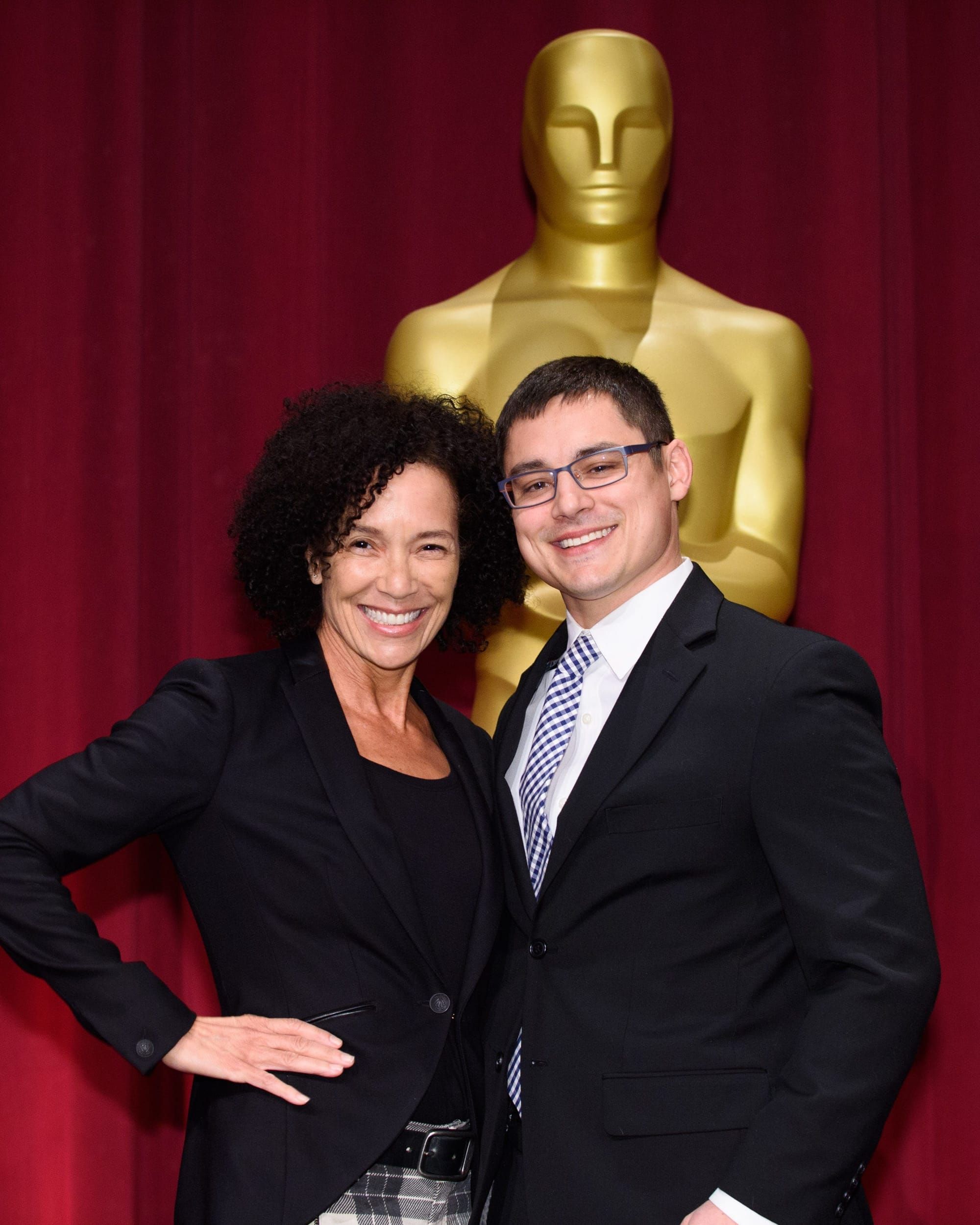
Stephanie Allain and Sam Regnier at the 2015 Nicholl Fellowship in Screenwriting awards ceremony
Scott: Whenever I read a script, and I’m looking at the protagonist as they’re set up in the first act, I’m always looking for what I call these Disunity elements. Essentially, these points of conflict going on in their lives, and Bridget’s got a lot of them.
You mentioned this issue of kids or not, and there’s a revelation on that in the story, but she’s a woman working primarily in a man’s world, the sports environment. She’s going through a messy divorce. She provides herself on her professionalism, and she’s carrying on an affair with a much younger associate at work.
Interestingly enough, too, she’s a statistical analysis type of person, one of those Bill James types of sports people. She got a rational nature, but it seems like a lot of her decisions in her personal life were more influenced by emotional impulses. She’s got a lot of Disunity dynamics going on there.
How did you go about developing that character, so that you had those layers of things to work with?
Sam: That’s a really good question. It all started from the same seed, which is this person that has gone through something dramatic, and as a result of that dramatic thing, had tried to sanitize her life as much as possible. Right around when we meet Bridget, she has finally succeeded in fully sanitizing her life, and that attempt to strip any emotion away from her life is what leads to the disunity that you describe.
All of those decisions — her relationship with Nick, her relationship with Taylor, her decisions that she makes at work, which even though they are based in statistics are often emotional in nature — all of those things are reactions to climbing this mountain of removing emotion from her life. And once she got there, she was so empty that she exploded into all these pieces.
The story is her trying to pick those pieces up, to get back to this place of no emotion — but it’s too late, she’s already unleashed all of these different relationships.
Scott: It’s like Joseph Campbell talks about the Hero’s Journey, saying at the beginning, the character is making do, but they need to change.
Sam: Exactly.
Scott: This younger associate with whom Bridget is having a relationship is Nick. Can you reconstruct how he emerged in your story crafting process?
Sam: He was the first element after Bridget. I thought, “What is the number one thing that can make things difficult for her, and really shatter her world?”
Immediately, I knew it had to be something to do with her workplace, and it had to be something emotional. I settled on a workplace relationship very quickly, and it had the added benefit of being something that she was pulling into her own life, as opposed to something that was imposed upon her. That makes the struggle internal; she wonders why she is the one that who is creating these complications by continuing this relationship.
Tomorrow in Part 3, Sam talks about the surprising route he took to figure out the sports angle in “Free Agent” and how it’s really a sports movie.
For Part 1 of the interview, go here.
Sam is repped by Paradigm and Management SGC.
Twitter: @dadbasic.