Interview — Part 2: Sean Hartofilis (“Beach Pillows”)
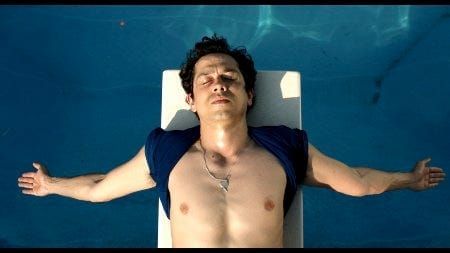
From Ivy League lacrosse star to writer-director of the new indie film Beach Pillows starring Geoffrey Arend, Vincent Kartheiser, Annette O’Toole, and Richard Schiff, the career path of Sean Hartofilis has been an interesting one. Recently I spoke with Sean about life as an indie filmmaker and Beach Pillows which has just been released on iTunes and other digital platforms.
In Part 2, Sean Sean digs into the two lead characters in the movie and some of the story’s key themes.
Scott: Let’s look at the two leads, Morgan played by Geoffrey Arend and Nick by Vincent Kartheiser. How would you describe Morgan’s character?
Sean: At the beginning of the story, he’s kind of a passive participant in his life. Previous success in his writing and maybe academic career is alluded to. But he’s reached this point where he’s working at his father’s furniture store, kind of stuck in the mud.
And he’s become okay with it because he’s putting the worth of his life in this romantic relationship that he’s had for all these years. Despite any of his pitfalls, or shortcomings, he’s saying, “I have this woman who completes me and that’ll be enough.” What he soon realizes is that the relationship was bankrupt, and he’s pretty empty inside because he’d been putting all his chips in that basket. No one’s going to complete him, or save him, so what then?
Someone like Nick is almost his opposite. He has all the ideas and energy in the world, but he just hasn’t put his chips on the table and participated in society, the workforce, or anything like that. Whereas Morgan has been on a designated path, more of a track, in terms of the girlfriend, college, working at his father’s store. Everything’s been laid out for him, and it’s led him to this dead end. Nick never engaged with that track. He’s always marched to his own beat, and it’s kind of relegated him to the outskirts of society.
Morgan thinks his life is over, and Nick isn’t ready for his to begin: that’s probably the most concise way I can say it.
I’m a writer, so Morgan is telling the story from his point of view. That was important to me, both visually and narratively. I think Morgan’s in every scene, almost every frame, except that scene at the beach with Nick and Ed. But it also gives us the opportunity to look at Nick a lot, and basically interact with him throughout. That’s pretty much what I was looking for.
I should say I have a friend who did some time in prison, the friend I went out to Los Angeles with. That partly inspired elements of Nick’s character, specifically his legal predicament. Anyway, I’m happy to say that friend is doing great now.
But in the end, it’s all the ego and the id, two sides of an individual personality, or the yin and yang of life.
From a storytelling point of view, Nick obviously has a kinship with characters like Johnny Boy from Mean Streets, Buddusky from The Last Detail, or Dignan in Bottle Rocket. Kind of dreamers that are causing trouble. [laughs]
Scott: You mentioned The Graduate. That did come to mind for me, too. There’s some images. Like in the swimming pool, floating recalls Benjamin in The Graduate. The point about young men disconnected from the values of their peers and parents… also in The Graduate. Could you talk a bit about that?
Sean: Well, there are only so many ways to shoot a guy on a float! But, yeah, just from the point of view of being inspired by The Graduate, that was a movie I saw growing up and enjoyed. I was moved by it in more of a subconscious way, I’m sure, as a kid. Then I saw it in college, as more of an aspiring filmmaker, and it just blew my mind with the way it was made. Technically, how it was shot and presented, and of course the music. You’re kind of looking at this guy Benjamin, but you also feel like you’re walking around with him or in his shoes or something, or even in his mind. It makes a real impression. I guess there are opinions on Nichols’s contribution to that aesthetic versus the DP, but you can certainly feel the filmmaker’s hand throughout.
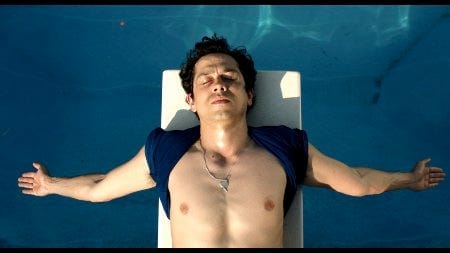
And, emotionally, it was very close to what I was feeling in college and shortly after, which I know is not a unique feeling. It’s a great movie and was certainly an inspiration. [laughs] But I didn’t want to be ripping it off in any way. I think you can see plenty of the French New Wave in that. And you can see all the great directors of the Hollywood studio era in those French films. And it just keeps going back. Like Bob Dylan, I guess.
As far as any sort of generational divide, I know exactly what you’re describing. It was important for me to portray the parents not as blowhards, but just as older humans who love their son more than themselves, which obviously creates a certain dynamic. And I think that might be more timeless than generational. It may be a misattribution, but I read something about Socrates, or maybe Plato, discussing the fading values and lack of ambition of younger generations. The specific context may change due to technology and all the rest, but I think that’s very much a story that will always be. And that’s a good thing. It’s why The Graduate still resonates, or something like Catcher in the Rye, and probably even Hamlet or The New Testament. Those feelings are more about a period in a person’s life, I think, than a period in history or a changing world.
Scott: There’s a really interesting line in there. When Nick’s talking about staying in that town as a kind of penance and it feels almost like they’re in a Purgatory. You know what I mean?
Sean: I do. Wow. I think it might be like Purgatory because…they’re not willing to fail. They haven’t stepped out on a limb to say, “Okay, I’m going to bring these ideas to the world and see if anybody responds to them. Because if I get rejected, that could put me in Hell.”
Obviously, if people want what they create, and they can make a life out of this, it’s Heaven. It’s the artist’s dream to do it for a living. You’re exactly right. They really need to put their chips on the table and take a gamble. They’ve thus far been unwilling to do that.
Scott: That ties into another theme you have going on here and that’s regret. Nick regrets a decision he made that sent him to prison. Morgan regrets not going to graduate school. Morgan regrets spending nine years with his girlfriend, who he finds out cheats on him. Nick regrets not telling Morgan about his girlfriend. You know, on and on.
I’m curious. What do you think appeals to you about exploring that idea of regret as a story theme?
Sean: That’s a good question and not something I’ve thought about too much, at least consciously. I think, by virtue of the fact that they’ve been stuck for so long, there are opportunities to look backwards and say, “Well, if I had only done this differently…if I had only pursued different relationships…if I didn’t make this mistake and go to jail…if I did go to graduate school…”
I think that almost…regret like that — and I’ve made mistakes in my life that I think about — but I think the regret feeds the stasis. It’s all about the past. That prevents them from looking forward and really seeing any opportunity to flourish.
People can become plagued by that, especially when you get to a point in life where you feel like your best opportunities may be behind you, where it’s all regret because the road has led you to this point.
You have to learn from mistakes and I suppose try to find motivation in regret. But, on its own, regret doesn’t have any value. Mistakes don’t have any value unless you can learn from them and grow. I think by the end of the story, hopefully, they’ve done some learning and they’re ready to move on and not look back as much.
Tomorrow in Part 3, Sean explores the meaning behind some key lines of dialogue in Beach Pillows.
For Part 1, go here.
Beach Pillows is available on iTunes here.
Comment Archive