Interview [Part 3]: Amma Asante, Director, “Belle”
![Interview [Part 3]: Amma Asante, Director, “Belle”](https://storage.ghost.io/c/8f/29/8f29b0a7-49e5-431c-a9bb-3ade9c0a785e/content/images/size/w2000/2026/08/0_OegLoc0HtoatAXNX.jpg)
Amma Asante has been an actress, TV writer-producer, and movie director. Her latest is the period piece drama Belle, written by Misan Sagay and directed by Asante. The movie opens this Friday, May 2nd in theaters across North America.
I had an engaging and informative conversation with Amma after she had just returned from the U.S. to her home in The Netherlands.
Today in Part 3, Amma discusses how she became involved with the project Belle:
Scott: I’d like to jump into talking about Belle, which is the latest project you directed, a period drama that debuted last year to strong reviews at the Toronto International Film Festival. Quick thumbnail summary of the plot from IMDB: “An illegitimate, mix raced daughter of a royal navy admiral is raised by her aristocratic great uncle.”
How did you get involved with this project?
Amma: 2009, around the time of the banking crisis, I had been involved with three projects that had collapsed due to financing. Like I said before, I was writing for New Line Cinema, commissioned through Material Films in the UK, on an adaptation of Lady Susan, a Jane Austen piece and the only one that actually hasn’t been adapted to screen yet.
So I was writing on this piece. I was also doing something for Focus Features, and in the middle of development with them. I had written my movie which will now shoot 2015 called “Where Hands Touch,” which back then had been announced at Cannes and later that deal collapsed as well.
I was in hospital. I’d been suffering a little. I’d lost lots of weight. I was in the hospital. One day, somebody came to visit, who was responsible for picking up my mail and collecting my mail. I was sent a picture postcard from the man, who then became my producer, Damian Jones, of the painting that the movie is inspired by. He’d also sent it by email me via my agent.
It was a painting of Dido Elizabeth Belle, this bi-racial young woman, child of Africans slave and child of naval officer standing next to her White sister, her White cousin actually, but they were raised as sisters. What was fascinating about this post card print was that the treatment of the two protagonists or muses in the painting was one in which they were treated with equal value.
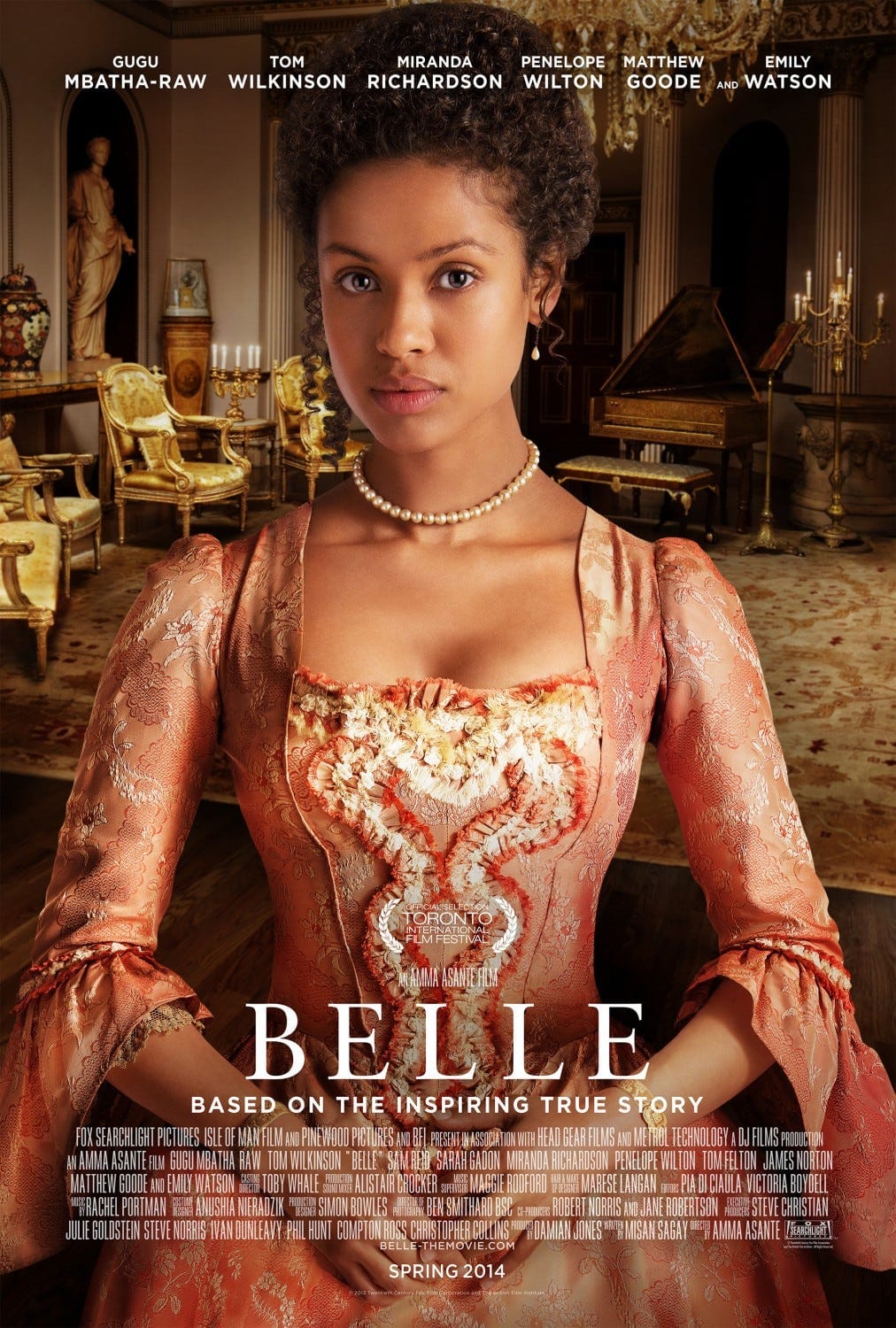
A year earlier, my husband, who was my fiancé at the time, had taken me in Holland to an exhibition in a wonderful place called Nieuwe Kerk. It’s an old church that’s become an exhibition gallery. He had taken me to an exhibition called “Black is Beautiful,” which was looking at the history of the Black people in European art from about the 14th century onwards. It charted them from background character, comparable almost to pets, occupying the same position as a pet might, and tracing them right through to front and center, main muse in a painting.
It was about a four hour exhibition, to be honest with you. It was pretty hard work, but it was completely fascinating to me. That was in 2008. Unbeknownst to me, it was laying a foundation to this portrait which eventually landed on my lap, this print. I looked at this print and I immediate knew this was something different. This was something completely unusual.
However, I knew that the only story that could be told from this was obviously one set in the 18th century with this girl, either as a prominent character or a lead. Nobody in the UK was making costume dramas at that point because they were very expensive. “The Duchess” had not long been made, and everybody was on a little bit of a pause with costume dramas, at the point. At least it seemed so to me.
I was constantly being told how difficult it was to sell movies with black leads. I just tried to forget about it and not really pay any attention. This postcard laid next to me on my hospital bedside table for quite a while. Damian himself wouldn’t let it go. He kept contacting me and contacting me. Eventually, I saw him on the very day that I came out of hospital just to appease him, really, and get him off my back.
That’s where it really started. He had been trying to get the movie, a movie using the same history that surrounds Belle and her Uncle Lord Mansfield for many many years. That script had started life at HBO as a TV piece called Belle and Bette. Bette is Dido’s white sister in the painting and in this version of the story, Bette was as prominent as Dido. Eventually, HBO dropped the project. Damian brought the idea for the postcard back to the UK, to the BFI, who had financed A Way of Life and who had financed a couple of the movies that I had developed that had collapsed.
They said to Damian “Do you know that Amma is absolutely obsessed with this period?” Actually I was annoyingly obsessed by the period and also the history of people of color in Europe. They asked Damian to show me the postcard, to see if i would come on board. I eventually agreed and was contacted as writer and director on the project, that’s how the project ended up coming to me.
Scott: I remember seeing Andrew Stanton, the Pixar writer director, who did a TED Talk. In it, he said that one of the fundamental questions in a story is, “Who are you?”
This issue of identity, I thought, “Wow, does that apply to Belle,” because here’s this young black woman in a white environment, a male dominated environment, coming from poverty into extreme wealth.
How important was this theme of self-identity as it related to Dido in terms of telling the story of Belle?
Amma: It was massive. If Dido, in her journey towards finding her identity and being OK with who she was, if we imagined that was the tree, then everything else, for me, were the branches.
I used The Zong case and the painting based on what I’d learned through my research, as tools, simply as tools to explore Dido and her identity. This thing that I talk about in all my interviews, this idea I’m obsessed with and features in everything I’ve ever worked on, which is who defines you? Society or yourself?
What happens when those two definitions are different? What is the biggest indicator towards your success?
It was very important to me. It was really at the center of the story.
Scott: I’m not surprised too, if you have a background where you’re 14 years old and working on a TV series and everybody you see around you in terms of authority figures is white and male. And all the way along in your own life, going against the flow of what is the convention, you might have a particular point of connection to this character, Dido.
Amma: That was very true and also, although I wasn’t biracial, I am bicultural. I had this life that was an absolutely 50–50 combination of West African life and English life. My parents would speak a combination of West African and English at home.
They had both the combination of West African and British values, some of which overlapped and some of which didn’t. I had this completely bicultural world.
When, as a small child, I’d visit Ghana on holiday, with my mother and go and visit my grandma, I was always deemed as a foreigner and way too English.
Back in early ’80s England, I wasn’t deemed as English at all. Even though I was born in England and I knew nothing else as him.
People would say, “Where are you from?” I said, “Well, I’m English.” They’d go “No, where are you really from?”
I felt like I had no authority to determine and to tell people what I was and where I came from. Whatever I said, nobody accepted it.
It was incredibly complex for me. The other thing, going back to exactly what you said about authority figures was that it also painted my idea of what a director was because I absolutely thought that a director was an authority figure because that’s the only relationship I had with them, being a child and them being adults
For me, I thought what a director did was actually tell people what to do, as opposed to collaborate, and facilitate performances, and facilitate a story on screen. I had no concept of that.
I thought, “Well, I don’t want to step on set and tell people what to do.” I’m certainly not an authority figure. That is not how I saw myself, at all.
I’m 100 percent thankful to A Way of Life, and the cast, and the crew for allowing me an experience that proved to me that it absolutely didn’t have to be that way and that collaboration is really the only way forward, if you want a great movie.
So, that’s really what I did. I find myself, in my writing. The directing, for me, is the end part of it. I find myself in the process of the writing and that is why it’s cathartic for me.
http://www.youtube.com/watch?v=KI1Zhlsjags
Scott: The story is a social critique, a historical saga, and a romance, all the while centered around this young woman, Dido. She’s trying to find her place in the world. That was a pretty different challenge, I would imagine, to balance all those different story elements.
Amma: First of all, I delivered about 18 drafts. That was the first thing. It happened over a period of time. I would never, ever pretend that I was able to balance everything in every draft, each time I took on a draft.
I had a pretty successful first draft, which I was comfortable with because u felt it was hitting all the right plot and emotional buttons or getting there. Usually, I was always very scared and very nervous delivering a draft to the financiers and getting notes.
I was always wondering what elements I was going to have to defend. How much I would be willing to compromise in terms of their notes. I was always trying to prepare before anything had ever happened in going to those meetings.
Whereas with this draft, I felt quite comfortable. The brief that both Damian and I had shared, the producer and I shared, and also the BFI, the financiers, is that we wanted to make a Jane Austin-esque piece that really had something to say.
That would combine the gentile world of 18th Century high society with the knowledge that this barbaric thing called, “slavery,” was happening in the background. I knew I never wanted to show slaves. The story I was going to put on screen was never going to actually show any slaves because my focus and challenge was to tell the harsh story of the Zong and it’s slaves whilst staying true to the sub-genre of Austen-esque British period drama
For instance, the original script that you know existed and I talk about that was with HBO originally, often would have slaves and lots of interludes where you’d find slaves floating in the water. I should say here that this earlier writer, Misan Sagay, through her union WGAw is credited as the writer of Belle. I am not a member of the WGA and was disallowed from keeping my writing credit. The producer has opted to abide by the WGAw’s decision.
So anyway, for me, I thought, “Well, gosh,” I tried to imagine a Jane Austen piece, I thought, “I can’t imagine Jane Austen ever, ever outlining elements of her story in which you would see slaves floating in the water.”
I was always really struck by this statement that Scorsese often gives which is that you have to “smuggle your ideas”. I knew I wanted to punch a powerful plot through Belle with the Zong slave case. But I wanted to smuggle that story, to heighten its power and see it through the context of gentile English life at that time. I wanted to prove that an Austen-esque period drama could be carried by a black lead and universally resonate.
Tomorrow in Part 4, Amma digs into several of the key story dynamics and themes at work in Belle.
For Part 1 of the interview, go here.
Part 2, here.
Amma is repped by CAA and United Agents.
Twitter: @AmmaAsante.
For an interview with Belle screenwriter Misan Sagay, go here.
For when and where to see Belle in U.S movie theaters, go here.
At the request of the Writers’ Guild of America, West, I am including this clarification from the Guild with regard to Belle: “Consistent with WGA credit determination procedures, the writing credit was based on a blind reading of the material written by all of the writers and the readers were given no information concerning any writer’s union affiliation.”
Comment Archive