Interview (Part 4): Elizabeth Oyebode (2016 Nicholl Winner)
My 6-part chat with the writer of the winning script “Tween the Ropes”.
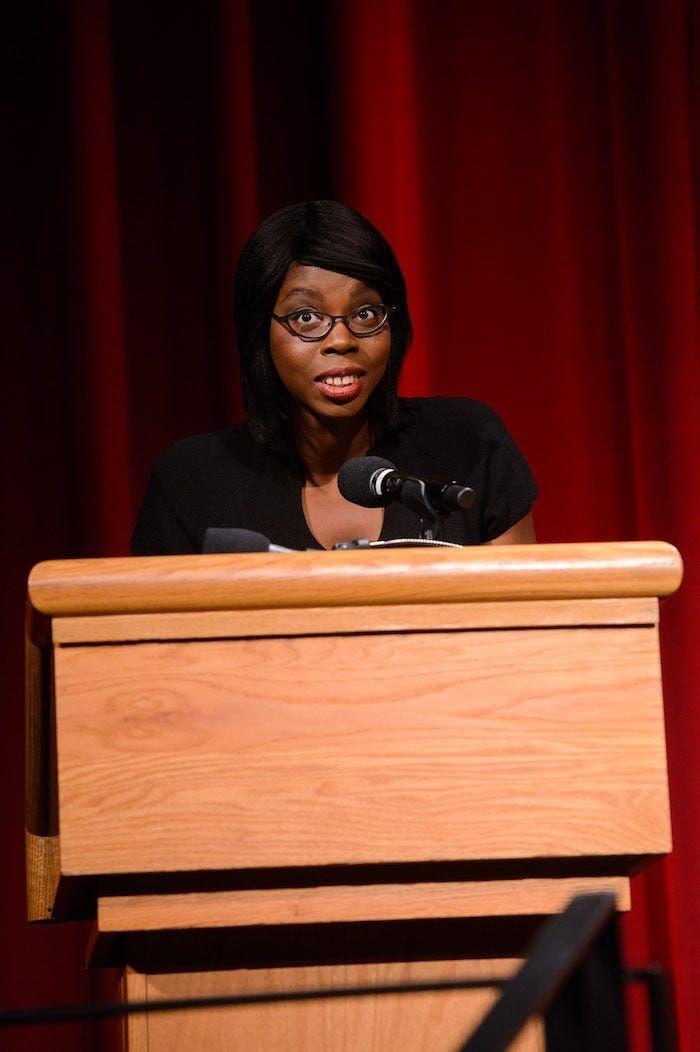
My 6-part chat with the writer of the winning script “Tween the Ropes”.
Elizabeth Oyebode wrote the original screenplay “Tween the Ropes” which won a 2016 Nicholl Fellowship in Screenwriting. Recently I had the opportunity to chat with Elizabeth about her background, her award-winning script, the craft of screenwriting, and what winning the Nicholl has meant to her.
Today in Part 4 of 6, Elizabeth talks about what it was like to win the Nicholl Fellowship in Screenwriting:
Scott: I think most readers, in reading the script, even reading the logline, they might project onto the story, “Oh, I get it. Nidi’s going to try to escape from her world or have the opportunity for her to escape from this world through the jump roping, the double dutch thing.”
Yet, while it has that layout like a sports movie, it really isn’t very much of a sports movie. There are three sporting events and they’re handled pretty quickly.
It’s actually her intelligence that’s going to ‑‑ and it’s kind of a twist ‑‑ that’s going to present her an opportunity to escape this world. How did that develop? I guess it’s a handoff in a way from the jump roping toward the more academic thing.
Elizabeth: I chose to have the sports portion of the script serve more as a counterbalance for the issues she was contending with in her personal life.
And I opted to have her intelligence be the key that could free her from her situation because it would better expose the baggage at the heart of her family unit’s dysfunction.
Scott: The ending of the story, there’s this wonderful opportunity that she’s going to have to go to a private school where she’ll be supported and allowed…They don’t have jump roping, but they’ve got track and she’s fast, so she could fit in there.
Mr. Teal, one of the educators, takes an interest in her, tells her…This goes back to your line about the butterfly. He says, “Nidi, no matter what anyone else says, always remember that you are a butterfly. Right now you may feel like you’re caught and you can’t stretch your wings, but you’ll get to fly. You were born to fly.”
We really get a feeling that she’s going to have that opportunity, the story goes in another direction. That ending, how early on in the process did you zero in on that?
Elizabeth: That’s what I started with.
Scott: You started with that ending?
Elizabeth: Yes, I worked my way back to justify that ending. The purpose of this story was to get to that ending and to get to it in a way that felt organic and truthful.
Scott: Two things. One, it speaks to the value of knowing your ending. If you know the ending of the story, then you’ve got that goalpost up there and the ending can imply the beginning.
Elizabeth: Yes.
Scott: The other thing that I wanted to mention. It’s pretty apparent, like on page one, you know this environment. There’s an authenticity to the characters ‑‑ the way they talk, the concerns in their lives, the activities that go on, the physical geography, the topography, everything. It just feels completely authentic.
How much research did you do on this, or how much was this based on personal life experience?
Elizabeth: Thank you for that. I spent part of my childhood in an inner‑city in DC. I incorporated some of those memories from that experience into the script.
I also conducted research, read news stories and other works, and watched double dutch teams in action. It really helped me get back into that mindset and into the world.
Scott: Obviously, it’s incredibly important to achieve that sense of authenticity for a story like this, for us to trust that the writer knows what they are talking about in order to really immerse yourself in the story, and you do that very, very well. What’s the status of the script at this point?
Elizabeth: Several producers have reached out to me about turning it into a film, so that’s been great.
Scott: Let’s talk about winning the Nicholl. When did you find out?
Elizabeth: I found out in September. Actually, as you know, I’ve been working on some other scripts…One of those scripts, “Sexton,” was in the Black List Lab, where I worked with you.
I remembered the Nicholl deadline was coming up and I had another script that I had wanted to submit, but it wasn’t ready yet, so I just decided to submit this one. [laughs]
Just sent it in and forgot about it until this summer when the Nicholl team informed me I was a quarterfinalist, then a semifinalist. And then Greg called and said I was a finalist and that was amazing. I was so thrilled.
Scott: And then you won.
Elizabeth: Yes, a couple weeks later, the Nicholl Committee notified the winners. Robin Swicord and everyone else was so welcoming, kind, and encouraging. It was very validating. It’s one of those moments that you long for as a writer.
Scott: You’ve had a lot of things. Let’s see, there was the Black List Lab we did in San Francisco together. Then you said that you got this thing through the WGA. What’s that about?
Elizabeth: Yes, through the WGA in partnership with DreamAgo, I had the opportunity to pitch a screenplay idea vying with other writers. My idea was selected, so now I’ll write that out into script form.
Here is a script reading from “Tween the Ropes”:
Tomorrow in Part 5, Elizabeth answers some screenwriting craft questions.
For Part 1 of the interview, go here.
For Part 2, here.
For Part 3, here.
For more of my interviews with Nicholl winners, go here.