Interview (Part 3): Gary Whitta
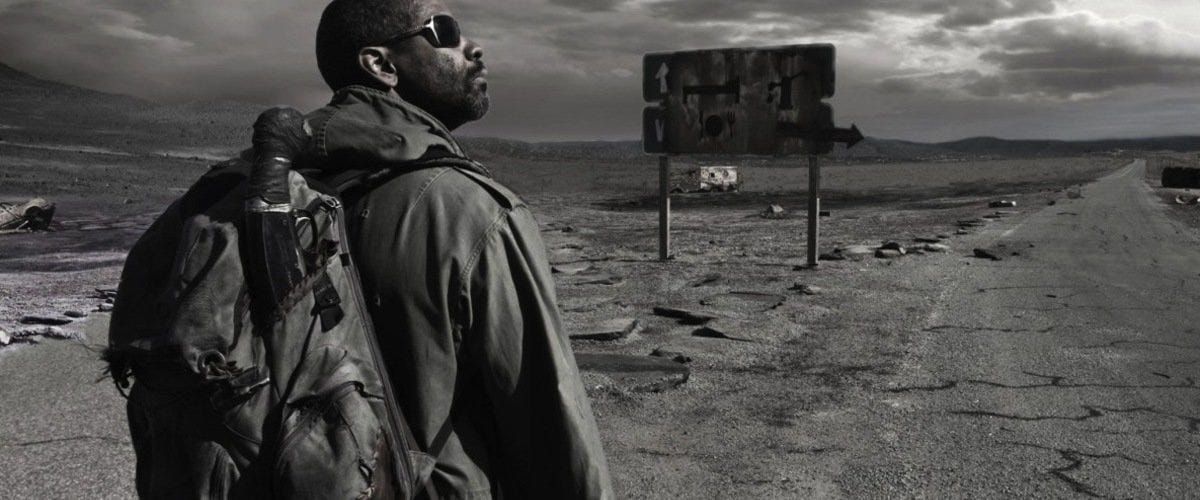
A few months back, I had the opportunity to interview screenwriter Gary Whitta whose movie credits include The Book of Eli (2010), After Earth (2013), and the upcoming Star Wars: Rogue One (2016). Having recently seen his first novel “Abomination” published, Gary and I had a wide-ranging conversation touching on a host of subjects which I think readers will find quite interesting.
Today in Part 3, Gary and I go deep into an analysis of The Book of Eli:
Scott: I’d like to drill down into The Book of Eli. You’ve got the sacred book, which is essentially the only remaining copy of the King James version of the Bible. You’ve got this ruthless, lawless, post‑apocalyptic world. But in some ways, why not the Magna Carta? Why not the Constitution? What was it about the Bible that drew you to it?
Gary: I actually did play around with ideas of it being something like the Magna Carta or the Constitution of the United States. I think that version could have worked also. A lot of what the movie is about is the importance of the preservation of knowledge and understanding where we came from so that we can learn from that and chart a better course for the future. That was always very, very important to me, and I’m glad they stayed true to it, that when Eli gets to his promised land at the end, the library in Alcatraz, that it wasn’t in any way presented like a temple or a holy place, but as a place of knowledge and academia and culture, and these were scholars who viewed the Bible as simply a historical artifact rather than something to be worshipped and followed. Malcolm McDowell, at the end, is very much an academic and is really trying to collect and preserve as much of the old world that has survived as possible, so that when we finally reboot civilization, we have a better understanding of where we came from.
My sense is that whether or not you agree with the message of the Bible or whether or not anything in it is true, one thing you cannot argue with is that it is one of the most influential literary works in the history of human civilization. It’s one of the few books that has impacted the course of our entire history as a species. So it’s a fascinatingly important book, and the idea of intellectual stakes really interested me. If this really is the last copy, and if this one disappears, what does that mean? The next generation of humankind grows up with no sense of “This is what we used to believe.” That doesn’t mean we should necessarily believe it going forward, but we should know that this is what we once believed. And maybe that’s why we almost became extinct as a species, because we believed some of this stuff.
Scott: We get the idea that the Bible, for Eli, represents purpose in life. On the other side of the equation, you’ve got this antagonist figure, Carnegie, played by Gary Oldman. Mayor of this town. He’s been sending out minions trying to find these books, so presumably looking for the Bible as well. What does the Bible represent for him?
Gary: Eli and Carnegie were always meant to be the two expressions of the theme of the film. As antagonist and protagonist, they have these two different perspectives. Eli is a man of faith, but he’s very private about it. He protects the Bible. He’s very guarded around it. He doesn’t want other people to look at it. He doesn’t proselytize or try to spread the word in any way. He’s a man of very personal and private faith. That is something that has sustained him and strengthened him through thirty years of hardship. This is supposed to be the way the movie talks positively about faith. The idea that things happen for a reason and that there is a greater picture and it’s not just about us is very, very comforting to us and we can draw strength from that… I’m quite envious of people who are able to believe that. In that regard, spiritual faith is a very valuable thing.
Where it starts to become dangerous, and this is the part of the story that Gary Oldman’s character speaks to, is when you get into the world of organized religion and how religion can often be perverted. So much of the terrible things that happen in the world are caused by people are taking what they read in these ancient holy texts to insane extremes. So the idea that Carnegie, who’s old enough to remember the world before it was destroyed, and remembers the power of those words and how they can be used to motivate and compel people… that’s what the Bible really is to him, a tool with which to control people.
When Carnegie talks about how the Bible is not just a book, but a weapon aimed at the hearts and the minds of the weak and the desperate… that’s obviously a twisted view but I think also a realistic depiction of how the Bible is exploited by many people today. There are people, clearly, who can be influenced and driven to do what we might think of as crazy things because of what can be interpreted in those pages. So those are the film’s two thematic poles ‑‑ Eli representing a very positive and personal and spiritual and private iteration of faith, versus what Carnegie is trying to do, utilize that faith for his own selfish gain.
There’s a great line that inspired me a lot when I was writing the book. Alan Ladd in Shane says, “A gun is only as good or as bad as the man who wears it.” I felt like that was the expression of religion in this movie ‑‑ that in Eli’s hands, faith is a very positive and powerful and empowering thing, but in Carnegie’s hands it has the potential to be something destructive and dangerous.
Scott: You’ve got a really nice twist at the end of the story involving the Bible. I don’t give it away for people who haven’t seen the movie, but suffice to say that the title, The Book of Eli has a double meaning.
There’s the actual book, the Bible that Eli’s carrying, and then there’s the knowledge that Eli’s carrying within himself, which based upon what you were saying is quite interesting. It’s like he’s internalized the meaning of it, and then of course that twist at the end where Gary Oldman’s got the book.
Gary: It’s funny, I struggle a lot with titles. I often have a hard time writing a piece until it has a title. I was very lucky with Eli that the title suggested itself to me quite early and I always loved it and I always felt exactly as you say, it has a cool double meaning to it when you get to the twist ending. As much as I personally don’t believe in God, in the fictional world of this film, God absolutely exists. I don’t think there’s any sensible interpretation of the film that allows you to rule that out. The whole idea is that through the entire movie you might well think that Eli is a crazy man. But when you realize what he did at the end of the film and the circumstances under which he did it and you reevaluate the film in that context, it’s impossible to reach any conclusion that doesn’t validate some of what Eli’s saying ‑‑ that God really was talking to him and helping him along his journey. So the idea was there was a validation of his faith and hopefully, again, a triumph of good over evil in that the book ends up in the hands of people who will treat it soberly and correctly and appropriately as simply a historical text.
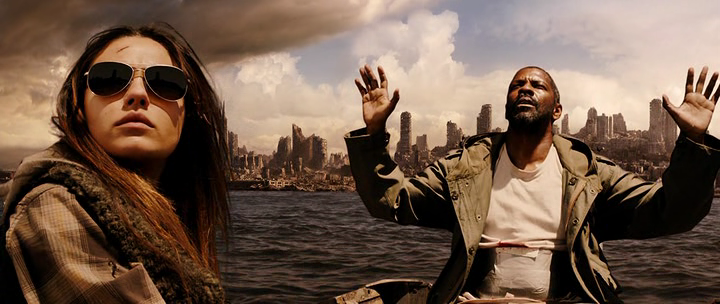
Scott: Really, a wonderful homage to the fact that the Bible was oral tradition for hundreds and hundreds of years. What we see Eli doing at the end, recounting it word for word, it’s a really wonderful image there.
Gary: Yeah, it’s a reversion to the most ancient form of storytelling that predates the written word, sitting around the campfire and telling stories. During the Dark Ages, when so many texts were destroyed, it was a similar thing. Part of the inspiration here was definitely “Fahrenheit 451” where the written word is on the verge of extinction and so the only way to keep literature alive is by reverting to an oral tradition.
Scott: One last question on The Book of Eli. Toward the end of the movie, Eli quotes the Apostle Paul from Second Timothy, “I have fought the good fight, I have finished the race, I have kept the faith.”
I thought, “That’s the perfect description of his accomplishment.” I’m gathering that you’re not a particularly religious person, so how did you hit on that specific Bible verse as a capstone for Eli’s life in the story?
Gary: Again, because I’m not a particularly religious person, I just went out and bought a Bible and I read through it. Eli actually quotes the Bible a lot more in the original script than he does in the final movie. But we kept the ones that we felt were most important. Adam and Eve’s expulsion from the Garden of Eden is in there. That little Timothy quote, even though it’s not one of the more well‑known quotes, felt perfect for Eli at the end of his journey.
One of the things that I’m really, really proud of, one of my favorite thing in the film, is that final speech that Eli makes in voice-over. I don’t know how many people got this, but certainly what I was intending was for that monologue to be the ultimate expression of Eli’s selflessness. If you think about what he did, he spent 30 years walking across this hellish wasteland and putting up with all kinds of impossible conditions, dedicating his life to this mission that he had been given. Then, when he dies and he offers up his final prayer, he’s not talking about his great accomplishments or asking for any credit. He’s expressing thanks for all the things that he was given along the way. He’s grateful for the blessings that he’s had in his life. I don’t think you need to have a religious interpretation for that to have meaning. It’s this simple idea of count your blessings. Don’t complain about what you don’t have. Be thankful for what you do.
Tomorrow in Part 4, Gary and I discuss “Abomination” and why he chose to write this particular story as a novel and not a screenplay.
For Part 1 of the interview, go here.
Part 2, here.
To learn more about Gary’s 400 page historical fantasy novel “Abomination,” go here.
To purchase “Abomination,” go here and here.
Gary has graciously agreed to answer reader questions, so if you have any, please post in comments.
Gary is repped by UTA and Circle of Confusion.
Twitter: @garywhitta.