Interview (Part 3): Rob Meyer and Luke Matheny
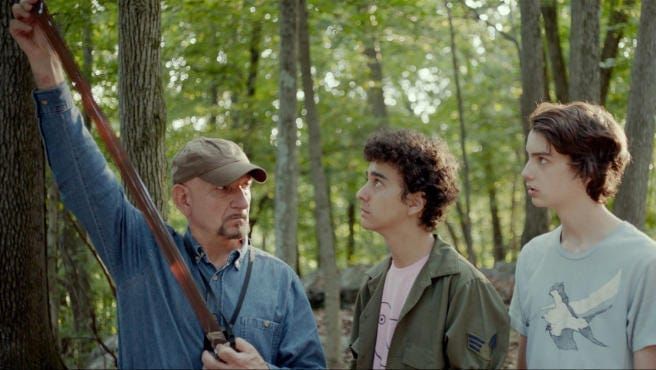
When I saw the trailer for the movie A Birder’s Guide to Everything, I immediately sought out its filmmakers: Writer-director Rob Meyer and writer Luke Matheny. It’s a wonderful story starring some terrific young talent as well as Oscar winning actor Sir Ben Kingsley. The movie comes out in theaters and on VOD this Friday, March 21.
In Part 3, Rob and Luke reveal some of the key issues they had to confront in developing the script:
Scott: I thought the choice of birding really worked quite well in that respect, and just dealing with this theme of dealing with grief and death. You show how in the birding community there are these…what did you call them?
Rob: The Listers and Watchers?
Scott: Yeah. And that got me thinking, “Why is David so focused on this?” Obviously, his mother was into birding, and so this is a legacy. But if you think about it psychologically, that’s his way of keeping her alive, and in keeping her alive, he’s in some respects refusing to acknowledge her death. So when you talk about that scene with the duck, I thought that worked really well. It was beautiful in a sad way, but it did feel almost like a breakthrough.
Luke: Thanks for acknowledging all that. We thought a lot about all those themes in that scene. But it was tricky to make that scene work from a writing standpoint. Having the duck get shot wasn’t our first idea. We did a lot of things to that duck in the drafts leading up to the final draft.
I think at one point one of us asked, “What’s the worst thing that could happen to David?” Then the other person said, “The duck gets shot.” We kind of laughed, because it seemed like it was too much, but then we were like, “Wait, actually, maybe we’re on to something here.” We worked through that notion a little more, and then that’s what we landed on for the final draft.
Scott: You chose to tell this story in a compressed time frame, a road trip in one weekend. How soon in the process did idea come to you?
Luke: I think it was just the realities of them being in school. We knew that for the quest to actually be somewhat plausible, they had to do it all in a weekend, or else they would have had to cut school for too long and they would have been caught.
Then the racing back for the wedding, that came a little later in the game, actually. That whole part of the story, the father’s remarriage, was pretty tiny in the initial drafts, but then we realized that that was just a really important part of David’s journey as well. So that ended up being a very big part of the story.
Rob: Also maybe interesting to point out, having the wedding at the end of the film was an idea from someone else. We always knew that the father would remarry. But the idea to actually have the wedding in the movie came from one of the development people that we pitched the film to get financing.
We got notes from probably 20 to 30 development execs, creative execs, producers, other directors, that Luke and I could flag up and acknowledge, “That is a really great point.”
There were a lot of notes we wanted to ignore, of course, but the long development period really gave us a lot of opportunities to improve the script, to the point where when we went to shoot it, there was very little that we hadn’t really thought about many times over. And we felt pretty confident that this is the best script we could write with these characters and this story. It really was a bit of a blessing that came along with the frustration of getting the film made.
Scott: As opposed to development hell, it was development heaven.
Rob: Yeah, it was both.
Luke: It was both, yeah.
Scott: I’m stepping back thinking, “Well, what would this movie be like without that ticking clock of the wedding?” And it’s hard to imagine. It just seems like it’s a perfect fit, brings that added pressure to the narrative.
Rob: Yeah, absolutely. Credit to … I think it was Todd Waldman, actually.
Scott: Another smart choice you made. You’ve got the three boys who understand birding and you’ve got Konrad, who’s an expert at birding, but you introduce Ellen, who is an outsider. Not only does she exist as a potential love interest or emotional connection for David, but she’s someone who can ask questions, allowing you to get across exposition about birding for an audience who is likely not to know much about the hobby.
Luke: She was always there, and I would say she functioned somewhat similarly as she did in the short. Yes, I think when the main characters are involved in something with such specialized knowledge, an outsider character like Ellen becomes a little bit of a proxy for the audience member who’s learning about the process of birding the same way she is. That was just a helpful built-in device for us right from the beginning.
Rob: I’d say Katie, the actress, brought a lot to it. There were times where I think the audience would roll their eyes at some of the stupider things that the boys said or believed, and she was sort of the built-in eye-roller. She had to roll her eyes a lot in this movie.
http://www.youtube.com/watch?v=j6iZBq_YY-A
Scott: We touched on how each of the characters has their own arc and that adds to making this a satisfying movie experience. Timmy has to deal with the fact he’s this gorgeous girl’s personal math hobbit. Peter’s got to overcome the identity where he’s known as something of a “pussy”. And then even Ellen, who’s an Air Force brat, moving around, she’s got to confess she’s concocted a story about her past and present an honest side to herself. How did each of these individual subplots evolve?
Luke: I think they evolved basically from the initial demeanor of each character, which usually suggested some sort of problem. Peter was very smart, but clearly he had some kind of issues of being too cautious, even cowardly. Timmy always talked a very big game about girls even though he was very insecure about girls. Ellen was the new girl in school, which brings its own set of problems. We just went down the line and figured out how to repair each character’s condition, I guess. That’s sort of how it worked out.
Rob: Which was a risk. We wanted this to be the kids’ movie and not be an adults’ movie with kids in it. I loved the movie Superbad, but I was always a little disappointed when they go to the cop’s story suddenly and we’re not putting our full faith in actual teenagers having their own arcs that are worth staying with the entire movie, and that the adults are the peripheral, supporting cast.
You mentioned Lucas. It was one of our favorite movies. When you make the kids the main characters, you’ve got to give them arcs or it’s like, “What’s the point? Why are we watching this movie?”
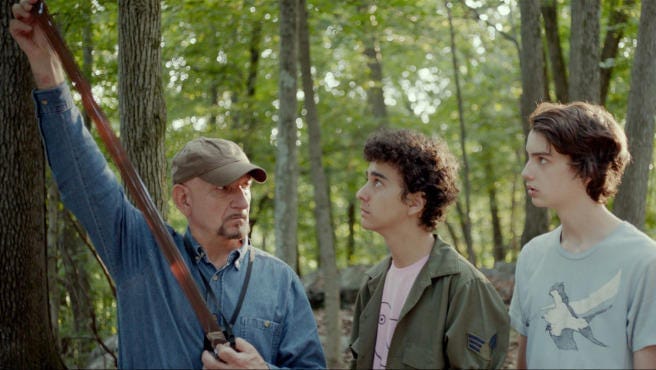
Scott: Let me ask you then about Konrad, who Ben Kingsley plays, as an adult figure. What were you going for with that character?
Rob: Well, he has his own kind of tortured past. As I was saying earlier, it’s a little bit of a cautionary tale about giving oneself too completely over to a hobby or a pursuit. But we also thought of him as kind of an outlandish character in that same way. We definitely wanted him to have some comic relief, as well.
It was an interesting balance. We really needed a good actor who could sort of make sure that could balance that sort of tragic backstory with the absurdity of his manner. And Sir Ben Kingsley is as good as it gets. We really got lucky in that respect.
Scott: Let’s talk about that. Putting on the producer’s hat for a second, were you cognizant you needed to have an adult role like that so you could get a name actor to help with the financing? Were you thinking about that when you were writing the Konrad character?
Rob: Not explicitly. But actually, two of our producers, Dan Lindau and Paul Miller, who came on first to produce the project, that was their first note. It would have been any smart producer’s first note: “Can you make that Konrad and Donald, the father character, bigger so, maybe, we can get a couple of name actors attached to those roles?” Because unfortunately a cast starring teen actors, even great ones like Kodi and all the great young actors we got, it doesn’t help as much as I would have hoped for getting the financing all together.
Tomorrow in Part 4, Rob and Luke talk about the movie’s production, the movie’s debut at the Tribeca Film Festival, and the film’s release.
For Part 1 of the interview, go here.
Part 2, here.
Rob is repped by WME and Apostle Management.
Luke is repped by Paradigm.
Comment Archive