Interview (Part 3): TJ Cimfel and David White (“Shut In”)
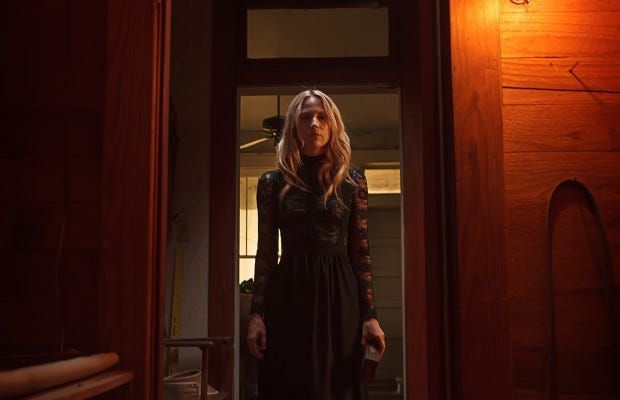
The horror movie Shut In has its world premiere this week at the Los Angeles Film Festival, screening on June 12 and June 17. Recently I had the opportunity to interview the film’s screenwriters TJ Cimfel and David White. It was a terrific conversation which I will be featuring over the course of this week.
Today in Part 3, David and TJ discuss using the house as a character in Shut In:
Scott: One thing I thought you did really well… since this is a contained thriller and the location’s so central… you used the house, various rooms, strange spots, and all the rest to maximum benefit.
It’s like it’s its own kind of character, a reflection of the past, and a trap in the present. How much thought process went into that? Did you think about the house as having its own personality to it?
David: We absolutely did. We appreciate you noticing that also, because one of the first things we started to talk about, when we were first developing the story was, “What is this house, what is this house going to be?” We came up with the idea of the puzzle box that she —
TJ: Yeah. That was one of the very first things.
David: Yeah. One of the first things we thought about was that she has this puzzle box, and she keeps this object that’s very important to her inside this puzzle box, but then moving out from there, the house itself is also a puzzle box. And the movie, then, also becomes a puzzle box, as you get into some of the twists and the turns.
TJ: We had a lot of other different forms of the house. There were going to be all sorts of different set pieces that never wound up fitting into the story. That involved whole additions of the house that were only hinted at and only came in in Act Three.
David: We had M.C. Escher staircases going up, going all over the house.
TJ: We had a widow’s walk, at one point. Yeah, the house was always critical to it.
David: Anytime you’re working on a script, you have all those ideas. Then it gets boiled down to, “OK, this is what’s absolutely essential to tell this particular character’s story.” That’s how we find the story as it is, in its final form.
Scott: Did you literally sketch out the house?
David: We had printouts of houses we found online. We had interiors and exteriors. We had long written descriptions. We have since done an actual floor plan, before the actual house was found, to help people understand what we were imagining.
TJ: That was really one of the most exciting things, in translation from script to screen, was when they found the house.
David: That was amazing.
TJ: When they found the house, and they started sending us photos, and they sent us emails that said things like, “Did you guys see this house when you wrote this movie?” Certainly, there were things that we had to change based on the physical house. But, there were very specific necessary things that that house had that couldn’t have been more plucked from our imagination.
Scott: Where is the house?
David: Outside Shreveport, Louisiana.
Beth Riesgraf, star of Shut In
Scott: So let’s retrace this process. TJ has this idea, the two of you get together. He pitches the idea to you, Dave. The next day, you send this email. How long does it take you to write the script to the point where you sent the script to your manager Marc Manus?
David: The first draft, I think, took us nine months.
TJ: That sounds about right. That was back when we were writing in a very different way.
David: Yeah. At that point, we were writing in the room together, both of us in the room, and we’d get together once a week.
TJ: Literally, one of us would sit and type…
David: And discuss every sentence. That’s a very laborious way to…
[laughter]
TJ: It’s an incredibly slow way to write.
Scott: I assume you got feedback from Marc?
David: We had that first draft done when TJ started his communications with Marc. We sent him that first draft.
TJ: It might’ve been a second or a third. Who knows how many drafts we’ve gone through. Before Marc got involved it had won Shriekfest. Then we got it to him and he gave us notes.
David: Once he gave us notes, then…
TJ: That wasn’t too long.
David: Then it was optioned, and then we waited. [laughs]
Scott: OK. Let’s talk about that. The script, it’s optioned. How did it go from option to production?
TJ: This is the long laborious road of Shut In. It was optioned three times. Only the third time did that turn into the real deal. The two previous ones were other companies who tried to get it off the ground or maybe optioned it, and then had other things come along. That was probably a two-year road, right?
David: It was early 2012 that the first option came about. Marc had gone out and he sent it to quite a few companies. I think this was one of our first really exciting moments, is when he started to say, “OK, people are reacting well to this and you guys are getting fans.”
TJ: It was kind of a polarizing effect. At the same time that people were responding well to it, there were also things that unsettled them. That was good. It means that they were reacting strongly to it. In fact, if you were to fast forward to what, early last year…?
David: The second option ran out early last year, and by summer we found out that it was going to be made. By August, it was being shot.
Scott: That’s a quick ride there.
TJ: Yeah. I think a big part of that was, Adam Schindler and Brian Netto, they did Delivery. They had impressed Christa Campbell and Lati Grobman with both Delivery, as well as a pitch that they did for them, previously that year. Christa and Lati wanted to work with them. They wanted to work with them on a movie that would be budgeted in a similar range as Shut In. A lot of credit to Marc for being able to connect the dots on that one. Christa and Lati read it and liked it. They had to send it up the chain to some other producers and it made it all the way through the chain.
Then, it was like, “Holy cow!” This actually feels like we’ve crossed almost every path that we need to. Then, all of the sudden it was off to the races.
Scott: Were you involved at all in production?
TJ: We were involved. Let’s put it this way, we had a lot of intense, hours-long phone calls with Adam and Brian and [producer] Erik Olsen. In terms of notes, and first it was just notes on story and notes for budget. Then, it was, “We’ve got the house. Now, we’ve got to revisit those notes.” Every time you cracked another draft, it was because of more realities of production and the needs of that. That was a really fun…
David: And interesting…
TJ: And educational…
David: Educational and…
TJ: And crazy experience.
David: Doing those fast rewrites with things that you had… There were some things that we had in place for a long time on that script that would then change overnight. What was so great about it, though, was that it was clear that everybody involved was making the same movie, that the changes they were making were changes that had to be made because of budget, because of the house that they had found, but the story remained the same and the intent that we had remained the same.
TJ: The spine of the story stayed the same. That was something that Dave and I would constantly be like, “Wow, we have really changed a lot,” but the whole effect of the movie that we dreamt from the very beginning is still intact. That was an amazing feeling.
Scott: As opposed to getting a note like, “Well, does she have to be agoraphobic?”
[laughter]
TJ: Yup. Exactly.
Tomorrow in Part 4, David and TJ discuss their approach to writing treatments and some of the other projects in which they are involved.
For Part 1 of the interview, go here.
Part 2, here.
If you have any questions for TJ or David, post in comments, and I will pass them along.
For ticket information about the upcoming Los Angeles Film Festival screenings for Shut In, go here.
TJ and David are repped by Marc Manus.
Twitter: @dkwite, @TeaJaySee.