Interview [Part 4]: Amma Asante, Director, “Belle”
![Interview [Part 4]: Amma Asante, Director, “Belle”](https://storage.ghost.io/c/8f/29/8f29b0a7-49e5-431c-a9bb-3ade9c0a785e/content/images/size/w2000/2026/08/0_ieljcP4OpfzP4UDB.jpg)
Amma Asante has been an actress, TV writer-producer, and movie director. Her latest is the period piece drama Belle, written by Misan Sagay and directed by Asante. The movie opens this Friday, May 2nd in theaters across North America.
I had an engaging and informative conversation with Amma after she had just returned from the U.S. to her home in The Netherlands.
Today in Part 4, Amma digs into several of the key story dynamics and themes at work in Belle:
Amma: I wanted to tell it through that lens of a Jane Austen world, if that makes sense. After the first draft, what I did, I would take each plot line, if you like, one draft at a time.
I literally looked at Lord Mansfield’s story and dealt with Lord Mansfield totally in one draft. Then, I would look at how the Zong story weaved its way through. I treated it as a character. I would take that through one entire draft.
Then I would look at John Davinier, who he was. I did this with A Way of Life as well. I take my central character and then I make each of the supporting characters facets or thematic facets of who my central character is or what her issues are.
Elizabeth is reflecting the gender issues that are relevant in Dido’s upper crust world. John is reflecting the struggle for morality within Dido’s life, if you like. He’s also a complete and utter loose cannon.
Again, I wanted him to reflect the other side of the Zong question, so that we could have the both sides of legal arguments on a personal level between John and Lord Mansfield. But I wanted John to be a young Lord Mansfield. Lord Mansfield was exactly John before growing older and perhaps more conservative John’s story of chasing his lawyer dreams is lifted straight from Lord Mansfield’s true personal history.
In fact, Lord Mansfield, though he had “status,” as John says in the movie, was fined heavily, or rather his family was fined heavily by the political opposition in Scotland. So, by the time, he came to be about 14, or 15, he had no money. They were property rich and cash poor.
He raised himself from the boot strings, if you like, after being sent to London aged 14 to find his fortune. Because he was a great orator, he was taken under the wing of several lawyers who loved how articulate he was and educated him in law. That’s how he evolved into the wonderful lawyer that he became.
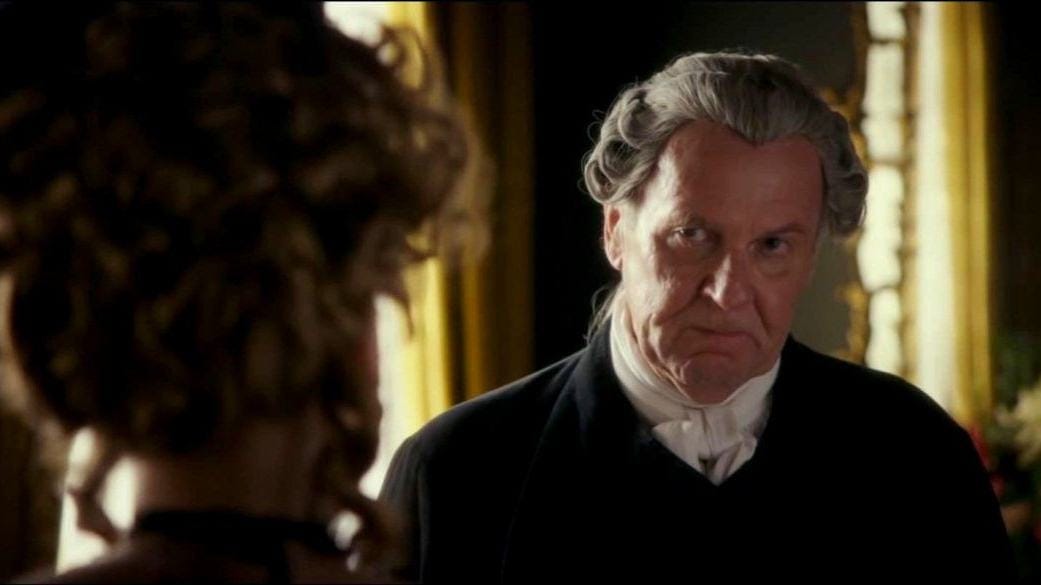
So I wanted John to reflect who Lord Mansfield was before he became a part of the establishment. Actually, that soul of Lord Mansfield, that’s still sitting within him but we just don’t see it quite in the same way but we see it in John.
I literally would take John Davinier’s story and weave it throughout the movie, in one draft and not deal with any other character, in each of those drafts. Basically, that’s how I was able to weave the complexity of the story. I could not have juggled all the balls at once.
Scott: I’d like to look at each of these key issues. For example, there’s obviously the issue of race. Dido is raised in this family, as a member of the family, and yet, by custom, she can’t even dine with them. She has to deal with one indignity after another.
There’s this really powerful moment where she’s alone in a room, looking at herself in the mirror when she starts to pinch her skin and run her skin.
The shooting script even says in scene description: “She begins to pinch and pull with self-hatred, rubbing the heal of her palm across her face, her forehead. As her face crumples, she begins to cry.”
Powerful scene. Why was it important to have that moment in the movie?
Amma: Well, I think that was the one scene that is not Jane Austin-esque at all, in any way shape or form. Two reasons, and actually I’ve never said this in an interview before, Scott.
I had that moment in my life at about the age of 14. I had that mirror moment. For me, I think all sort of dramatic movies, of course are about taking your character to rock bottom, if you like, and then, building them up to a sort of winning place.
This is an unashamedly commercial movie but is one in which, as I say, I wanted it to have something to say. All I try to do with my stories is try and walk in each of the character’s shoes.
That’s also why I had to take each of them one by one. I found it too difficult to see every side of the story in one whole draft.
At that point, I wondered “who else could she be?” I grew up in a world, again, not just as a film maker, as an actor in “Grange Hill.” I grew up in a world, where my family were one of only two black families on the street.
We would get feces put through the letter box. We would get matches put through the letter box. We would have graffiti on Dad’s car or on the side of our house.
Oftentimes, when we left in the morning, the racist language that was used towards, even me, as a eight, nine year old girl, walking home from school, before I went to stage school, I would often be surrounded by horrible teen boys, who would use really nasty language towards a very young girl.
There were times I just did not want the burden. I didn’t want the burden of being different being brought to me.
I remember having that moment where I just thought, “If I could just pull it off, if I could just take it off, then wouldn’t everything be OK?”
I wanted Dido to have that moment because I couldn’t fathom how I could feel that way in the ’80s and how she couldn’t feel that way in 18th Century England.
I mean I, at least, had a sister, I had a mother who looked like me. I had a father who looked like me.
She had nobody to reflect back at her. The only version of herself, or anybody like her, that she had to reflect back at her, was her mirror image.
I couldn’t imagine what kind of self-hatred that might bring before self-love could be encountered.
Scott: That’s an important starting point because it sets a baseline for her sense of self-acceptance and frankly, for Lord Mansfield, too, in terms of where he ends up. You need to have that starting point to show the transition.
Amma: You need to have that starting point. She’s going through, apart from a political awakening, she’s also going through that transition, which is from girl to woman.
For all of us, whether we’re going from boy to man, or girl to woman, whatever color we are, whether we’re biracial, or bicultural, or completely Caucasian or completely whatever, there is that kind of uncomfortable transition that we go through, which of course, may not be as dramatic as Dido’s is, but that we can all relate to in some way.
Her transition from girl to woman is not smooth. The realities of that time and what it is to be a woman are not easy to deal with.
Yes, this has to be the starting point of her exploring those elements and coming to terms with them.
http://www.youtube.com/watch?v=bqt2Mdf9cuY
Scott: You bring up gender. You mentioned that Elizabeth functionally, as a character within the narrative, she exists as a way of exploring that dynamic along with Dido.
In the social customs of the time from your script, as I understand it, a woman’s fate or self-worth was pretty much determined by who they married. Is that a fair assessment?
Amma: Yes. That’s what gave you status in life. Absolutely.
Scott: So, in a way, that’s really interesting with the Elizabeth subplot. It’s like the story explores gender for women in that time as another form of “enslavement,” at least metaphorically, to a patriarchal system. Is that right?
Amma: You’re bang on the money with that one. Yes, I mean, I am both a woman and a woman of color. We went through this phase in the UK where we’d often ask each other the question, “How do you define yourself? What do you see yourself first and foremost as? A black person or a female?”
I could never answer that question because I don’t know what drives me in life more because I am equally each of those things. To be able to explore slavery without exploring the role of the woman in that time would have been disingenuous of me.
To explore gender, at that time, without exploring the elements, the world of slavery, at that time, would have been equally disingenuous.
For me, I have always seen, I married very young, as I say. When I first married, I didn’t take my husband’s surname. I’m married to the love of my life today.
In my private life, I have his surname. It’s a choice I made, as opposed to, having to take it.
We know where that tradition came from. It came from the fact that when a woman marries a man, she belongs to him in a way that his horse does, his slaves, [laughs] his property, and his children belong to him.
That, to me, was a complete parallel that needed to be explored. Hence you get that line that Dido imparts to John which is, “I’ve come to realize that I have freedom twice over, both as a Negro and as a woman, or have I?”
Then she goes into her questioning. I haven’t seen anybody do that on film before.
You know, as a writer yourself, these are old stories, and you’re always looking for your unique way to present them. These stories, you’re always looking for your unique lens.
I don’t mean the lens of a director. I mean the lens of a storyteller to express an idea or theme, a complexity to an audience. I hadn’t seen anybody do this before, I mean make the comparison between slavery and gender in a period film. I wanted to.
Scott: Then there’s this third theme that runs through the story, too, which is money. Dido, at some point, her actual father dies. She gains this inheritance. She’s an heiress. I think it’s 2,000 English pounds a year, and so you think that’s great news. Yet, due to her mixed racial background, she’s made to be something of an outcast.
In fact, she says to Lord Mansfield, “Papa, how may I be too high in rank to dine with the servants.” That’s her money. “And too low to dine with my family.” That’s her racial background.
It’s it fair to say, basically on all fronts, race, gender, money, Dido finds herself in this no man’s, actually no woman’s land, in terms of her search for this answer, “Who am I?”
Amma: She’s absolutely at this cross junction of everything and has no path, as she says in the movie, “No place that she can claim as her own.” No place where she can belong.
She can’t, at any point, actually walk down any path and say, “This is mine. I am an heiress. This is mind. I am an aristocrat. This is mine. I am a wealthy woman.”
Everything is questioned and yes, she’s at the junction of everything. It is absolutely fair to say that, in terms of identity, she’s utterly lost.
As a young woman, she couldn’t be anything else at this point because who would any of us be presented with those circumstances? That’s the joy, as you know, in storytelling, is that you can play somebody in a very detailed, specific context and yet, it can resonant with everybody because they can recognize it also, “Well, bloody hell. [laughs] If you put me there, I’d be exactly the same. I wouldn’t know if I was coming or going.”
That essentially is her. This goes back to what I was saying about identity. At various points in the movie, Dido attempts to feel like a lady. Society tells her, “No, you are not.”
Tom Felton’s character, for instance, young Tom Felton who plays James Ashford, tells her essentially through his actions, “You are not, you’re the child of a slave. I will treat you as nothing other than that.”
Then there are the times where she feels like a slave and nothing else, and wants to blend in the background. Yet, she’s treated utterly like an aristocrat and as somebody who can bring worth to another family and to a gentleman and allow him to keep his gentlemanly status, if she marries him.
At one point, she’s defining herself in one way but the world is defining her in another. Then, those two positions change.
She can never quite hang onto an idea of herself for too long without somebody else coming along and challenging it. For me, the message is, that’s why it’s so important to know who you are, no matter what society says.
Tomorrow in Part 5, Amma talks about a horrific historical event that serves as a key point of legal contention in Belle.
For Part 1 of the interview, go here.
Part 2, here.
Part 3, here.
Amma is repped by CAA and United Agents.
Twitter: @AmmaAsante.
For an interview with Belle screenwriter Misan Sagay, go here.
For when and where to see Belle in U.S movie theaters, go here.
At the request of the Writers’ Guild of America, West, I am including this clarification from the Guild with regard to Belle: “Consistent with WGA credit determination procedures, the writing credit was based on a blind reading of the material written by all of the writers and the readers were given no information concerning any writer’s union affiliation.”
Comment Archive