Interview (Part 4): Rob Meyer and Luke Matheny
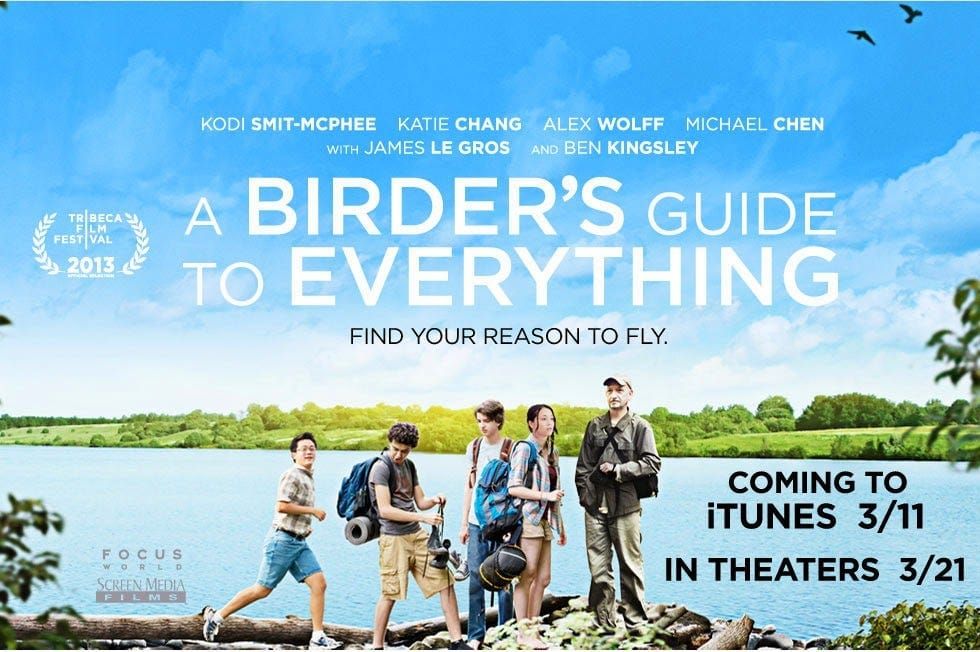
When I saw the trailer for the movie A Birder’s Guide to Everything, I immediately sought out its filmmakers: Writer-director Rob Meyer and writer Luke Matheny. It’s a wonderful story starring some terrific young talent as well as Oscar winning actor Sir Ben Kingsley. The movie comes out in theaters and on VOD this Friday, March 21.
In Part 4, Rob and Luke talk about the movie’s production, the movie’s debut at the Tribeca Film Festival, and the film’s release:
Scott: For other filmmakers who will be reading this interview, could you run through the whole casting and pre-production process?
Luke: I’ll let Rob do the heavy lifting here, but I will say quickly, there’s a line in Terms of Endearment where Debra Winger is talking about having kids and she says, “As hard as you think it’s going to be, you’ll only end up wishing it was that easy.” [laughter]
Rob: I feel like this was a long, long road. I’ll leave out the crying. It was the hardest thing I’ve ever done, by far. My advice to first-time filmmakers would be, “Don’t put all your eggs in one basket.” This was my one basket. It was based on this short that I made that did really well. I had this mindset that I had to make this feature and it was all or nothing for me.
So I had trouble writing another feature or being told, “Why don’t you write something else that might be easier?” I wanted to make this movie and it took five years to make from start to finish, which actually is not even that long in the scheme of some films, but it felt like a really long time.
In terms of getting financed, it was actually pretty straightforward. We started in 2009, right after the financial crash, and that was a terrible time to try to get financing for anything. But we eventually got producers on board and then, we got our biggest score: getting Avy Kaufman to be our casting director.
She responded to this script. It always came down to the script. It won some awards too, which helped. It got fellowships from the Sundance Institute, the Tribeca Film Institute, the Sloan Foundation, NYU’s Columbus Vague Award.
Luke and I got a lot encouragement about this which gave me the motivation to keep trying — to keep bashing my ego by trying and then failing to get this movie made. Because we really thought the script was good. Other people thought it was, too. So we got Avy, who read the script, and she got Ben Kingsley and then that led to basically getting all private investments.
It wasn’t through a big film fund. It was all through people who had financed films before and a couple for whom it was their first film. It was a real collective effort by a group of people who believed in the film.
After we finally got all the money in place, we filmed in the summer of 2012, we premiered in 2013 and then, it’s coming out March 21st of this year. It was a long process.
Luke: There were so many obstacles in financing. But ultimately those obstacles gave us a lot of time to work on the script. We didn’t really have anything else to do besides keep working on it.
Rob: And researching and getting to know people in the birding world. I doubt we’ll ever have the luxury of having so much time to write a script. And by luxury, I mean unpaid work. [laughter] This is actually true. Luke was still finishing up grad school and I was just out of grad school. So not getting paid and doing odd jobs and living kind of a cheap lifestyle was still an option for both of us.
Scott: Let’s talk about production. Where did you shoot? How long was the shoot? Any interesting experiences?
Rob: The whole thing was, for me, incredibly interesting and exhilarating and Luke was there for the last week. Luke, actually, directed his first feature film literally at the same time that I was directing this. So it was weird confluence of events.
But we had 20 days, so four five-day weeks, to shoot the film up in Westchester, New York, and they were short days, because the actors are young and we can only work them from eight or nine hours a day, which made for a really, really tight shooting schedule.
I know all directors feel that way, but I really think it was quite tight. To make it all work, we actually trimmed the script down from 110 pages to 90 pages to 88 pages and then there were a couple of bits we didn’t even shoot during the shoot. We cut it down to the bone.
Scott: Where you able to do any sort of group-building exercises with the young actors before production started or did they basically just get thrown into the mix and off they went?
Rob: A little. Because they were from California, Chicago and New York, they were only in the same place for about a day before we started actually shooting. So we did a quick afternoon of birding in Central Park, but the main bonding was that they all did stay in the hotel together and bonded and stayed up late. Actually, Alex Wolff was the one who brought Stand by Me and really wanted to watch that as a group. They really hit it off immediately.
If I had my choice, I would have had them for them two weeks and we would have really gotten to know each other before we started shooting, but that just wasn’t an option.
Scott: Their performances were terrific and I thought the character interactions felt very authentic, and that the directing was great.
Rob: Thank you.
http://www.youtube.com/watch?v=pJyjCGMcV3I
Scott: The movie premiered at the 2013 Tribeca Film Festival. So what was that like for you guys?
Luke: It was a blast. We went to NYU, so we had a lot of friends who were there. We shot in Upstate New York, so a lot of the crew was there and wanted to come, so it was really fun.
Rob: We had the hometown advantage. At the opening night screening, at a huge theater in New York City, you couldn’t get a ticket. I could barely get my parents’ tickets. It was really exciting to feel like we made something that’s in high demand. The audience response to that one really big. It was actually so good, I didn’t buy it because it was like, “Come on, these must all just be people who know us.” But, then, actually, the later screenings, where we had more unbiased audiences, were also really positive and that was, in a way, even more exciting. And people start talking about their experiences with loss or their love of bird-watching or something else that their passionate about. That’s why you do this.
Scott: I hope it connects. I know Hollywood seems to be so consumed with the whole edgy filmmaking thing. Which is great — I love edgy films — but there is also room for character-driven pieces like Birder’s that… I don’t know what the word is. Non-edgy? More humane or something.
Rob: Human.
Scott: Human.
Rob: I like the concept of “humanist filmmaking” — like the films of Tom McCarthy, I’m a huge fan of his. Win Win, it has everything in it. It’s a huge film in a very small package. That’s what we wanted to make. That’s what we want to make in the future: films about people.
I think both of us feel like films are about giving people hope and bringing people up and not rubbing shit in the their face. I won’t speak for Luke, but that’s how I feel.
The risky thing we did was write a film that was quite straightforward and from the heart. You’re kind of putting yourself out there. There are not a whole lot of places to hide when you do something like that.
Luke: That’s a good way to put it: There wasn’t really anything to hide behind. We knew the film — in the end — was just going to rise or fall on how much people responded to the characters, on how emotionally true they found the characters to be. I know that can be setting the bar pretty high, but I think that’s a noble place to set it.
Rob: I’ve had a number of people, especially filmmakers, who have said, “This film really could have failed very easily. You guys really walked that line.” It’s almost like this film should have failed. It has the potential to fall into after-school special territory: saccharine, small or insignificant. I hope we avoided that.
Scott: So the movie’s got distribution with Focus World and Screen Media and it’s slated for both VOD and limited theatrical release. What’s that experience been like?
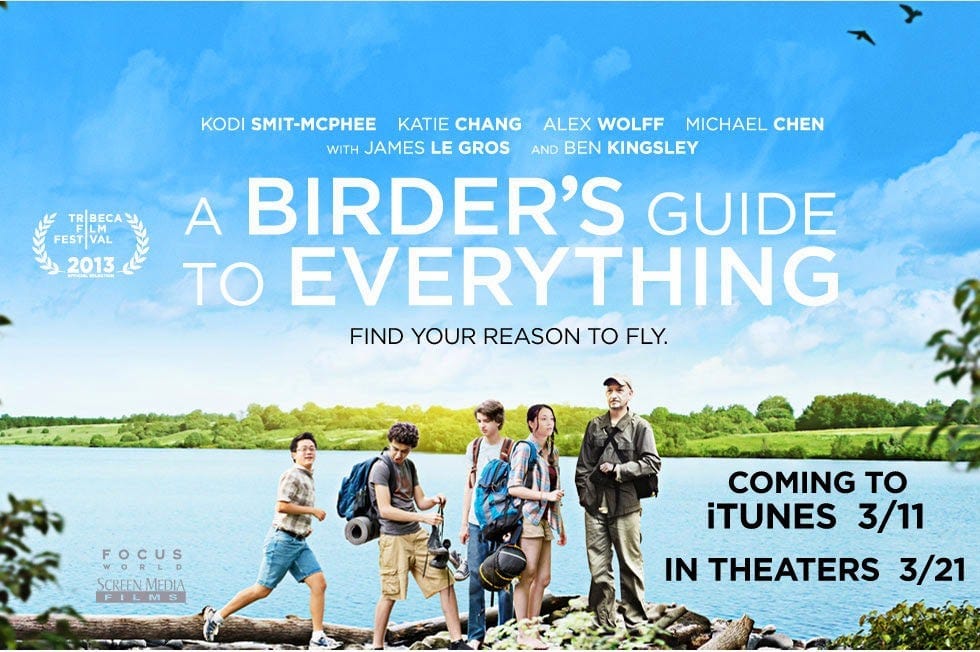
Rob: March 21st is the date I’m trying to put out in everyone’s head. But as of March 11th, actually, they’re going to release on VOD and iTunes. But I think it’s easier to just to say one quick date: March 21st in theaters and OnDemand!
All the cities where it’s playing in theaters are listed on either our Facebook page or our website — right now it’s scheduled to play in NY, LA, Chicago, Seattle, Houston, Dallas, Newport, Wilmington, Portland, Tucson, Boulder, Albuquerque, Boston, Miami and Santa Fe! It could expand some more and actually, especially with the help of the bird‐watching community, and we’re also on Tugg, which is website that allows you to arrange your own screening.
What’s really exciting about Focus World is they’re part of Focus, which is part of Universal and they are very present on Comcast. They have great relations with all the other cable providers, iTunes, Vudu, and all the other new on demand companies that are starting to pop up.
So, basically, it should be available to everybody in the United States, starting March 21st, but I really hope people go see it in the theater because we’ve spent a lot of time making it look beautiful and, also watching it with an audience, as is often the case, is really special experience.
Tomorrow in Part 5, Rob and Luke reveal some of the plans they have for other film projects, then share some thoughts on the craft of screenwriting.
For Part 1 of the interview, go here.
Part 2, here.
Part 3, here.
Rob is repped by WME and Apostle Management.
Luke is repped by Paradigm.
Comment Archive