Interview [Part 5]: Amma Asante, Director, “Belle”
![Interview [Part 5]: Amma Asante, Director, “Belle”](https://storage.ghost.io/c/8f/29/8f29b0a7-49e5-431c-a9bb-3ade9c0a785e/content/images/size/w2000/2026/08/0_8fOrauhphe27lMPY.gif)
Amma Asante has been an actress, TV writer-producer, and movie director. Her latest is the period piece drama Belle, written by Misan Sagay and directed by Asante. The movie opens this Friday, May 2nd in theaters across North America.
I had an engaging and informative conversation with Amma after she had just returned from the U.S. to her home in The Netherlands.
Today in Part 5, Amma talks about a horrific historical event that serves as a key point of legal contention in Belle:
Scott: That’s what I thought was very sophisticated about the storytelling here because in terms of gender, race, money, all this stuff is coming at her, basically she’s reacting to it. Then, the story brings in this Zong case and it’s like she finds a moral truth there and, essentially a pathway to herself in getting involved in this case.
Amma: Yes, indeed. The one thing we knew about the real Dido was that she was very clever or deemed to be very clever, and Lord Mansfield really admired her mind, which is why he put her in a strange position, strange for a woman at the time, of working with him and his study and taking down his dictation.
The difficulty for me, Scott, was in preventing this woman of color, surrounded by White people, Caucasian people, a young woman who knew slavery existed but had little information about it. How would I present her without making her irritating to an audience, naive, and not allowing that naiveté to come across as stupidity.
What she is, is she’s a clever woman. She’s smart. She’s hungry for information but she’s starved of it.
Lord Mansfield has wrapped her up in cotton wool, stuck her in this house in the countryside, where he is showering her with love, in the best way he knows how, as are the family.
Yet, she’s starved of information. The Zong case gives her this glimmer of light into self-awareness, into self-fulfillment, in some way, at the end of the film, and into this political awakening.
This self-awakening and this political awakening. She’s hungry for that information because she’s smart. Give her the information and she will run with it.
Her mind knows how to work with it and what to do, despite the fact that, in the beginning, she cannot quite grasp that transactions could be made on the deaths, on the killing of human beings.
Her understanding is that transactions, money, can be made on the sale of human beings but on the killing of human beings, that’s the bit that she can’t get her head around.
I felt that that disbelief was at least acceptable. Most normal people would find that difficult to believe. I mean, informed people would find that difficult, as well.
Yes, as a character, she’s hungry for that information. The Zong is the perfect tool for her to be able to explore the world, her own political agenda, and herself, her own identity.
Scott: For readers, this is an actually case that happened, in 1781 the slave ship “Zong” in which 142 slaves were killed in order for their owners, the company, to collect insurance money.
Amma: This is right. Basically what happened is they were very, very tightly packed, like Amistad. Think “Roots”. Think all of those film, historical images that we have from those great productions.
Think about how those people were stacked below deck, in the ship. What this would do, it would create great illness, great sickness.
They said you could smell a slave ship a mile down wind of it because of how disgusting it was on the ship. These slaves become very sick, along the journey, because the journey was long and protracted.
In actual fact, the captain of the Zong ship was inexperienced. He takes the ship a long way round. They become ill. The slaves become ill.
He realizes that at a certain point they’re not going to earn their previous value on the open market. He’s simply not going to make the money from them that he had hoped to make or that he had even spent on them.
The best way to recoup most of that money back is to drown them and recoup the money through insurance.
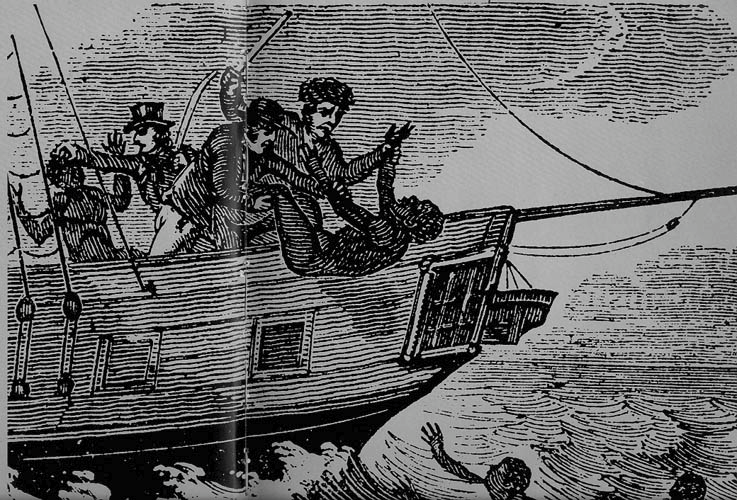
Scott: From a storytelling standpoint, what’s interesting about this case is it creates an intersection in for Dido… with Lord Mansfield, who is the judge on the case, so eventually that story resolves. Then also with John Davinier who appeals to Lord Mansfield’s sense of what is moral. There’s a nice seamlessness to that because in a way, isn’t he articulating the moral truth that helps clarify things for Dido.
Amma: Yes. As writers, what we want to do, always, is have a two way relationship between the characters. We see what Dido brings to John and then we want to know what John is bringing to Dido.
You’ve absolutely hit the nail on the head that through him, he is one of the elements that’s facilitating her truth about the world, about herself, about where she belongs, about who she is, about what’s important. All of the things we know.
Yes, you’re quite right that his role, in being the young Lord Mansfield, is not the only one position he fulfills in the story.
What he’s also there to do, if you look at the relationship between him and Lord Mansfield, we know what he brings to the Lord Mansfield. He brings that moral truth, as you say, as he does to Dido.
He’s the reminder to “do the right thing,” as Spike Lee would say. What does Lord Mansfield bring to him?
I think what Lord Mansfield brings thematically in the story, is the idea that sometimes you have to know the game to play the game. Sometimes you have to be in the game to change the game.
Being passionate, being a loose cannon, will get you so far but there comes a point where you, if you really, really want to change the world, there comes a point where there might be the possibility that you have to be more savvy and strategic about the way that you do that.
For me, personally as a writer, I think that both elements are required. If we think about the Arab Spring, we think about all of these modern day contemporary mini-revolutions that have come about recently. They’ve come about because of passion. They’ve come about because people have endeavored to take huge risks and be loud and noisy about requiring change and about what is wrong.
Yet we also need the strategic endeavors in order to fully implement change. That’s what those three people, Dido, John, Lord Mansfield bring together, and at the same time Dido is finding self-value, partly through John, The Zong and other means.
One of the things I wanted to do with John is have him fall in love with Dido’s mind before we know that he also is physical attracted to her. When she tells him, “All I know about my mother is the color she has left me.”
He says “Then at least you know she was beautiful.” I wanted us to be very clear that he was in love with her and that this was a meeting of the minds first, but yes physical attraction too.
He’s opening up all these windows for her. The thing about John is he’s running around waving the flag for people less fortunate than himself. But he’s never walked in the shoes of any of these people.
She is the first person that comes into his life and he tries to judge her. He tries to, at some point, early in the movie, perhaps not deliberately so, but he’s rather demeaning towards her.
At some point, the scales have to fall from his eyes. He has to become more empathetic or sympathetic in the way that he feels towards her. He has to walk in her shoes, a little bit and understand, as a white guy in 18th Century England, it’s a little bit more complex. [laughs]
Life is a little bit more complex being a black female or a mixed-race female than life might be for him. So that’s what he learns from her. He learns the power of empathy, I think, which he doesn’t have at the beginning.
Scott: There’s a specificity about her that in connecting with her, that intimate knowledge of Dido enables him to bring to bear a personal grasp of more generalized political interests.
Amma: Absolutely.
Scott: I also thought it’s as if Dido is all along crying out, “See me for who I am, even if I can’t see myself.” John eventually does.
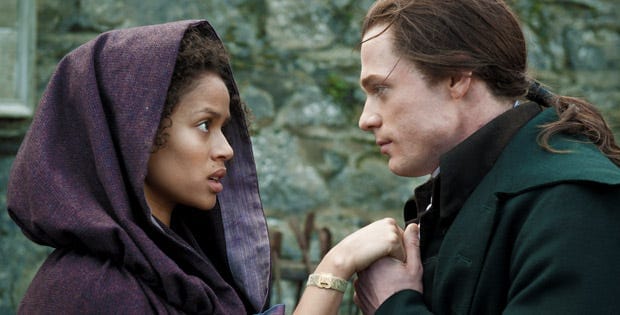
Amma: Exactly, he does. I remember when I was working on a love story for another movie that I mentioned we will be going into production with in 2015. I was writing this love story. I wanted to know what are the formal definitions of love that are out there?
I was looking this up one day doing my research and being nosey about what the poets have written, and what the great literary minds have written and what the great psychologists have said.
For me, when I fell in love, when I truly fell in love, and in the end, I went for my own definition, I really felt that my partner saw me and accepted me, has accepted me who and what I am.
My biggest terror, and I think all of our biggest fears, at times, is that we’ll be discovered. Somebody will work out who we really are and then we’ll be repealed by that.
Actually, the most joyous love I think is when you’re with someone who you think just totally gets it and totally accepts you for who you are. What he does is he loves the combined Dido before she does.
He loves the child of a slave and the child of an aristocrat before she does ‑‑ the combination. He loves the black Dido and the white Dido before she does. He loves her for what she is before she learns how to, and through that she learns how to.
Scott: Then there’s a wonderful rounding off of the relationship between Dido and Mansfield. It’s almost like a father‑daughter story in that he’s moved ultimately by his relationship with Dido knowing her humanity. That contributes to the critical decision in the final disposition of the Zong case.
Amma: Yes. In the UK, Dido is known. She’s now taught in schools, so kids below the age of 16 will learn about her. She’s known as the little girl who helped change history and the little girl who helped to end slavery.
The belief is that her being in Lord Mansfield’s life had some kind of impact in terms of the decisions he made both with an earlier case called the Somerset case in which he set a slave free in the UK and then later on with the Zong case.
My father was dying during the filming of Belle. He actually died whilst I was penning some of the last scenes to do pickups on Belle, and I was sitting right next to him as I wrote these scenes.
In putting Belle together, I wanted to make the movie that I felt my dad would want to go and see and would buy a ticket for. I wanted to pay homage to the great, great relationship, the great love story that I had with my father. I was being pushed by the wonderful financiers who were quite right in telling me this needed to be a big love story in all of their notes. I was pushing the big love story between John and Dido, but I also wanted to push the other love story in this movie, which is the paternal love story.
Lord Mansfield, for me, is very much my father, a man both steeped in rules. He’s sitting on this sort of cusp of change. He has one foot stuck in the rules in the status quo, and he has another foot firmly entrenched in progression. He is progressive. That was my dad. He was this complex character.
The whole movie for me is a movie about, and I’ve said it many times before, conditioning versus instinct. I think that’s often all of our struggle, how we make those choices about the decisions we make and how we move forward. Lord Mansfield is battling this right the way through the movie as is Dido and many of the other characters in the film.
At some point heart, truth, and instinct will out, and each is bringing that out in the other. John brings it out in Lord Mansfield. Dido brings it out in Lord Mansfield. John brings it out in Dido and vice versa. I wanted all these two‑way relationships to exist in which something quite beautiful and quite pure is emerging and quite simply is the biggest thing we have, isn’t it, in film, which is just love.
Tomorrow in Part 6, Amma shares her thoughts about how she hopes Belle is received by moviegoers and how it conveys a message of hope that things can change for the better.
For Part 1 of the interview, go here.
Part 2, here.
Part 3, here.
Part 4, here.
Amma is repped by CAA and United Agents.
Twitter: @AmmaAsante.
For an interview with Belle screenwriter Misan Sagay, go here.
For when and where to see Belle in U.S movie theaters, go here.
At the request of the Writers’ Guild of America, West, I am including this clarification from the Guild with regard to Belle: “Consistent with WGA credit determination procedures, the writing credit was based on a blind reading of the material written by all of the writers and the readers were given no information concerning any writer’s union affiliation.”
Comment Archive