Interview (Part 5): Gary Whitta
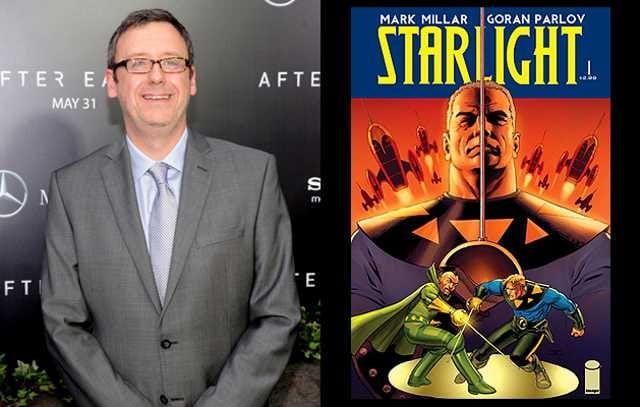
A few months back, I had the opportunity to interview screenwriter Gary Whitta whose movie credits include The Book of Eli (2010), After Earth (2013), and the upcoming Star Wars: Rogue One (2016). Having recently seen his first novel “Abomination” published, Gary and I had a wide-ranging conversation touching on a host of subjects which I think readers will find quite interesting.
Today in Part 5, we delve more deeply into “Abomination,” the experience Gary had writing a novel in contrast to a screenplay, and some questions about the craft of writing:
Scott: You’ve got another theme at work, too, with the magic that’s involved in the discovery of these nine scrolls with ancient incantations. Once mastered by the archbishop, they have a shocking transformative effect.
You mentioned Frankenstein. That echoes the original Frankenstein story. The archbishop in effect Dr. Frankenstein, right? He starts off with good ambitions whic gets consumed, that whole absolute power corrupts absolutely thing.
Gary: What you see in stories like Frankenstein and The Fly is, in part, the idea you can stumble on idea that is so powerful that it’s very easy to become corrupted by it. Our technological development often outpaces our moral and ethic development. As soon as we develop a new technology, one of the very first things that we figure out to do is how to we weaponize it. Very, very quickly, after we split the atom, we had figured out how to make a bomb out of that technology and on and on it goes.
Scott: What was the process like for you writing novels as opposed to screenplay? You’re freer from a page count perspective. You don’t have to worry so much about the narrative being an externalized reality. Did you enjoy the process?
Gary: Yeah, it was really nice that to not have to worry about page count for once. Often, my first drafts of screenplays are really, really long. Close to like a 170 or 180 pages when really it should be close to 110‑120. Then, a lot of what I do in the rewrite process is trying to cut it down and figure out what I do and don’t need. That’s not to say that when you write a novel, you’ve instantly bought yourself license to warble on and on — you still want to cut the fat and make the story as lean and as well-paced as possible. But it was nice to be free of that numerical restriction.
In many ways it felt like starting over. A lot of what I have learned in fifteen years as a screenwriter went out the window because it didn’t apply to the story I wanted to tell in the form I wanted to tell it in. Writing in prose is very different, and I had to give myself the license to do things that usually I wouldn’t be comfortable with, like spending time in the head of a character or devoting a whole chunk of the story to background. It took a little while to get comfortable doing that because all those years of screenwriting conditioned me to avoid those things. Once I got past that phase… it’s like breathing liquid oxygen in The Abyss. The initial panic subsides and you acclimatize to your new environment and you realize it’s actually pretty cool, this new environment. By the end of it, I probably had more fun writing it than I have any screenplay that I’ve written — with the exception of Star Wars — because I was able to give myself so much more license dramatically than I usually would in a script.
Scott: So, the book’s rolling out and you decided on this really interesting publishing strategy. In fact, I’ve never heard about it. I’ve read an article in the Wall Street Journal about it. Inkshares, could you describe what that’s about?
Gary: Yeah, Inkshares is very new. They’re based here in San Francisco, where I live. And their approach appealed to me for a couple of reasons. They’re an online startup and since I come from kind of a techy background I liked what they were trying to do. The internet has created this tremendous democratization in the creative marketplace where a lot of the gatekeepers who traditionally decide what gets presented to an audience have gone away. Now you can fund a project on Kickstarter, you can create a show on YouTube and just get it out there. And now it’s the audience that decides if it’s something worthy of success, not the old gatekeepers. We’re seeing this in publishing too, with a huge surge in the digital self-publishing movement, and now with Inkshares, with offers all the benefits of a traditional publisher with a lot of the freedom you’d associate with self-publishing. Abomination, like all Inkshares books, was crowdfunded. We put up a couple of sample chapters and some stuff about what the book was, and people could decide if they wanted to pre-order a copy. If enough people pre-order to fund the initial publication of the book, it gets published. And Inkshares is then able to tap into the resources of a “real” publisher — distribution, production, marketing, all the stuff that is often very difficult to do when you self-publish without any support.
Scott: It sounds like a terrific idea, and hopefully Abomination will be a big success. Before we get in some craft questions, I’ve got to ask you one question about the Star Wars movie. You worked on Star Wars Anthology: Rogue One, the film that Gareth Edwards is directing. It’s due out in 2016. What was your experience working on that project?
Gary: As I’m sure you can imagine, I’m really not in a position to say very much about it. But I worked on it for the better part of a year, breaking the story and writing the initial screenplay, and I had a fantastic experience. Gareth is one of the most talented filmmakers I’ve ever worked with, and he’s going to make a terrific film.
Scott: You’re also doing an adaptation of Mark Millar’s Starlight. how’s that going for you?
Gary: It’s been going really well. Basically I came right off of Star Wars and went onto Starlight. It had been waiting in the wings for me to finish on Star Wars. And it’s a big relief to go from a project where I’ve been able to say literally nothing to one where the whole story has basically already been published in comic-book form. There’s a lot of secrecy around Star Wars, but you can go buy the Starlight comic right now and essentially see at least in its original comic book form the story that we’re going to be telling you this time.
Scott: That’s great. A few craft questions for you. It’s interesting to hear you talk, because several times you’ve mentioned putting on the producer or studio executive hat when you’re looking at story ideas. How important do you think the story concept is to the overall strength and commercial viability of a spec script?
Gary: It’s funny, you don’t really hear that term “high concept” so much anymore. It was a big thing in the ’80s, and then it kind of went away. Put the thinking still very much prevails. If you have any ambition to see your story realized as a big movie, something that is not going to be super‑cheap to make, I do think you have be able to boil that idea down into one or two sentences that makes people say, “I would see that movie”. Because there’s nothing more depressing than pouring your heart and soul into a story and writing a script, and then seeing it not sell because at the end of the day there was never a simple, compelling idea at the core that people can grasp and get excited about.
So, I do try to submit everything that I write to this test before I really invest in it. Is this something that has a realistic chance of getting made? Is it something that people would want to see? I try to always take into consideration before and during the writing, simply so that I’m giving myself the best chance of seeing some satisfaction at the end. I don’t want to spend my life writing movies that I deeply care about, but which have no chance of anyone ever seeing.
Scott: I’ve read when you were first starting out, you didn’t do much in the way of outlining or prep writing. But I’m assuming that’s evolved over time. So, which aspects of prep do you tend to devote the most time to?
Gary: It went back and forth. When I was just starting out, I didn’t prep or outline at all. I would just dive straight into writing the script. And of course, that is not the way to do it. You will very quickly write yourself into all kinds of corners It’s a very amateurish way to do it, born of impatience and enthusiasm, but a lot of writers probably start out that way.
From there, I kind of rubber‑banded in entirely the opposite direction — I would very, very rigorously structure things. And I would write these really long, 30 or 40‑page treatments. Once the treatment was done, I had the satisfaction in knowing I wasn’t going to write myself into a corner. I know exactly where the story was going. The problem with that is that that made the writing process itself a little bit boring, because I had the story so well worked out ahead of time I hadn’t left myself anything to discover while writing. Trust me, writers hate writing treatments. It’s like writing the script but without any fun of writing the script. It’s helpful but it’s a joyless process, because the fun part is having the idea. The fun part is figuring out when a story clicks into place and you have that “eureka” moment. It’s really, really edifying. It’s so much fun to do that. That’s what we love about writing, when you get that little adrenaline hit. If you do all that in the treatment and don’t leave any of that for the actual script, the emotional process and the fun of writing the script can be quite flat.
Where I’ve ended up now is somewhere in the middle of the two, where I will outline and I will give myself a basic backbone of where the story is going. I’ll leave enough open and vague so that I still have latitude in the writing of the actually script to make those discoveries and find the little things as I go along.
With Eli, the outline was literally one page long, just a simple beat sheet of the 10–12 key story points that laid out the basic structure. So I had a handrail as I went along. As long as I held onto that through writing a story, I wasn’t going to get lost. But a lot of the cool little details and specifics and things that happen in the film came through in the actual writing of the draft. Because I tend to be most creative and have my best ideas when I’m knee-deep in the real writing rather than one step removed from it, which is where you are when you’re doing a treatment or an outline.
Scott: Does that extend to developing characters?
Gary: With Eli, yeah. I’m much, much more interested in character than I am in plot. It’s why Eli has a really simple plot. Abomination has a really simple plot. I like to think of the best stories as thin on plot but thick on character. Look at Beverly Hills Cop. Can you remember what the actual plot of the film was? Very few people can, but they all remember the character of Axel Foley. Because he’s what was what made the movie fun. We all remember that character. What was the actual plot of Pirates of the Caribbean? Do you really remember? Probably not, but everyone remembers Jack Sparrow.
So for Eli, all I had written for the story was that one‑page beat sheet. But I had pages and pages of character stuff written about Eli and Solara and Carnegie, who they were, where they came from. I wanted to know the characters really, really well before I started writing. By having just the basic outline of a plot and a really deep sense who the characters were, I felt the actual writing the movie became much easier.
Because if as a writer you’re in a situation where, for example, your character walks into a room and there’s a guy there pointing a gun at him, if you don’t instinctively know what your character would do, how they would react, I don’t think you’ve done enough work. You should know those characters as well as you know yourself.
Tomorrow in Part 6, Gary offers advice on the single best way to learn the craft of screenwriting.
For Part 1 of the interview, go here.
Part 2, here.
Part 3, here.
Part 4, here.
To learn more about Gary’s 400 page historical fantasy novel “Abomination,” go here.
To purchase “Abomination,” go here and here.
Gary has graciously agreed to answer reader questions, so if you have any, please post in comments.
Gary is repped by UTA and Circle of Confusion.
Twitter: @garywhitta.