Interview (Part 5): Kelly Marcel
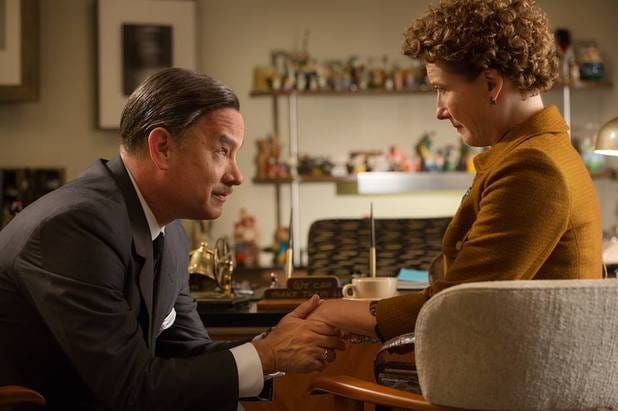
London-based writer Kelly Marcel wrote the 2011 Black List screenplay Saving Mr. Banks which was produced starring Emma Thompson, Tom Hanks, Colin Farrell, and Paul Giamatti. She is involved writing several other high profile movie projects including The Little Mermaid and Fifty Shades of Grey.
Kelly and I engaged in a wide-ranging Q&A, the focus of which is her thought process in writing Saving Mr. Banks. You will find her responses insightful, frank and hugely entertaining. Today in Part 5, Kelly reflects on the psychological dimension of Saving Mr. Banks and some of her other movie projects including Fifty Shades of Grey:
Scott: Perhaps the central theme of the story is implied in the title itself: Saving Mr. Banks, referring to the father character in “Mary Poppins,” but symbolically representing Ginty’s father, who was also a banker. Could you touch on what is going on psychologically with regard to Pamela in relation to her father as she endures the script development process with Disney?
Kelly: Psychologically, she is struggling to let go. She associates her own father with Mr. Banks; she is breaking down and realizing that she has created a fiction of Travers that she now cannot bear to see as a character through anyone else’s eyes. He was everything to her, and so Mr. Banks is everything to her now. But Disney as Disney’s own salvation, his own homage to the father that had caused him such pain, has also adopted Mr. Banks, the character. It’s a fight over this one man. They’re battling over their legacies subconsciously, and neither one of them can bear to let Mr. Banks be what he needs to be, which is simply Jane and Michael’s father.
Scott: Walt Disney has to go through his own psychological journey in that over time, he comes to understand what “Mary Poppins” really means to Pamela, how it is tied to the redemption of her own father. In fact, at the movie’s most critical moment, Disney has a monologue in which he has to sway Pamela and he says about the proposed movie version of “Mary Poppins”:
In every movie house, all over the world, in the eyes and the hearts of my kids, and other kids and their mothers and fathers for generations to come, George Banks will be honored. George Banks will be redeemed. George Banks and all he stands for will be saved. Maybe not in life, but in imagination. Because that’s what we storytellers do. We restore order with imagination. We instill hope again and again and again.
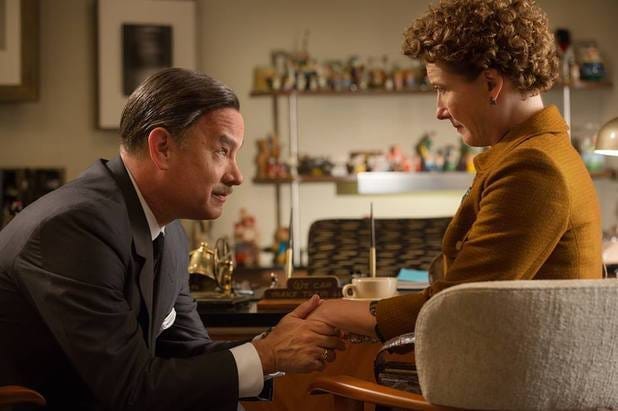
Two things. First, given the fateful nature of this moment, how difficult was this monologue to write? Second, how much of that last point — “That’s what we storytellers do… restore order with imagination… instill hope again and again” — reflects your own attitude about your role as a writer?
Kelly: Writing Tom’s speech about his dad was very very tricky. How could I say the words that would allow PL to give up her precious creation? He had to be convincing, he had to tell her something that would unlock her. She had to know he understood.
Not that they would ever be pals, but that he knew. He knew how hard this thing was to do. That he felt her pain. I don’t know how that got done. The little boy in the snow was all I had; I knew I wanted to build it around that. It happened over a period of days. I wrote everything I wanted to say, it ran to 17 pages or more and then I cut it down and then I threw it all away and then I started again. One night, late, it just metamorphosed on the page. Talking about writing that speech is hard, because I don’t know how it came. It just unfolded from a mish mash of thoughts and half-sentences.
Scott: Here’s an off-the-wall observation: Compare Pamela to Clarice Starling in The Silence of the Lambs. Both were young girls ‘victimized’ by the traumatizing loss of a father, and the psychological point of their respective stories is to confront and deal with the unfinished business of those deaths. Clarice has to kill Buffalo Bill in order to ‘redeem’ her father’s death. Pamela has to allow the movie to go forward, as Walt Disney points out, to ‘redeem’ her father (via Mr. Banks). Again totally different genres and tone, and one story involves destruction at the end, while the other’s climax is about creation, yet the net effect (psychologically) is pretty much the same: Both Protagonists have in effect confronted, then moved through the pain of their past and can now have a ‘new’ life in the present.
Kelly: Woah! That’s deep! Yeah! Silence of the Lambs. It’s exactly that. I’m gonna take this analogy and run with it and tell everyone that that’s what I meant to do, that I totally saw that comparison from day one and you ain’t gonna tell no one you came up with ya hear? I’ma hurt you bad if you do.
Scott: Saving Mr. Banks soon will be rolling out in thousands of movie theaters across the United States and around the world. You wrote and rewrote the script, you’ve tracked the project’s development from pre-production through post, and now you’ve seen the movie and heard the crowds react. If you had to choose one word to describe what you’re feeling about the entire Saving Mr. Banks experience, what would that be?
Kelly: Grateful.
Scott: There are some other high profile projects you’re involved with including The Little Mermaid, based on the Hans Christian Anderson story with Joe Wright attached to direct. What’s the latest on that?
Kelly: Little Mermaid is still in progress. Joe is a genius and Working Title are wonderful people to work with so yeah, you know how long these things take to figure out. It’s still an ongoing project and one that is so bold it hurts my brains when they show me how they’re going to make it work. What I can say is that it’s a much darker take on it than we have seen before and it’s all live action.
Scott: Of course, I have to ask about Fifty Shades of Grey, which you were the first writer chosen to take on the adaptation of that hugely popular book. What were some of the biggest challenges you faced in writing that project?
Kelly: Well, it was quite difficult to write the sex stuff because I am a virgin, so I don’t know anything about what happens in the birds and bees department. Luckily some very nice people told me all about it. There’s some kissing and such and then someone sits on a rabbit or maybe it’s a duck, I don’t know but then you rub a bald man’s head and you either get pregnant or you get some flowers. So hopefully what I’ve written will ring true.
Scott: Do you have any plans to explore TV again or are you satisfied just now to work in feature films?
Kelly: I do I do! Get this! Westbridge came back around and we are finally getting to make it. The good ole BBC stepped up, and I start work with Tommy Schlamme — who I developed it with — next week. It’s so nice to be back working with him. We spent a lot of time together developing the pilot and took a trip to Texas to research it, so it feels like coming home to be able to rejoin him and his producing partner Julie.
Tomorrow in Part 6, Kelly provides her take on several aspects of the screenwriting craft.
For Part 1 of the interview, go here.
Part 2, here.
Part 3, here.
Part 4, here.
Please stop by comments to thank Kelly.
Kelly is repped by WME.
Twitter: @missmarcel
Comment Archive