Interview (Part 6): Sam Regnier (2015 Nicholl Winner)
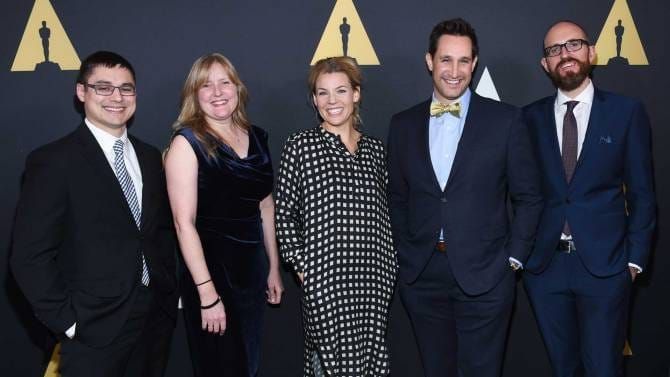
Sam Regnier wrote the original screenplay “Free Agent” which won a 2015 Nicholl Fellowship in Screenwriting and has been set up at CBS Films. Recently Sam and I had an excellent phone conversation in which we covered a lot of territory, his background and how he got into writing, a deep analysis of “Free Agent”, and a discussion about the writing craft.
Today in Part 6, Sam offers some thoughts on the craft of screenwriting and advice to aspiring screenwriters:
Scott: How about dialogue? Your script is great in that regard. The characters really pop on the page, and of course, that’s super important when you’re writing a character-oriented piece. Of course, we hear writers all the time say, “Well, you either have that ability or you don’t.”
How do you go about finding your characters’ voices? Do you think it’s possible to develop an ability to write dialogue?
Sam: I think so. It’s difficult to differentiate dialogue, for me, from any other quality of writing because I didn’t do anything different to develop that skill. It wasn’t innate — my dialogue was not very good when I started, and it got better with time.
I am especially prone to giant blocks of dialogue, which can be helpful. I don’t do any editing on my first pass, so my scripts are incredibly long, and every conversation is interminable because each character is saying a soliloquy followed by another soliloquy.
But it’s helpful, because usually in there somewhere, there is one line that is interesting. You have to cut, cut, cut, reword, reword, reword, obsessively until you find an eight word snippet that works. Then you string together enough of those and you’ve got a scene. I’m obsessive about every line being shorter because I’m paranoid about my scripts being overwritten.
You want your characters to be able to express themselves extremely concisely and get their points across, unlike real life. That’s really the only way that I know how to do it: to overwrite everything and then to see if, in those ten lines of dialogue, there’s one kernel that’s really good.
Scott: Zero in on that.
Sam: Yeah, and then slice, slice, slice.
Scott: I’m wondering, because you said you had an early interest in poetry, I oftentimes…specifically scene description. I’ll say, “To me, the best scene description reads more like poetry than prose.” Do you ever circle back to your instincts? In terms of poetry, that concise language and really trying to choose the exact words that are going to convey the most visual and emotional meaning?
Sam: Yeah. That’s something that I have focused on much more recently, because when I was even writing “Free Agent,” I was extremely logistical with the scene description. I really wanted the writing to feel extremely clean and very tight, for the script to have a certain pace.
As I’ve written more, as I continue to try and grow as a writer, I realized that a lot of times the poetry of it is more important than the logistical aspect of it.
Instead of trying to use five lines to describe an entire room, if you describe a single detail on the wall, it’s so much more effective in portraying the feeling that you want with your audience.
You can’t denigrate screenwriting if you want to be a good screenwriter. It’s a very easy thing look at a screenplay and to think, “The audience is never going to see it, and so the artistry of it doesn’t matter.”
That’s a really big mistake because the art of a screenplay is the ability to create a world that the actor and the director and the cinematographer and the art director can all see and they can all reference together, so that when it comes time to construct it everyone involved in the project is on the same page and living in same world that you created.
You can only do that by using poetic language and trying to imbue the script with something that’s more than “Ted walks to the door. Ted opens the door. Ted exits. Ted closes the door.”
While that may cover your bases in terms of physically what happens on-screen, it’s not going to create a world that people are going to want to inhabit with you.
Samuel Regnier, Amy Tofte, Elizabeth Chomko, Anthony Grieco, Andrew Friedhof
2015 Nicholl Fellowship in Screenwriting winners
Scott: You mentioned a key word there, for me, too, which is emotion. You want to make the reader feel something.
Sam: Absolutely. When I started, I focused on becoming a very by-the-numbers writer at first, because I wanted to be very workman-like and straightforward. I didn’t want it to seem like I thought I was better than I was.
But what I realized is that when people read a script, they want magic. People are paying for the magic, for something to leap off the page, and you can’t be afraid of that.
Scott: That leads me to a final question here, for you. Back to Stephanie Allain, what she was talking about in the Nickel speech. Before she got to you, she was talking to all five of the winners. She implored you to “keep your distinctive voice.” I’m sure you’ve gone on bottled water tours, and you’ve got a deal in place.
For better or for worse, obviously for better, ultimately, from a career standpoint, you’re inside the bubble now. The 405, 110, the nexus. Have you thought about that? How do you intend to keep your distinctive voice, and how should aspiring writers out there try to nurture their own distinctive voice?
Sam: You just have to remember that it’s not good enough to write something that’s good. And I don’t think it’s possible to write something great, something special, that’s not distinctive to you.
You’re talking about taking ideas from your head, writing them in plain text for someone else to direct and act and build sets and all the rest. The idea has to go through so many hands — like a game of telephone — and the only way it can make it to the end without getting mangled is if it resonates in each person along the way. And the only way to make it resonate in each person is to have it resonate in yourself. And if you do that, and you’re really lucky, maybe it can resonate with each person in the audience.
You can’t fake it. It doesn’t fake, not if you want to be able to do it again and again, to make a career.
If you want to write great stories continually and stuff that other people can’t do, then it has to be personal. You’re fishing in the same communal pool of ideas as everybody else, and the only way to protect yourself from serving up stale or duplicative work is making sure that everything you write is personal in some regard.
If everything I write comes from someplace personal — a place of real emotion — I know that at least I’ve done as much as I can do.
For Part 1 of the interview, go here.
Part 2, here.
Part 3, here.
Part 4, here.
Part 5, here.
Sam is repped by Paradigm and Management SGC.
Twitter: @dadbasic.