Interview: Rajiv Joseph and Scott Rothman (“Draft Day”) — Part 3
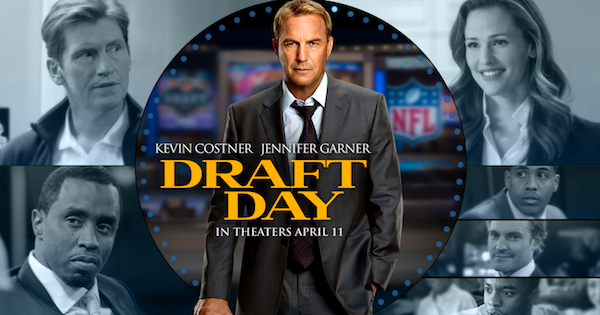
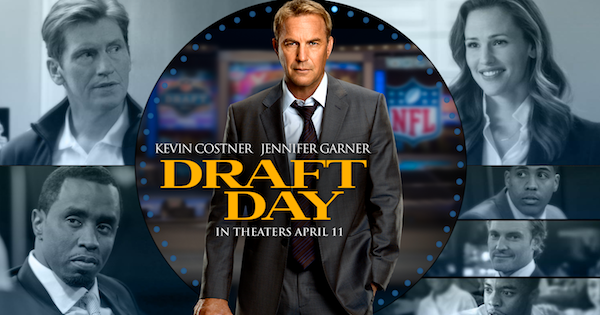
Rajiv Joseph and Scott Rothman wrote the script Draft Day which landed at the top of the 2012 Black List. Subsequently Lionsgate produced the movie starring Kevin Costner, Jennifer Garner and Dennis Leary, and directed by Ivan Reitman.
In March, 2013, I interviewed Rajiv and Scott while they were in Cleveland during the film’s production, and I’m happy to share that wide-ranging conversation this week as Draft Day opens in theaters nationwide this Friday, April 11.
Today in Part 3, Rajiv and Scott discuss the appeal of telling a compressed time frame story and a real-life parallel to the choice facing the Protagonist of Draft Day — what player to pick with the #1 selection in the NFL draft:
Scott M: Now you mention how the minute you came up with this idea for Draft Day, you said, “Compressed timeframe, let’s do this story…” basically it takes place in one day. And because it all boils down to the first pick in the draft, there is a built-in ticking clock. Literally they’ve got to make a choice, a draft pick, and you even amp that up a bit because Sonny puts pressure on everybody to try and find out information on the star collegiate quarterback Bo Callahan, who’s a lock for the number one draft pick. What were your intentions there? Was that just strictly about creating a pressurized atmosphere or you thought it would be fun to write?
Scott R: I think it was inherent in the idea. You’re always looking to invent a ticking clocks to some degree, and that was one of the amazing things we knew as soon as the idea pop up that we had that, that we didn’t…that was completely organic to the story. There literally is a ticking clock. That was half the work was done for us just in coming up with the idea.
Scott M: You know what’s interesting too, because in some ways the script reads like an action film. You’ve got this driving pace to it because of all this pressure, and then you’ve got another set of narrative devices, split screen and film clips of pro’s in action which you intersperse, combined with a lot of short scenes, clipped dialogue, walk-and-talk scenes. How conscious of creating that type of pace were you?
Rajiv: Like I said one of the first things we had was that it was going to be in one day and so that compresses the action to such a degree that we had to make sure that not only is every scene popping out but that it’s ramping up as the stakes go higher and larger with every scene. That was the mandate we set ourselves from the beginning. I don’t think we ever looked at it as an action movie per se, but it’s got the same feel as that quite naturally, because action movies are the movies that probably have the most ticking clocks.
Scott R: The way I thought about how we wrote it, I’m not sure if Rajiv agrees or not. But we always knew what the big turns of the script were going to be, and there was so much stuff to get to those turns that it just naturally fell into place, that pacing. Like I knew where the midpoint was, the end of the second act was, and I knew ultimately what our ending was going to be, and that was a lot of stuff to pack into a day, or as it turns out, like 10 hours. I think trying to get to those big act breaks, we felt that sense. We felt the pressure of getting to the act breaks. A lot of things needed to happen in order to make the act breaks make sense and be organic and not feel completely contrived. We didn’t want to get into a situation where we’re just putting lots of turns in there just because we needed a turn.
We felt a lot of that pressure, like, “Oh my God, we only have 30 pages to get to this point. How’re we ever going to get there?” I think that really came through in the final product.
Scott M: I want to drill down a little bit more into this idea of putting pressure on the protagonist because you not only have all those things, the compressed timeframe, the ticking clock, the civic pressure, but there’s a lot of stuff going on in Sonny’s personal life. You’ve got a relationship with his mother which is fairly contentious. He discovers that this woman Ali is pregnant with his child. He’s got this pressure on whether to pick this seemingly once in a lifetime quarterback with the number one draft pick or not. How did you know this is the right amount of subplots to put to work on this protagonist?
Scott R: Good question. The short answer is we’re just geniuses, Scott…
[laughter]
Scott R: …we just know these things. No, that’s not the answer at all. We spent a long time. We spent a year outlining this and figuring out beat by beat how this would work. It had to work out that…It had to be believable that things would happen at this place, at their office. We interviewed a real NFL GM and he gave us a lot of valuable information about what his moment to moment day was like on the day of the draft, as well as his day to day life outside of the draft, his relationships with players, his relationship with his scouts, his relationship with the staff.
Then, the fun part for me also was thinking about this as a guy who was dealing with the death of his father on the same day he’s dealing with the news of himself becoming a father. That’s a giant dramatic quandary that you don’t even need the NFL draft to add it to but luckily this was like our subplot.
It was a concern early on about keeping too much stuff, like let’s say, for example, Sonny could have been in financial straits as well, but that felt too much and unnecessary. But there was a lot of back and forth, and you just figure out and calibrate like, OK, how much can one guy take, and at what point is too much too much?
Scott M: You mentioned that you spent like a year outlining this thing. One of the most impressive features of the story is there are a lot of interesting twists and turns. We all know where it’s heading, which is toward the actual draft pick. But there’s a lot of wheeling and dealing going on multiple fronts, and that third act is filled with surprises. How conscious were you in aiming for that and how much of that evolved organically in your process of working through the story?
Rajiv: Like I said, to put the restriction of the one day on it, to me as a playwright, is something I think about a lot. In fact, it’s something that I struggle with, with screenwriting outside of draft day, I’m always thinking in terms of how do you compress the action as much as possible, and we knew we had this built‑in draft day contrivance that was like we know this is going to take place in less than 24 hours. Also, going back to what we said before, that this had to be a movie that appealed to people who didn’t even like football, and understood zero about what the NFL draft is about, that was a challenge. These challenges help you I think as a writer. The challenges that seem to be obstacles in your way end up being the things that help you write a better script. I think we were very openhearted about, “Let’s just make sure that any problem we’re having turns out to be a gift in reverse.”
Scott M: There’s a dynamic at work in the story about the job of a general manager, the tension between rationality, using one’s brains to make a decision, and just pure luck.
Scott R: Yeah, absolutely. As sports fans, Rajiv and I have always been fascinated by just which way the ball bounces, that one person’s career could be defined by one moment. It colors the way we look at a 15 year career, like Chris Webber calling timeout in college during the Michigan game defined the way everyone thought about Chris Webber. He went on to be arguably one of the 50 great players of all time, but when I think of Chris Webber, that’s all I think about and how his career could have been different if just that one little thing hadn’t happened. For me, one of the big inspirations was…I don’t know how big a football fan you are, but Ryan Leaf was this guy who went number two in a year that Peyton Manning was drafted.
Scott M: The San Diego Chargers.
Scott R: Yeah, that was one of the big things that was driving the way I thought about this story. Why didn’t Ryan Leaf happen the way everyone though he would happen? Then, on the other side, could there be a person who could have seen that he wasn’t going to happen? Because I figured you ask all 32 teams that drafted that year, they all would have taken Ryan Leaf where they took him. But I was fascinated by, what if there was a guy who could see what the flaw in Ryan Leaf was? Then, OK, if there was a guy like that, what did he see? I’m not sure anyone ever gave us a great answer to that question, and that’s something we really at least tried to explore in the script.
Rajiv: Similarly, a lot of the idea of the movie is about character and identity. I’m a big believer that, especially for a national football league team, the teams that I like generally are the teams that are successful year in and year out. That lead us to talk about Ray Lewis who is definitely inspiration for Vontae Mack. Ray Lewis embodies the Ravens franchise in a way that transcends good playing, and he went 26th in the draft the year he was selected, and there were three linebackers taken before him. Who missed the boat on that one? Everyone. If someone had known it, what would they have done differently?
Scott R: Probably my favorite movie of all time was The Hustler, the Paul Newman movie. There was big inspiration I think for both of us as we were writing. That movie’s ultimately about character and, particularly when we were first telling people about the script and people were first reading it or hearing about it, they all were trying to put us in the Moneyball category, which I could see. It’s such an honor. We both loved that movie and Sorkin is one of our favorite writers. But, to me, I always saw this as the exact opposite of Moneyball, that Moneyball is really about math and statistics and how you can use numbers to forecast what’s going to happen. To me, what we were trying to explore is, “How can you tell what a person’s going to do based on who that person is? Can you quantify a person’s character?”
Scott M: I hope it’s still in the movie, but that little green piece of paper that Sonny writes something down on at the very beginning. Later on, we learn what he’s written, which speaks to his ultimate choice, why he makes the number one draft pick he does. It’s his insight into the character of both of those players, preferring someone he believes has a solid character, as to someone that he’s not quite sure. Isn’t that right?
Scott R: Yes, absolutely.
Tomorrow in Part 4, Rajiv and Scott discuss plot twists and turns, not only in the movie Draft Day, but how it came to be produced by Lionsgate, and the surprise of learning their script topped the 2012 Black List.
For Part 1 of the interview, go here.
Part 2, here.
Rajiv is repped by Gersh and Kaplan / Perrone.
Scott is repped by CAA and Kaplan / Perrone.
Twitter: @scottmrothman, @RajivAJoseph, @DraftDayMovie.
Comment Archive