Interview (Written): Ava DuVernay
The prolific writer-director-producer goes deep in this conversation.
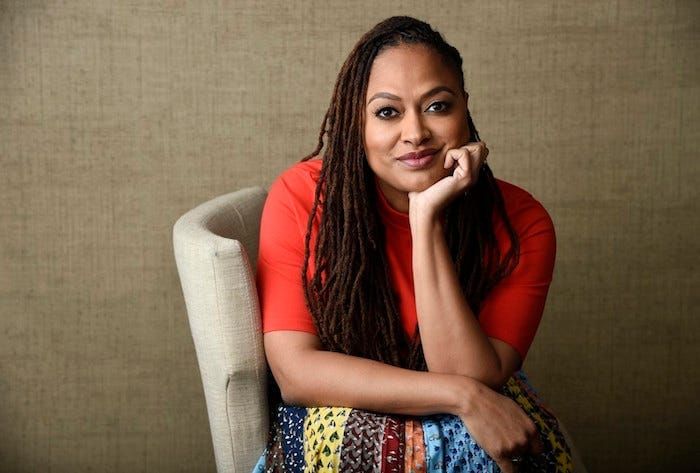
The prolific writer-director-producer goes deep in this conversation.
From The Atlantic, an excellent interview powerhouse writer-director-producer Ava DuVernay whose credits include I Will Follow, Middle of Nowhere, the award-winning movie Selma which she directed, the TV series “Queen Sugar” which she created and exec produces, the documentary 13th which she wrote and directed, and the A Wrinkle in Time, due out in 2018, a major motion picture she directed.
Green: I want to talk to you more about your experience as a businesswoman. You described yourself as a “weekend warrior,” when you were first starting out in filmmaking and didn’t attend film school. What do you hope that people take away from your experience when they think about the entertainment industry at large?
DuVernay: Just that the most important thing is the “thing,” not all the stuff around the thing. If you say you’re a filmmaker, then focus on your story and your filmmaking as opposed to the industry. When I started I wasn’t focused on the industry, and I wanted to make my thing, and I wanted to get it out in any way that I could. Yes, I would work and I would write on the weekends. I made my own little films with my own money that I pieced together. I would distribute my work on my own and go around to DVD stores and record stores and sell my own DVDs like E-40 out of the trunk of his car. It wasn’t really dissimilar. It was like trying to hustle these movies and play these tapes. The joy that I got by showing my films at a small black film festival in North Carolina or Seattle is the same joy that I get — I can’t convince people of this, but I know it’s true in my heart — when I show it at Sundance or Toronto or Venice.
Walking into a theater and seeing people watch my first film I Will Follow is the same feeling that I get seeing people watch Selma or 13th. The conversation around Queen Sugar on social media is a completely new phenomenon, and it shows me that there are always new ways to reach people and share my stories. If there’s anything my path can help people understand, it’s that you can have joy in the work, as opposed to, “I need an agent, I want to walk the carpets, I want the magazines, I want to be Issa Rae, I want to be Donald Glover, I want to be Ava.” None of that [success] happened to them because they wanted to be anyone else. It all happened because we were focused and enjoyed the process.
It doesn’t work for everyone. But let’s say no one ever wants to see anything you made, sang, painted, wrote, directed. If no one wanted to eat the food you made, but you had an amazing time in the kitchen making it, you loved it, you were tasting your own sauce, and you were chopping up the onions, and you got the chop down just right, and you enjoyed the meal … wasn’t it worth it? I just see so many people on the grind for the wrong thing. Don’t be on the grind for the fame. That’s fleeting; who cares. Be on the grind for the joy.
Green: I want to return to you hustling out of your car like E-40. You’ve made so many different kinds of work: a network television show, independent films, a documentary, multiple feature films, one of which, A Wrinkle in Time, has a $100 million dollar budget. How has navigating the business sides of these projects changed with their scale and exposure?
DuVernay: I’ve done feature films, narratives, or documentaries, a series on traditional linear television, a series on streaming platforms. There’s a film I did for the Smithsonian that you can only see when you walk in there. The beautiful thing is that I’m able to make my work at a time when the traditional walls have collapsed and everything is open and changing. You have Ron Howard who is across the pond shooting Star Wars, but he also shot a documentary and a documentary series that are both nominated for Emmys. He’s one of the biggest filmmakers, and yet he can go make a documentary series for television and no one blinks.
Twenty years ago, you couldn’t do that. Documentarians made docs, and TV people made TV, film people did film, and it was all segregated. People looked down on you when you crossed. Now, what a blessing that we’re in a world where literally I can make a movie of a certain price point at Disney and then my next project, Central Park Five, is for a streaming platform and it’s in five parts. A lot of the black women who came before me did not enjoy that flexibility. We’re at a time where there are no boxes. Martin Scorsese can do a commercial. A director of a television show can make an indie and be nominated for an Academy Award. I just feel fortunate, and I’m trying to step into the moment and take advantage of it.
For the rest of the interview, go here.
For my June 2013 interview with Ava, go here.
Twitter: @AVA, @TheAtlantic.