Interview (Written): Kiel Murray, Bob Peterson, and Mike Rich
The three credited screenwriters of the new Pixar movie Cars 3.
The three credited screenwriters of the new Pixar movie Cars 3.
A Creative Screenwriting interview with Cars 3 screenwriters Kiel Murray (Cars) and Bob Peterson (Finding Nemo, Up), both Pixar veterans, and Mike Rich, a first-timer with the animation company after having written such movies as Finding Forrester, The Rookie, and Secretariat.
At what point did Pixar decide it had the right story to go forward with Cars 3?
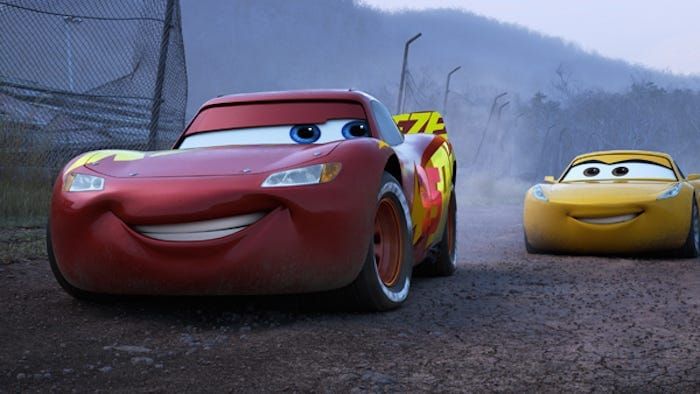
Kiel Murray: With these franchises you always want to know who it’s about. The first movie was about McQueen, and the second movie was a sort of off-ramp to the Mater story. We wanted to get back to the McQueen story. When we looked at what would be next for him, we wondered what that would be like both as an athlete, and also for what he was dealing with in the rest of his life.
Bob Peterson: Director Brian Fee, executive producer Jon Lasseter, Mike Rich, and story supervisor Scott Morse spent a lot of time in the early stages about three or four years ago talking about what would make a worthy sequel.
We had told the first two acts of McQueen’s life. In the first film, a rookie becomes a humbler racer. And although Cars 2 was a Mater film, it had McQueen at the top of his game. So we thought, “Well, why not go for the third act of any athlete’s life? What happens when you start declining, and how do you redefine yourself?”
Only then did we feel like this movie was really worth doing, because it might have universal themes that the audience could get behind.
Mike, you’re the rookie when it comes to Pixar in this group. How did you get involved with Cars 3?
Mike Rich: I got a call from Pixar. I think part of the reason they were expressing an interest in me — and I was thrilled with the prospect of working for them — was that I had worked on several films which had sports as a theme or sports as a backdrop. Also, my very first film, Finding Forrester, had a bit of a mentoring aspect to it as well. While they were very early on in the development and the brainstorming of this idea, those were two themes that they were interested in pursuing, so I think that’s why I got the call.
I came on board in late 2014, and ironically it came at a time when a lot of iconic athletes — Derek Jeter, Kobe Bryant, and Jeff Gordon — were beginning to consider what they wanted to do next. They were confronted with what every athlete is confronted with at some point: When should I hang this up? When is the moment in which I need to be looking at what the next step is for me?
That was the thing that was so interesting to me — giving McQueen that challenge and obstacle that everybody faces: That you’re not getting any younger.
The “aging sports star” story has a natural arc. Why do you think it was time to do this story with Lightning McQueen?
Mike: I think it represents a universal truth — not just in sports. In this day and age so many of us are wrestling with a changing landscape in our lives and work. Sometimes we feel that if we don’t find a way to adapt, get smarter, or fit in with what’s happening in our careers, that we’re just going to be simply forced out, and probably not on our own terms.
We have a line that pops up more than once in the film, where Lightning says, “I get to decide when I’m done.”
I looked back on the first Cars at the relationship that McQueen has with Doc Hudson, who was his mentor. Doc was forced out of racing because of a crash, and McQueen finds himself in that same situation in this film. That to me seemed like such a natural progression in the story.
When I read this interview, I was struck by three themes which I’ve seen over and over and over again as I’ve immersed myself in all things Pixar:
- Their stories are about relationships. As Peterson says: “All of our films are about relationships, and we felt like the franchise could use a new character that would push McQueen to evaluate who he needs to be by the end of the film.” Relationships are between characters and its that character development which lies at the heart of the Pixar story-crafting process.
- They tell stories which have clear universal themes. Peterson says this several times in the interview: “Only then did we feel like this movie was really worth doing, because it might have universal themes that the audience could get behind… [talking about the movie Up] We all have a grandfather, husband, wife, or grandma, and the idea of loss — how you deal with loss and how you move forward — is universal… It’s the universal theme of loss mixed with crazy fun.” Pixar chief John Lasseter only gives his okay to move forward with any project if he determines the story has clear universal themes.
- They are laser-focused on story, story, story. Murray point blank says this: “I am sure it’s been over-said that it’s preached everywhere at Pixar that ‘Story is King,’ but it really is true.” I think this observation by Rich, who experienced the Pixar process for the first time, gets at the spirit of storytelling which infuses the company’s creative process:
I cannot tell you how many times when I hit a bump in the road on Cars 3, Scott Morse or Brian Fee would say, “Well, let’s get the story team together! How’s after lunch?” We would go in that room and it would be this embarrassment of riches of ideas that would just pour down. In that regard, the Pixar experience was unlike any other that I ever had.
Three great writing takeaways. For the rest of the interview, go here.