Interview (Written): Max Borenstein (“Kong: Skull Island”)
A Creative Screenwriting interview with ‘Kong: Skull Island” co-writer.
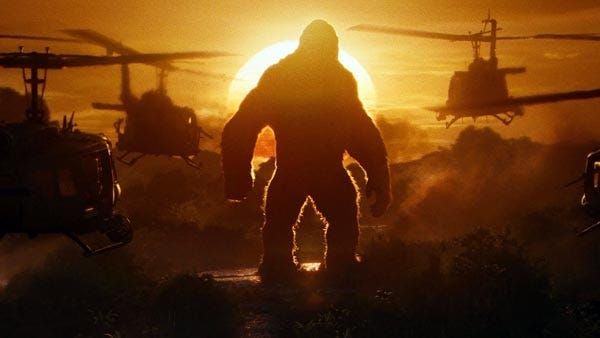
A Creative Screenwriting interview with ‘Kong: Skull Island” co-writer.
A revealing conversation with Max Borenstein whose writing credits include Godzilla, the TV series “Minority Report”, and Kong: Skull Island.
Kong is one of the most recognizable icons of cinema. Is there anything you specifically wanted to do in Kong: Skull Island that hasn’t been done with Kong before?
The beginning of this project was when we were in post on Godzilla. Producer Thomas Tull asked me if I was interested in doing a King Kong movie that would ultimately lead to Kong colliding with Godzilla.
I thought about it, and I felt like the “Beauty and the Beast” King Kong-type film had been done a lot recently. That wouldn’t work as a lead-in for a movie universe where giant monsters had been existing unnoticed. For one thing, Kong dies at the end of that story. For another, there’s an archaic tint to the old Kong movies in terms of the treatment of the natives and the damsel in distress which isn’t contemporary in its tone.
What popped into my head for the paradigm of the movie was Apocalypse Now. That’s obviously a war movie, but I liked the idea of people moving upriver to face a misunderstood force that they think of as a villain, but ultimately they come to realize is much more complicated.
I pitched the idea of a movie that was going to begin during the Vietnam War and then jump ahead to the present day. The reaction I got was, “That sounds great, but how could it be that an island could be undiscovered this long in the second half of the 20th century?” That was felt to be a logical hole.
So I went back and set the film before the first King Kong movie in 1917 during World War I, but it was the same Apocalypse Now concept. We then redeveloped it again into a present-day story.
So we had these two versions, but we didn’t have a director yet. Jordan Vogt-Roberts was scheduled to come for a meeting, and he and I had lunch to get to know each other. He wanted to know how we could make a Kong movie fresh, and he was intrigued by my Apocalypse Now take and went in to meet about it. He not only pitched them the Apocalypse Now version, but also pitched setting it just immediately after Vietnam and keeping it there.
They liked the idea, and that’s the direction the movie took from there. It took a strange, circuitous route back to being the initial impulse by thinking our way through the logic concerns.
One of the challenges of writing a film like Godzilla or Kong: Skull Island is finding the right balance between the human characters and their conflicts and the gigantic beasts. Can you talk about finding that balance?
That’s always a huge challenge of writing any of movie with non-human IP. But especially so in the cases of Godzilla and Kong because the creatures are so big. Literally, their scale is so large.
Actually, in traditional King Kong movies the scale is easier, because while Kong is larger and scarier than the people, he’s still small enough that can interact with people and even fall in love with a human woman. She can also feel empathy and love for him.
That’s something you just can’t do when the scale of the creature is so large, which is around 300 feet in this film. It becomes like a building falling in love with a person, or a person falling in love with an ant.
However, you still have awe and wonder, and you end up dealing with themes like nature and the environment, which is something else that has a scale that outsizes us. But it becomes challenging to keep your heroes involved in a way that gives them agency in the action when at the end of the day Godzilla or Kong could just kill twelve people with the flick of a fingernail. [Laughs]
In this film, there is a large ensemble of people who each offer their own perspective. Because of the nature of the design, they’re probably underdeveloped individually. But hopefully as a mass they represent a group of individuals, and their relationships with this thing that represents the wonder and the unknowable, uncontrollable aspect of nature.
For the rest of the interview, go here.
Twitter: @MAXBORENSTEIN, @CreativeScreen.