Interview (Written): Michael Mann
Writer-director on the question: “Why is ‘Heat’ so great?”
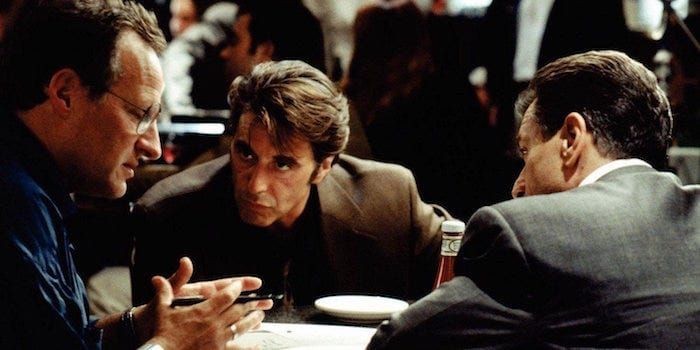
Writer-director on the question: “Why is ‘Heat’ so great?”
From Vulture:
Michael Mann’s broody pulp style has seeped into the groundwater of American pop culture so much that we often take for granted how influential his films are. Heat alone has influenced any number of subsequent action films, including The Dark Knight, The Town, and several others. This is partly because the film remains a creative peak for Mann, a testament to his skill as a filmmaker whose signature concerns are philosophical alienation fostered by corrupt or just ineffectual institutions, and the romanticism of being a disciplined loner in a world that encourages communal identities. It’s also one of Mann’s most viscerally satisfying films, and features several career highlights, like the two-hander coffee-shop scene, the now-iconic bank heist, and the concluding airport shoot-out. Just in time for the Blu-ray release of the newly restored “definitive director’s cut” of Heat, Vulture spoke with Mann about cocaine, Walter Hill, and prison.
In previous interviews, you’ve cited Soviet filmmaker Dziga Vertov as an influence. Vertov promoted a theory of cinema that goes beyond the human way of looking at things and into a mechanical, or perhaps superhuman view of events. I thought about that in relation to Heat because you do not view these characters or their behavior through a moralistic lens.
I was fascinated with a couple of things. One is human life in all of its dimensionality. That’s restricted, of course, in a drama like Heat, but it’s a lot more dimensional than archetypes. I’m really not interested in archetypes. In my research, I met a lot of people who are just gonna do what they’re gonna do. I believe [my characters] as people, and that allows me as a writer and director — and I believe audience members — to access them with more intensity. It leads us to believe them to a higher degree. That’s what I tend to be interested in. And, of course, when you’re making a film where worlds collide, you want the best characters possible. Characters who are quite extraordinary at what they do are attractive.
[Al Pacino’s] Hanna is a great detective. He’s a great hunter. I’ve met people who act like this, and they all tend to be very self-aware. Hanna is self-aware to the point where he knows that the concentration of trying to discover what he’s trying to discover — of getting to the person he’s trying to get to — that’s a high unlike any other. So he says to [his girlfriend] Eady at the end: “All I am is what I’m going after.” He know that he’s prioritized other deep parts of his life, and has basically left a mess behind him. And he will again. The concentration of purpose is what attracted me to him. And [Robert De Niro’s] McCauley is the only other person who’s as concentrated as Hanna. He’s from a different world, but with a similar focus.
One fascinating aspect of the research you and your cast did for the film is time spent talking to inmates in Folsom prison. That comes to mind once you know that McCauley wears an unassuming suit because he wants to blend in, or when you hear him say vocabulary words that indicate that he’s well-read, like penologist and iridescent. What kind of routine would you say McCauley had when he was in prison?
When I spent time in Folsom Prison, it was the end of the line. There was no Pelican Bay [State Prison]. If you were convicted to San Quentin, and you committed a stabbing or a murder in San Francisco or San Quentin, you would go to Folsom. So it was the end of the line. They had a very mature prison population, meaning that it was a dangerous place, but there was order to it. If there was a killing among prisoners, it was because somebody violated a known rule. It wasn’t just because somebody freaked out. So, sociologically, you could understand the rules that governed the place. If you broke the rules, it had tangible results.
McCauley’s routine would have been … people who are doing time have a strong ego, and a discipline. They’re either working on their bodies or their minds. They ask themselves: How am I going to spend my time? Am I going to become a vegetable? Why don’t I just commit suicide? If I’m not going to commit suicide, how am I going to do my time? What is time? The strongest-willed among them educate themselves. They read — and the cons sometimes are stunningly literate. And they’re literate not because they taught sophomore lit. They’re literate because they had fundamental questions they want answered: How should I view the present? They’ll get into philosophy; they’ll read Kierkegaard. You encounter people who have a fifth-, sixth-grade education — and by this time, they’ve been inside for five, six years — and they’re quite astute. I have a friend named Jerry Scalise who’s in prison right now. If you met him, you’d think he’s a retired English-lit professor.
Here is the famous coffee shop scene:
This scene is everything. Two characters. Complex. Text. Subtext. Incredible writing and acting. Love the hint of a smile the two share at the very end off of McCauley’s last line: “Or maybe we’ll never see each other again.” It’s as if both are laughing inside at that possibility… because there’s absolutely NO chance they will NOT meet up in the future. It’s clear from the dialogue in this scene… THAT is their mutual destiny.
For the rest of the interview, go here.