Interview (Written): Noah Oppenheim
A Creative Screenwriting conversation with the screenwriter of Jackie.

A Creative Screenwriting conversation with the screenwriter of Jackie.
From the latest issue of Creative Screenwriting,
So much of Jackie is about image control — with the reporter, planning JFK’s funeral, and even the first White House tour on television that was hosted by Jackie Kennedy. Can you talk about that aspect of the film?
One of the things that most fascinates me about her was that she was one of the first people to really have understood and used the power of television, imagery, and iconography for political purposes in the modern era.
People talk about how the first televised presidential debate between Jack Kennedy and Richard Nixon impacted the campaign. Well, when Jackie got into the White House she understood intuitively the impact that she could have by delivering this tour of the White House, and creating this illusion that she was welcoming the American people into their home and the power that those historical artifacts would have.
She then took that same sensibility into those dark days after the assassination, when she understood that her window to define how her husband would be remembered was closing. She knew that what the funeral looked like, and how it would be viewed on television both here and around the world, would go a long way towards cementing people’s memory and consciousness of what her husband’s presidency had meant.
One of the reasons why I wanted to write the film was because Jackie Kennedy has been written about and portrayed on television and film many, many times, but it’s almost always a very superficial approach. People are fascinated by her beauty and her sense of style, and they’re intrigued by her marriage, but I thought no one had ever given her proper due as being one of the primary architects of the Camelot mythology, and the way her husband’s presidency is now remembered.
Like so many women in history, she has been peripheral to the story that had been told. In fact, I thought she was central to it all.
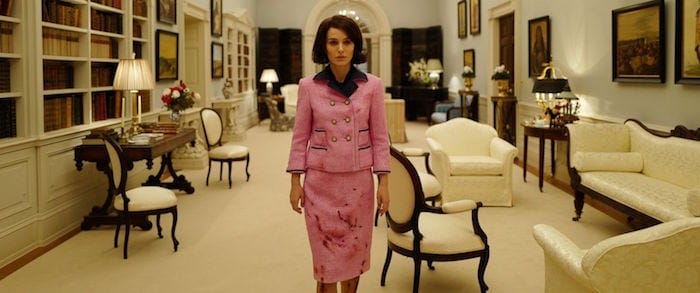
One of the few instances where she lets her guard down are in the scenes with the priest played by John Hurt. The dialogue in those scenes is just beautifully written. Obviously, you could be more creative when writing these conversations: what do you feel these scenes reveal about Jackie’s personality?
Those intimate, behind-closed-doors moments are where you have the most creative license. You get to really challenge yourself to try to capture what her emotional frame-of-mind might have been, and the kind of things that she would’ve been saying and debating with the people around her.
What I think that they reveal is that she was obviously presenting difference faces to the world depending on the context, as we all do. I think there’s an additional layer of complexity when you’re a public person, but we all behave differently when we’re with our family or in the workplace.
In the film, you see different faces of Jackie — the way she relates to her children, the way she relates to her old friend and employee Nancy Tuckerman, and the way she relates to The Journalist. With the priest, you’re seeing her relate in a raw, unfiltered fashion and really acknowledging and admitting the depths of her despair in the way that she doesn’t with other people.
I think it’s important to point out that while the dialogue in those scenes is obviously imagined, it is rooted in ideas that we know that she was grappling with in the aftermath of the assassination. She wrote letters to certain members of the clergy, and grappled with a loss of faith and perhaps a lack of will to keep living.
We wanted to dramatize and capture that crisis that she was going through. As strong as she appeared to the outside world, she had obviously endured this extraordinary trauma and was deeply shaken by it.
For the rest of the interview, go here.
Twitter: Creative Screenwriting, @noahoppenheim