Interview (Written): Taylor Sheridan (“Hell or High Water”)
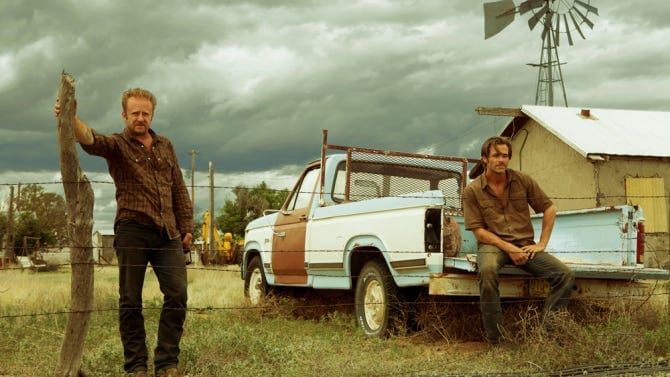
A WGA interview with actor (“Sons of Anarchy”) turned screenwriter Taylor Sheridan whose writing credits include two movies: Sicario and Hell or High Water:
Many actors have confided that the only power they really have is the power of choice — what will they say yes to, what will they turn down.
Right. So you write a screenplay to make some new choices.
And then you don’t act in the films you write. Explain.
By the time I started writing, I’d been losing my interest in acting for a long time. I know the story about the actor who isn’t happy with the roles he’s being offered, so he goes off and writes himself a great part. That’s not what I was doing. I didn’t want to act. I wasn’t writing roles for me. I never was. I was interested in telling great stories — and the time being a screenwriter would allow me to spend with my family. When I’m acting on a show, I’m gone all the time. When I’m writing a screenplay, I’m down the hall from where the kids are playing. Turns out, I’m a better writer than actor anyway!
Ben Foster and Chris Pine in Hell or High Water
You got good faster than one might have reasonably expected. What were some of the things you kept in mind, writing Sicario and Hell?
Most of the acting jobs I’d had were in television. Television is very plot-driven, usually. Plot, to me, is one of the least interesting parts of watching a film. My favorite films — and the kinds of films I like to write — are the ones that don’t sweat over plot, that spend as little time as possible on plot. The best movies are the ones that keep the actual story incredibly simple. The simpler the plot, the better the film.
What were some of the cardinal sins committed by the mountain of terrible scripts you read as an actor?
One of the biggest challenges facing the screenwriter today is this idea that everyone in the audience has got to fully understand what’s going on at all times. That is absolute death. On a basic level, that means you’re removing all complexity and ambiguity. Everything is stripped down to its simplest component. It’s all utility at that point, like a bunch of prefab parts you’re clicking into place. You’re building a machine, basically. On another level, if everyone in the audience has to understand everything at all times, you’re also adding an awful lot of “clunk” to your script — unnecessary exposition, awkward dialogue, scenes that are meant to spell things out for an audience and end up being incredibly redundant. You lose all grace in your storytelling if you’re trying to write something that every person is going to instantly “get.” I’m much more interested in taking my time, in leaving things to simmer as long as possible, in allowing characters to be everything that they might be — not just good or bad. And if you can identify my politics from one of my movies, I’ve done a terrible job. An audience has to do some of the work. That’s where the fun is.
A trailer for Hell or High Water:
For the rest of the WGA interview, go here.