Movie Analysis: “Creed” — Themes
Another in our bi-weekly series in which we analyze movies currently in release. Why? To quote the writing mantra I coined over 5 years ago: Watch movies. Read scripts. Write pages. You will note which one comes first. Here are my reflections from that post about the importance of watching movies:
To be a good screenwriter, you need to have a broad exposure to the world of film. Every movie you see is a potential reference point for your writing, everything from story concepts you generate to characters you develop to scenes you construct. Moreover people who work in the movie business constantly reference existing movies when discussing stories you write; it’s a shorthand way of getting across what they mean or envision.
But most importantly, you need to watch movies in order to ‘get’ how movie stories work. If you immerse yourself in the world of film, it’s like a Gestalt experience where you begin to grasp intuitively scene composition, story structure, character functions, dialogue and subtext, transitions and pacing, and so on.
Let me add this: It’s important to see movies as they get released so that you stay on top of the business. Decisions get made in Hollywood in large part depending upon how movies perform, so watching movies as they come out puts you in the same head space as reps, producers, execs, and buyers.
This week’s movie: Creed, screenplay c-written by Ryan Coogler and Aaron Covington, story by Ryan Coogler, based on characters by Sylvester Stallone.
Our schedule for discussion this week:
Monday: General Comments
Tuesday: Plot
Wednesday: Characters
Thursday: Themes
Friday: Dialogue
Saturday: Takeaways
For those of you who have not seen the movie, do not click MORE as we will be trafficking in major spoilers. If you have seen Creed, I invite you to join me in breaking down and analyzing the movie.
There are several key themes which run throughout Creed, but the central one has to be Father-Son. While Apollo Creed is formally absent, his presence looms large in the story. Donnie watches videos of Apollo’s fights. He frequents training rooms where Apollo used to work out. Even Donnie’s last name, which he tries to avoid using, is a reminder of his father. It’s like Apollo is a ghost looming over Donnie’s every move, even following him to Philadelphia.
Yet even though Apollo is seemingly everywhere, he is not there. And that void lies at the heart of Donnie’s psyche.
Thus he seeks out Rocky, a fighter forever tied to Apollo Creed. Despite the fact Donnie immediately takes to calling him “Unc” (for Uncle), symbolically Rocky becomes a surrogate father figure. While this psychological dynamic is clear as it flows from Rocky to Donnie, it takes on a whole other layer of meaning when Donnie takes to ‘fathering’ Rocky. Apollo may not have been present for Donnie’s life, but Donnie will be present for his surrogate father’s brush with death. Donnie’s commitment to Rocky is not just about needing Rocky’s coaching or their friendship. It’s also about Donnie proving himself as an even better man than Apollo… because he is there.
This Father-Son dynamic between Donnie and Rocky reaches its peak in those critical moments just before the final round of Donnie’s fight with Conlan, where Donnie confesses his deepest darkest question to Rocky. Donnie had to go through everything he has in order to gain the trust in Rocky — and in himself — to share that most painful aspect of who he is and what he has grown up with his entire life: Feeling rejected by his father.
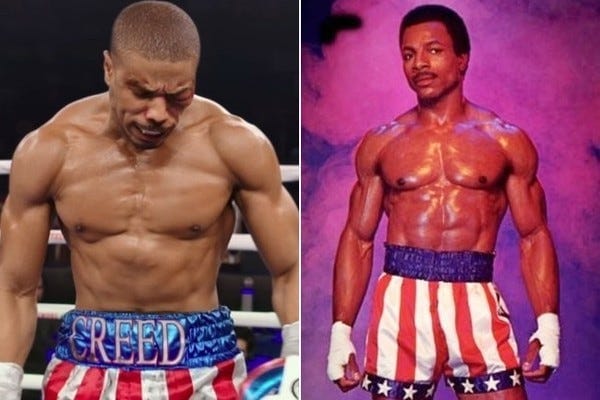
This Father-Son theme is at work in every single scene in the movie, either up top or down below. No matter where it plays, it’s there. Indeed, I would argue everything that happens services it enabling Donnie to confess what he’s never shared with anyone… then win the moral victory he does with Conlan, proving that he was and is worthy of his father’s love and acceptance.
And oh, by the way, this is about as universal a theme as there is: Father-Son, Mother-Daughter, Parent-Child. Each of us has to deal with relationship. One reason in my view why this movie generated the word of mouth it has and become a box office success. In other words, that stuff resonates!
How about you? What themes do you see in play in Creed?