Movie Analysis: “Star Wars: Episode VII — The Force Awakens” — Characters
Another in our bi-weekly series in which we analyze movies currently in release. Why? To quote the writing mantra I coined over 5 years ago: Watch movies. Read scripts. Write pages. You will note which one comes first. Here are my reflections from that post about the importance of watching movies:
To be a good screenwriter, you need to have a broad exposure to the world of film. Every movie you see is a potential reference point for your writing, everything from story concepts you generate to characters you develop to scenes you construct. Moreover people who work in the movie business constantly reference existing movies when discussing stories you write; it’s a shorthand way of getting across what they mean or envision.
But most importantly, you need to watch movies in order to ‘get’ how movie stories work. If you immerse yourself in the world of film, it’s like a Gestalt experience where you begin to grasp intuitively scene composition, story structure, character functions, dialogue and subtext, transitions and pacing, and so on.
Let me add this: It’s important to see movies as they get released so that you stay on top of the business. Decisions get made in Hollywood in large part depending upon how movies perform, so watching movies as they come out puts you in the same head space as reps, producers, execs, and buyers.
This week’s movie: Star Wars: Episode VII — The Force Awakens, screenplay by Lawrence Kasdan & J.J. Abrams and Michael Arndt, based on characters by George Lucas.
Our schedule for discussion this week:
Monday: General Comments
Tuesday: Plot
Wednesday: Characters
Thursday: Themes
Friday: Dialogue
Saturday: Takeaways
For those of you who have not seen the movie, do not click MORE as we will be trafficking in major spoilers. If you have seen Star Wars: The Force Awakens, I invite you to join me in breaking down and analyzing the movie.
Let’s consider two angles when it comes to the characters in this movie. First, let’s see if we can track all of the similarities between Rey and young Luke Skywalker from Star Wars: A New Hope because there are many.
The other thing is to consider what archetype functions the story’s key character’s provide. Here’s my take:
Protagonist: Rey
Nemesis: Kylo Ren, General Hux
Attractor: Rey’s departed family
Mentor: BB-8, Han Solo, Maz Kanata, Luke’s lightsaber, R2-D2
Trickster: Finn, The Force
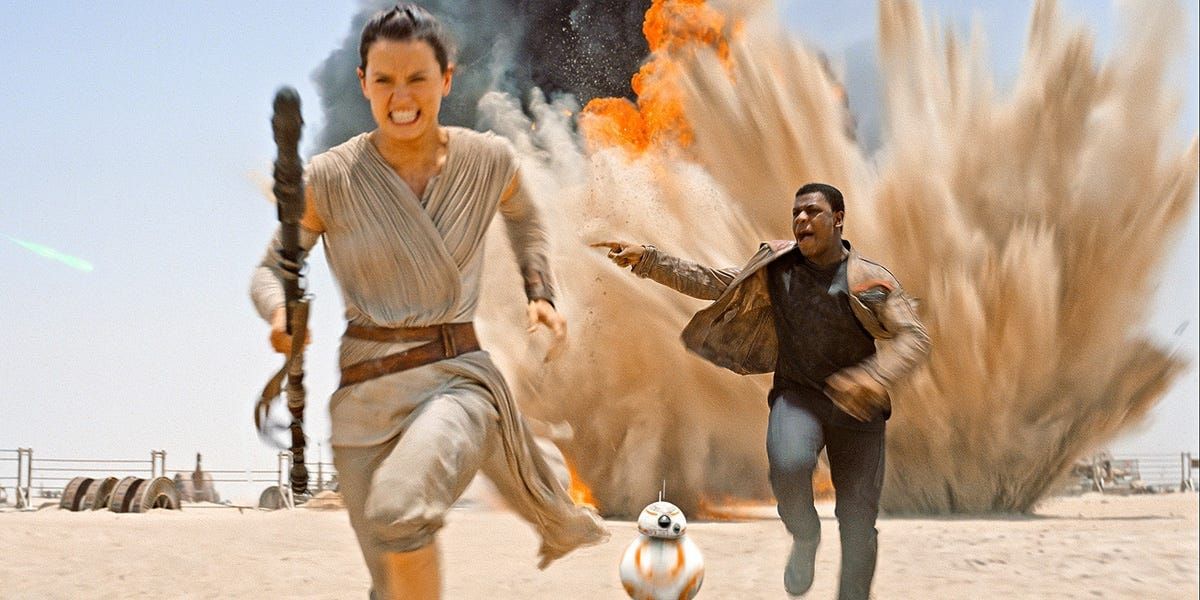
Even though the story begins with Poe Dameron and he has his own subplot involving the Star Killer, it’s obvious Rey is the story’s Protagonist. It’s her journey which constitutes the backbone of the narrative. The story devotes the most time to her External and Internal journeys. She’s the character who goes through the most significant psychological transformation. And as it becomes clear she is strong in The Force, her role becomes more and more significant.
Nemesis figures: Kylo Ren (directly) and General Hux (indirectly), leaders of the First Order, hell bent on destroying the last of the Jedi.
Let’s set aside Attractor for a moment and consider the various Mentor figures:
- BB-8: Carries the map which can help lead the Rebels to Luke Skywalker and the droid has intimate knowledge of events which have led it to Jakku.
- Han Solo: Takes on the role of the wise old man, even if he has his same edge as per his younger days.
- Maz Kanata: Has deep insight into Rey’s inner life and is the holder of Luke’s lightsaber.
- Luke’s lightsaber: When Rey touches it, the lightsaber reveals flashing images of past truths in Rey’s life.
- R2-D2: Reactivates late in the game, but holds the key to solving the riddle of the map.
As far as Tricksters go, Finn slots into this function quite easily, even down to his lies about being a Rebel fighter. He’s an ally — at first — only insofar as working with Rey can take him far away from the First Order and, indeed, heads off on his own, turning away from Rey and her cause. Then he returns and even volunteers to save her from being held captive by Ren, ultimately revealing himself to be a true ally.
Then there is The Force. Yes, it can be used for the Good, but it also has a Dark Side. Furthermore Rey has to adapt to the knowledge she has plenty of The Force within. At first, she’s not very good at using it, but over time she begins to master her Force-fueled powers.
Which leaves Attractor. Even though she has a touching moment with Princess Leia, a wordless hug to let Leia know she grieves for and with the General now that Han Solo is dead, that is their only moment together, so it doesn’t even qualify as a subplot.
No, I have to go with Rey’s parents as Attractor figures, the characters most connected to her emotional life. She has spent countless days on Jakku… waiting for her parents to return. She is deeply invested in the belief they will return. It is a crushing blow when she learns they won’t, causing great upheaval in her psychological nature.
As far as sequels go, it seems like Finn will take on the role of the Attractor and Luke will become a Mentor. Kylo Ren figures to continue to be a Nemesis figure. Perhaps Poe and Leia will take on roles which intersect more directly with Rey.
In any event, once again we see these five narrative functions — the forward moving Protagonist, the oppositional dynamic provided by the Nemesis, intellectual energy from the Mentor, emotional resonance from the Attractor, and a test of wills from the shapeshifting Trickster.
What are your thoughts about the characters in Star Wars: The Force Awakens? What parallels do you see comparing Rey to young Luke Skywalker in A New Hope? See you in comments!
Comment Archive