Movie Analysis: “Straight Outta Compton” — Characters
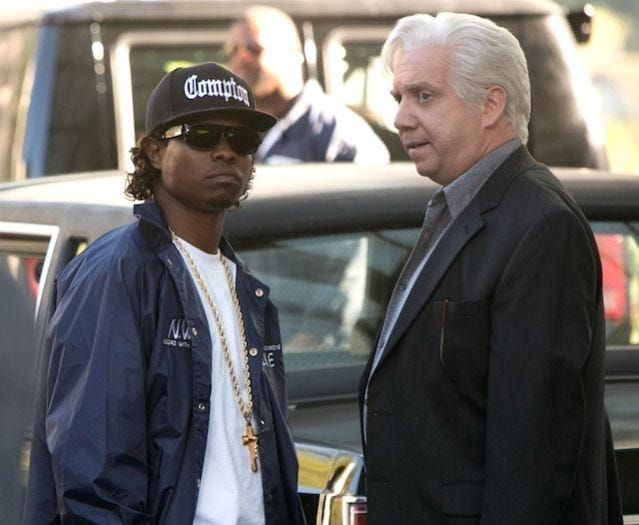
Another in our bi-weekly series in which we analyze movies currently in release. Why? To quote the writing mantra I coined over 5 years ago: Watch movies. Read scripts. Write pages. You will note which one comes first. Here are my reflections from that post about the importance of watching movies:
To be a good screenwriter, you need to have a broad exposure to the world of film. Every movie you see is a potential reference point for your writing, everything from story concepts you generate to characters you develop to scenes you construct. Moreover people who work in the movie business constantly reference existing movies when discussing stories you write; it’s a shorthand way of getting across what they mean or envision.
But most importantly, you need to watch movies in order to ‘get’ how movie stories work. If you immerse yourself in the world of film, it’s like a Gestalt experience where you begin to grasp intuitively scene composition, story structure, character functions, dialogue and subtext, transitions and pacing, and so on.
Let me add this: It’s important to see movies as they get released so that you stay on top of the business. Decisions get made in Hollywood in large part depending upon how movies perform, so watching movies as they come out puts you in the same head space as reps, producers, execs, and buyers.
This week’s movie: Straight Outta Compton, screenplay by Jonathan Herman and Andrea Berloff, story by S. Leigh Savidge & Alan Wenkus and Andrea Berloff.
Our schedule for discussion this week:
Monday: General Comments
Tuesday: Plot
Wednesday: Characters
Thursday: Themes
Friday: Takeaways
For those of you who have not seen the movie, do not click MORE as we will be trafficking in major spoilers. If you have seen Straight Outta Compton, I invite you to join me in breaking down and analyzing the movie.
I have already noted the narrative is structured to follow three Protagonist figures: Eazy-E, Dr. Dre, and Ice Cube. And as discussed yesterday with the four overarching movements in the plot — Rise, Tour, Infighting, Reunion — the amount of time the three spend together as a team tracks along with the flow of the narrative.
In Rise, they come together to form the group N.W.A. and do their first recordings.
In Tour, they travel the country and perform, experiencing the highs and lows of the road.
In Infighting, they split up and go their separate ways.
In Reunion, through Eazy-E’s overtures to both Dre and Ice Cube, the three make a move to do a reunion album, however E falls victim to AIDS.
The story doesn’t go into a huge amount of depth into the respective psychological makeup of each character, but they are distinct personalities reflected in how they mesh together as members of a musical group: Eazy-E is the businessman; Dr. Dre is the musical leader; and Ice Cube is the chief lyricist. More important is the life-experience they hold in common: Being a black man in a racially divided and bigoted society.
Interesting to note, there’s not really a specific individual in the movie who we could call an Antagonist. And yet if we think about the narrative function of a Nemesis figure, that is to provide opposition to the Protagonist(s), there are plenty of characters who don that ‘mask’ from scene to scene.
- The police pass the ‘baton’ — L.A., Torrance, Detroit, etc — in opposing the trio.
- Suge Knight very definitely acts as a Nemesis to Eazy-E.
- There are times when the three provide opposition to each other, particularly when they are recording and releasing albums which call out their ex-band mates.
That said, there are several Tricksters who don the Nemesis mask:
- Both Dr. Dre and Ice Cube are suspicious of Jerry Heller, and Ice Cube has a specific bone to pick with their manager.
- Bryan Turner of Priority Records provides opposition to Ice Cube who seeks out payment for his songs, providing a nifty opportunity for the rapper to ‘convince’ Turner to make amends.
- Suge Knight reveals his true colors as he goes all in with Death Row Records over and above his connection with Dr. Dre, the latter eventually cutting lose from Knight.
Perhaps the most interesting relationship of all is the one between Eazy-E and Jerry. E’s longstanding loyalty to Jerry, beyond even his relationships with Dr. Dre and Ice Cube, is a complex one. It feels like E and Jerry are ‘brothers,’ not due to their blood or color of their skin, but rather their connection as businessmen. This explains in part how E is blind to Jerry’s malfeasance for such a long time.
Finally there has been quite a bit of commentary about how Straight Outta Compton overlooks issues related to N.W.A. songs about and its members’ relationships with women such as this article. I knew nothing about Dr. Dre’s violence against women in the past — for which he recently apologized — so it was not something that stood out to me. However the female characters in the movie represent some of the weakest aspects of the story. The girlfriends and wives of the three lead males are handled in little more than perfunctory fashion, servicing the facts of history, but not much more than that (although to be fair, Eazy-E’s girlfriend does serve a key role in the plot in exposing Jerry’s financial misdeeds).
And yet as it is, the movie is 147 minutes long. Some of the toughest and most important choices in adapting a life story is what you choose to omit, and my guess is the filmmakers opted to leave out content related to women in order to focus on the interrelationships of Eazy-E, Dr. Dre, and Ice Cube, and N.W.A.’s place in the political and cultural environment.
What do you think of the characters in Straight Outta Compton?
Comment Archive