Movie Analysis: “Trainwreck” — Plot
Another in our bi-weekly series in which we analyze movies currently in release. Why? To quote the writing mantra I coined over 5 years ago: Watch movies. Read scripts. Write pages. You will note which one comes first. Here are my reflections from that post about the importance of watching movies:
To be a good screenwriter, you need to have a broad exposure to the world of film. Every movie you see is a potential reference point for your writing, everything from story concepts you generate to characters you develop to scenes you construct. Moreover people who work in the movie business constantly reference existing movies when discussing stories you write; it’s a shorthand way of getting across what they mean or envision.
But most importantly, you need to watch movies in order to ‘get’ how movie stories work. If you immerse yourself in the world of film, it’s like a Gestalt experience where you begin to grasp intuitively scene composition, story structure, character functions, dialogue and subtext, transitions and pacing, and so on.
Let me add this: It’s important to see movies as they get released so that you stay on top of the business. Decisions get made in Hollywood in large part depending upon how movies perform, so watching movies as they come out puts you in the same head space as reps, producers, execs, and buyers.
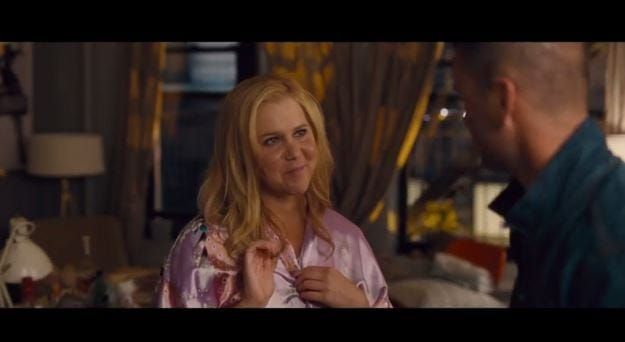
This week’s movie: Trainwreck, written by Amy Schumer.
Our schedule for discussion this week:
Monday: General Comments
Tuesday: Plot
Wednesday: Characters
Thursday: Themes
Friday: Takeaways
For those of you who have not seen the movie, do not click MORE as we will be trafficking in major spoilers. If you have seen Trainwreck, I invite you to join me in breaking down and analyzing the movie.
Girl meets Boy. Girl loses Boy. Girl gets Boy. In some respects, Trainwreck represents one of the most conventional narrative archetypes of all time. Which raises this question:
Why is this such a popular pattern, qualifying for the Trope Hall of Fame?
Let me posit a general theory on the subject:
* Girl meets Boy / Boy meets Girl: This has its roots in our collective sense and belief there is someone out there who is supposed to be our soul mate. From a consumer standpoint, the belief that is true is much preferable to, “I’m gonna screw around for a long time, then maybe I’ll end up with some two steps from douchebag individual who may be far from perfect, but at least I can put up with them.”
* Girl loses Boy / Boy loses Girl: I suspect this has it roots in two things. (1) Everything worth having is worth fighting for. (2) For these feelings to be Real, they have to be tested . Plus there’s this: If there’s no struggle with regard to the relationship, no ups or downs, that translates into… B-O-R-I-N-G.
* Girl gets Boy / Boy gets Girl: This is easy because Hollywood’s default mode is Happy Endings and the attainment of Boy / Girl in the end is the ultimate symbol of a positive resolution.
So let’s consider this: What if in Trainwreck, Amy had not met Aaron? In that case, the plot might have been this:
* Girl meets Boy: Steven the muscle-head stud-muffin.
* Girl accommodates herself to Boy: An unhappy marriage.
* Girl divorces Boy: And sets off on her own. And in that story, maybe she meets Aaron.
Nope, the Story Universe surprisingly deposits the feature magazine article on Dr. Aaron onto Amy’s lap which intersects her with the good doctor, then the rest is history.
This was Amy’s transformation-journey through which she had to go.
Did you find Trainwreck to be too traditional in terms of its narrative structure or was it a satisfying movie-going experience?
Please join me in comments to further analyze Trainwreck.
Comment Archive