Profile: Walter Murch (Part 4)
Our friend Trevor Hogg is back at FlickeringMyth with another profile, this one on famed film editor and sound engineer Walter Murch. Attentive readers know that I am fascinated about the relationship of editing and screenwriting, and in particular Murch’s ideas, as evidenced by previous posts here and here. How we, as writers, ‘cut’ shots, scenes, and transitions in script form can be a critical component in how the narrative flows, pace, visuality, and so forth.
Here are some excerpts from the fourth part of the profile on Walter Murch:
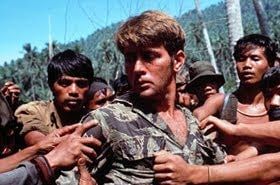
“It has become part of the culture,” observed Walter Murch on the Vietnam War saga starring Martin Sheen (Badlands). “As much as a work affects the culture, the culture mysteriously affects the work. Apocalypse Now, in the year 2000, is a very different thing from the physically exact-same Apocalypse Now in the second before it was released in 1979.” The New Yorker revisited the movie as a film editor and re-recording mixer at the behest of American filmmaker Francis Ford Coppola who wanted to produce a DVD version with a number of major scenes which were eliminated from the original theatrical release. “The film acquired a body in the absence of these limbs. Now we’re trying to sew them back on,” stated Murch of the project titled Apocalypse Now Redux (2001) which saw him insert the medevac scene involving the helicopter-stranded Playboy Bunnies, more scenes with Marlon Brando in the Kurtz compound, and the ghostly French plantation sequence featuring a burial, a politically charged dinner conversation, and a love scene. “[They] were casualties of the hallmark struggle in every editing room; how short can the film be and still work? Even though Francis had the final cut, he was as acutely aware as anybody of the strictures of getting a film into the theatres as lean as it could be. With the new version, that particular drive — for compression above all — is not as compelling.”
Searching for the proper visual and audio transitions between the original and new material called for a lot of creative ingenuity on the part of Walter Murch. “The burning helicopter — which before was just a passing scene — is the thing that causes the boat to stop at the medevac station, where we discover that the impresario Bill Graham, played by himself, and the three Playboy Bunnies are stranded. Willard negotiates with Graham, who needs fuel for his own helicopter. The problem was that the negotiation was never filmed — a typhoon hit with full strength on that day, and they had to abandon filming for a month or so.” To fill in the visual gap Murch decided to provoke the audience’s imagination. “We’re treating the moment elliptically. You see Willard wandering through the desolate camp, and we intercut his wandering with a fight that’s beginning amongst the crew of the boat. Then Willard is beckoned into one of the tents by Bill Graham. The fight escalates, Willard returns, stops the fight, and tells them about the deal he’s made; the crew can spend a couple of hours with the girls in exchange for fuel.”
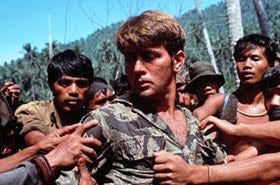
Another challenge was the inclusion of film footage which Eleanor Coppola lamented being cut from the original picture. “Probably the trickiest thing in this version of Apocalypse Now has been the French Plantation sequence and how to get into it — even trickier, how do we get out of it?” revealed Walter Murch. “It was something that completely foxed us back in 1978. Structurally, the scene always happened too late in the film; once the boat passed beyond the nightmare of the sampan massacre and Do Lung Bridge, it seemed to enter another world, and there wasn’t the physical, temporal, or even psychic space for a dinner-table discussion about the French involvement in Vietnam in the early 1950s. The viewer needed to arrive at the Kurtz compound as quickly as possible.” In the process of speeding up the pacing of the story, a major plot hole was incurred. “An important element of the French plantation is the burial of Clean — Larry Fishburne — who has just been killed in a firefight, the first crew member to die. If the scene came earlier, the burial would have to be eliminated. But burying Clean is one of the reasons for the boat to come to shore. It was a dilemma.” Murch added, “In the original version of the film you never know what happened to him, which is a little strange, and out of keeping with Chef’s obvious grief at losing someone who was like a son to him.”
Having never seen any of the raw footage for the sequence since his responsibilities for the original project had ended with the sampan massacre halfway through the production, Walter Murch discovered that Francis Ford Coppola had shot the approach to the plantation in two different ways. The first was a formal dockside introduction and the second involved “French soldiers materializing, bedraggled, out of swirling mist, as if they were ghosts.” Choosing that latter version, Murch had to figure out how to construct the departure. “I found a shot with Martin Sheen — Willard — and Aurore Clément where she gets out of bed, undresses, and closes the mosquito netting all around the bed. There was something beautifully evocative about her seeing her silhouetted against the mosquito netting, and I thought, ‘She looks like a ghost, and the mosquito netting looks like fog.’” The three-time Oscar winner experienced an epiphany. “When I discovered that transition, which was not intended in the script, something unlocked for me. I felt that I was beginning to grasp the language of this new version.”
Looking back on the extended cut of the picture, Walter Murch remarked, “This is the funny, sexy, political version of Apocalypse Now. Willard has a romantic interlude at the French plantation; Lance and Chef have theirs at the medevac station. There are political arguments about the French involvement in Vietnam, so similar to ours. And Kurtz questions the accuracy of how the war is being reported back home.” What terrified Murch the most was doing the final mix of the soundtrack. “We had to go back to the original masters, and find a way to reweave the fabric of the sound — so not only will the transitions into and out of the new material be perfectly undetectable but also the quality of the sound of the new sections will coexist on friendly terms, both artistically and technically.” To make the audio transitions as seamless as possible, original crew members Michael Kirchberger (The Sixth Sense) and George Berndt (The Usual Suspects) were recruited to help with the new soundtrack along with actors Martin Sheen, Robert Duvall (Thank You For Smoking), Albert Hall (Ali), and Sam Bottoms (Sugar Hill) who came back to re-record their dialogue.
For Part 1 of the Murch profile, go here.
For Part 2, go here.
For Part 3, go here.
For the rest of Part 4, go here