Reader Question: What does it mean to “workshop” a script?
My two cents worth based on years of leading writing workshops.

My two cents worth based on years of leading writing workshops.
Since I began teaching as a hobby back in 2002, then part-time, and now full-time as an assistant professor at the DePaul University School of Cinematic Arts, I have been involved in over 100 writing workshops. They have ranged from several week-long and weekend Black List Feature Writers Labs, four-day UCLA Extension Writers Studio intensives, semester long screenwriting classes at the University of North Carolina at Chapel Hill, quarter long advanced screenwriting classes at DePaul, and Prep: From Concept to Outline, Pages I: Writing the First Draft, and Pages II: Rewriting Your Script online workshops through Screenwriting Master Class. Fair to say I have some experience in this area.
In answer to your question, Esther, a workshop can take on any number of formats, but its central function is pretty much the same: A group of writers discuss, critique, and provide feedback on one or more of their stories.
What are some benefits of a writing workshop?
- As opposed to working in a vacuum, a writer receives creative input from other writers.
- Discussions can not only lead to identifying story problems, but also brainstorming ways to go about resolving the issues.
- When led by a capable mentor, writers come away with a focused plan of attack in crafting, writing, or rewriting their story.
Bottom line, workshops can help a writer identify what works and what doesn’t work in their story, and ideally come away with suggestions which they can use to move their creative process forward.
The quality of the workshop depends almost entirely on two factors: The composition of the participating writers and the experience, capabilities, and attitude of the mentor.
If the peer group involved doesn’t have much experience as writers and/or lack an understanding of story, then the feedback may not be helpful, indeed, may actually hurt a writer’s creative process, sending them down paths which may take the story away from where it ought to be headed. On the other hand, if it’s a knowledgeable group of writers, group advice can be enormously beneficial.
The role of the mentor is perhaps even more important as they can provide expert critiques and creative solutions. Moreover a good workshop mentor will foster a positive evaluative environment, one where participants do three things:
- Note what works in the story: This is not to heap praise on the writer, but rather to identify story elements which should be preserved or can be exploited to the story’s benefit.
- Identify problems: The workshop group ought to zero in on areas where the story needs improvement.
- Suggest potential solutions: Going one step further, a good workshop group will brainstorm ways to resolve story problems.
In my online Screenwriting Master Class workshops, the process goes like this:
- Each Monday, I post a lecture and accompanying content to lay out that week’s writing assignment.
- Each Sunday, the workshop’s writers upload their weekly pages for group review.
- Each week, the writers participate in a group teleconference in which I provide extensive feedback on their pages, then elicit a group discussion.
- At the end of the workshop, an exit conversation with me about the state of their story and advice on moving forward.
Week by week, writers move their stories forward toward FADE OUT, encouraged by their fellow writers and steered into and through the process by me as their mentor.
Circling back to the original question, the phrase ‘workshop a script’ can mean a variety of different approaches, but the goal is as noted above: To discuss, critique, and provide feedback on a writer or writers’ stories.
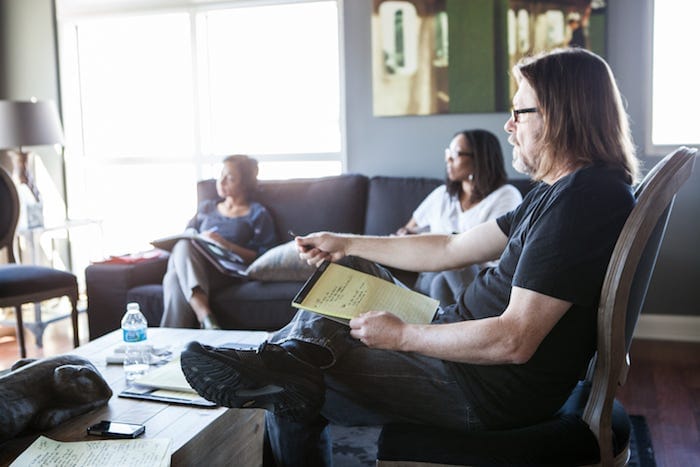
I love workshops. facilitating the process whereby writers go back and forth, ideas flowing one after the other, I almost always come away from a session feeling energized by the spontaneity of creative inspiration. In sum, I highly recommend workshops… especially if you work with me!
How about you, GITS reader? What’s been your experience in a workshop environment? Upsides? Downsides? Love to hear from you.