Reader Question: Will new technology cause script style to change?
Will reading scripts on tablets and smart phones impact screenplay style?

Will reading scripts on tablets and smart phones impact screenplay style?
Question via Twitter from Jim Snell:
Jim is talking about something like this:
Which is a far cry from the Old Days:
Fact: Screenplay style, even format is in a constant state of evolution. You can go here to read my post on how there has been a shift over the last two decades or so away from a ‘scripty’ style to a more ‘literary’ one. If you compare a contemporary screenplay with one written 30 or more years ago, you will see the following:
- Contemporary selling scripts do not include camera shots anymore, so gone are the days of LONG SHOT, MEDIUM SHOT, CLOSE UP.
- Contemporary selling scripts don’t have long blocks of scene description, but rather break them up into smaller paragraphs (2–4 lines).
- Contemporary selling scripts don’t have primary slug lines that extend over one line.
- Contemporary selling scripts don’t include directing jargon.
More white space, less black ink. Use lines and paragraphs to suggest individual camera shots without using camera lingo. Scripts are becoming more readable, more ‘literary’ and less a blueprint to make a movie.
With that as a framework for discussion, let’s consider the impact of reading scripts on tablets and especially smart phones. With the former, you can adjust the view so the margins are essentially the same as a printed page, therefore I’d see that as having a limited influence. With the latter, however, that is not the case, everything is squeezed, so what would be 1 or 2 lines on a printed page become 4 or 5 lines on an iPhone.
Near term, my hunch is the practice of the Hollywood development community reading scripts on their phones — and anecdotally from my discussions with people, I feel safe in saying this is a growing phenomenon — will take a screenwriter’s keen awareness of white space from an already maxed out 10 to one louder.
This is not inherently a bad thing. My mantra about screenwriting: Minimum words. Maximum impact. If the awareness a producer, studio exec, or talent is going to be reading my script on their iPhone causes me to trim dialogue and especially scene description even more, that can make for a tighter, cleaner read, a net positive.
So at minimum one takeaway is for us to redouble our attention to each line choice. Make every word count, force it to justify its existence as a legitimate contributor to the story, so as not to clutter a smart phone page and distract the reader.
If, however, this practice becomes the norm as opposed to reading a script on a computer, I could see at least a few possible format changes. Check out this screenshot of a script page laid out in the Highland program:
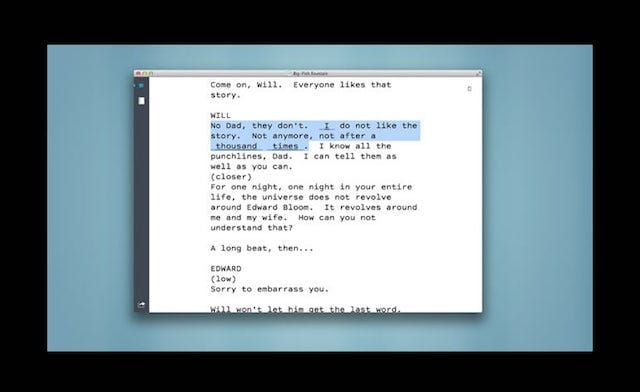
Notice how the character name position is left-justified, not center. Parentheticals, too, left-justified. Plus the margins for dialogue are the same as action description.
This could become the standard over the next 10–20 years. Highland, which John August and friends developed, pitches itself as a screenwriting program which is “Distraction free. Focus on words, not margins.” The original idea, as I understand it, is for writers to pound out afirst draft in Highland, then export to another program with ‘proper’ margins and do rewrites from there.
But what if a majority of script reads taking place in the future were on smart phones (or some other new small screen technology)? Wouldn’t it be easier for both writer and reader to have everything left-justified?
I don’t have a problem with that. In fact, for years here on the blog, some text from scripts I’ve copied and pasted ended up being left-justified, and I simply left it at that. One example: 12 Monkeys. It’s clear when the text is dialogue and when its scene description.
That’s one format change which wouldn’t surprise me. Who knows? Maybe Highland becomes the industry standard.
But again, the thing to remember: Screenplay style is not static. Consider this page from Psycho:
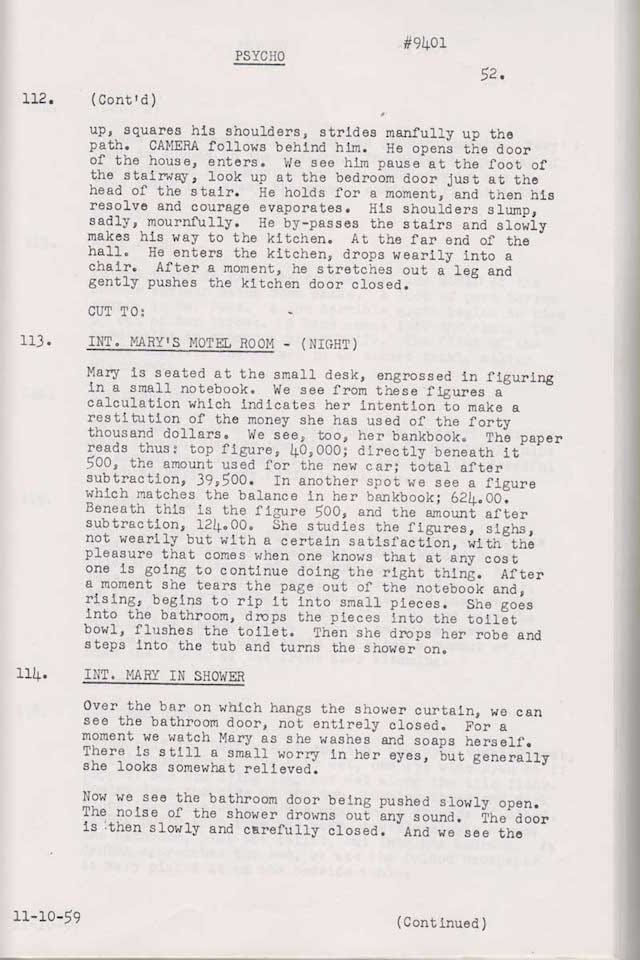
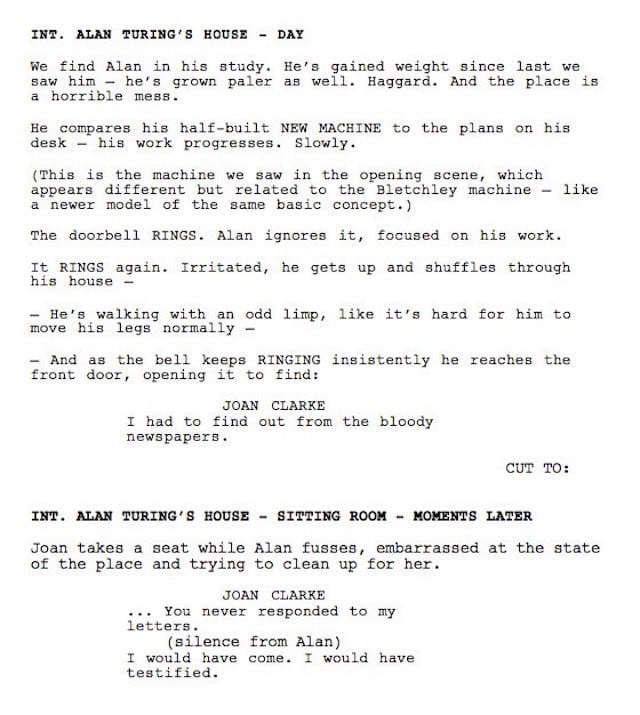
Looks nothing like contemporary scripts. Over the years, screenplay format and style has changed incrementally from the approach present in the Psycho script to that which we see nowadays as here in the script for The Imitation Game:
Bottom line: Don’t get hung up on formatting or margins. They’re not nearly as important as the words you write, the characters you bring to life, and your understanding of story as evidenced by what you put down on the page. Moreover screenplay style and format are, as I’ve noted, in a constant state of evolution. And currently, smart phones may very well be a contributing factor.
For more information on the Highland program — which is excellent by the way — go here.
What are YOUR thoughts on the matter? Do you read scripts on your smart phone or tablet? Does it affect the way you read and what you prefer to see in terms of screenplay style? Love to hear your thoughts. Post a RESPONSE and let’s see what you have to say.