Script Analysis: “The Good Dinosaur” — Part 2: Plot
Reading scripts. Absolutely critical to learn the craft of screenwriting. The focus of this weekly series is a deep structural and thematic analysis of each script we read. Our daily schedule:
Monday: Scene-By-Scene Breakdown
Tuesday: Plot
Wednesday: Characters
Thursday: Themes
Friday: Dialogue
Saturday: Takeaways
Today: Plot.
In every scene, something happens. A plot point is a scene or group of scenes in which something major happens, an event that impacts the narrative causing it to turn in a new direction.
A relevant anecdote. Years ago, I was on the phone with a writer discussing a script project. My son Will, who was about four years old at the time, must have been listening to me talking about “plot points” during the conversation because after I hung up, he asked, “Daddy, what’s a plop point?”
That’s in effect what a plot point is. It’s an event that ‘plops’ into the narrative and changes its course. So when you think Plot Point, think Plop Point!
The value of this exercise:
* To identify the backbone of the story structure.
* To examine each major plot point and see how it is effective as an individual event.
* To analyze the major plot points in aggregate to determine why they work together as the central plot.
This week: The Good Dinosaur. You can download a PDF of the script here.
Screenplay by Meg LeFauve, story by Peter Sohn & Erik Benson & Meg LeFauve & Kelsey Mann & Bob Peterson, original concept and development by Bob Peterson, additional screenplay material by Peter Hedges & Adrian Molina.
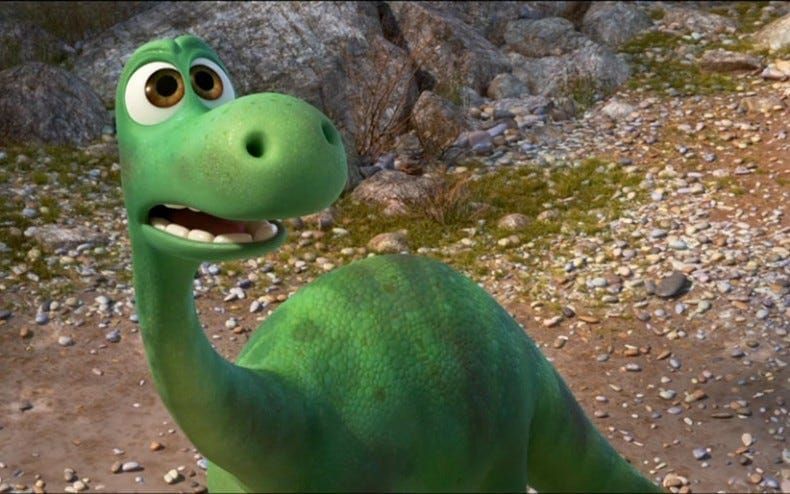
IMDb plot summary: In a world where dinosaurs and humans live side-by-side, an Apatosaurus named Arlo makes an unlikely human friend.
Major kudos to Rhidian Pentz for doing this week’s scene-by-scene breakdown.
For Part 1, to read the Scene-By-Scene Breakdown, go here.
Tomorrow we shift our focus to the script’s key characters.
If you have a favorite movie script you’d like to break down scene-by-scene and contribute to our archive, as well as provide the foundation for a week’s worth of discussion and analysis, email me with your suggestion.
Note: The script has to be available online somewhere.
To see the archive of scene-by-scene breakdowns, go here.
Circling back to where we started, reading scripts is hugely important. Analyzing them even more so. If you want to work in Hollywood as a writer, you need to develop your critical analytical skills. This is one way to do that.
So seize this opportunity and join in the conversation!
I hope to see you in comments about this week’s script: The Good Dinosaur.
Comment Archive