Watch Movies. Read Scripts. Write Pages.
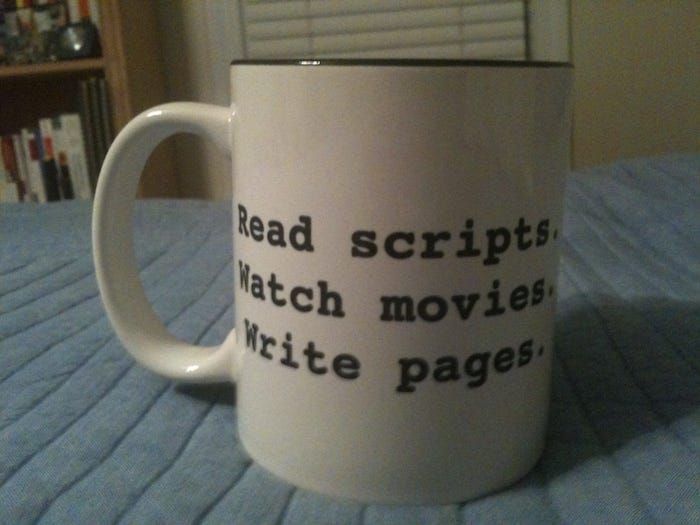
When I came up with this screenwriting mantra back in 2009.
I received an email yesterday from a student who began writing in high school and is now studying at a community college. She has written “a few” spec scripts. Her basic inquiry was where to go with her spec scripts. Here is my response:
First of all, congratulations on finishing your spec scripts. In my experience, a lot of people talk about writing a script, but most don’t, so to get that far is an accomplishment.
Assuming what you’re talking about is how to break into the movie business as a screenwriter, let me be candid: It’s extremely difficult. In the past, the best way to do it has been to write a great spec script — by great, I mean a script with a fantastic, commercial high concept, compelling and multidimensional characters, a strong story structure, memorable dialogue, and overall a superior read. That is still one route into the business, but the odds are increasingly long as more people write and submit spec scripts than ever before, while the studios buy fewer specs, favoring instead, at least for now, preexisting source material (i.e., books, graphic novels, TV shows, toys, video games).
Even if you do write a great spec script, the next challenge is to figure out how to get someone who has ties to the movie business to read it. I wish I had all the free time in the world, then I would open my virtual door to every writer, but I simply can’t do that.
My suggestion to you is this: Focus on the writing. There are various theories — to which I generally subscribe — that a writer has to write x amount of scripts / x amount of words or spend x amount of hours writing in order to really learn the craft. The time you spend worrying about how to get your script to Hollywood is time you could be writing.
So three things: Watch movies. Read scripts. Write pages. That should be your focus for the next several years. Because if you’re not ready to work in Hollywood as a screenwriter, then it doesn’t matter who you get to read your script: You won’t sell it.
Watch. Read. Write. That’s my big advice. Trust that if you do that, you will meet whoever it is you need who will help you advance your career in Hollywood.
Two things I’d like to expand on. First, the focus must be on the writing. That’s a given even if you’re lucky enough to break in as a screenwriter. Yes, the networking, following business trends, and the rest is important. But it always comes back to what you put down on the page. And to feed your screenwriting, you need to watch movies and read scripts — to give you both a broad framework in which to place yourself, what you like and dislike, to find your voice, and to bump yourself up against all the minutiae that is a part of writing a script, forcing you to learn what works and doesn’t work, which helps you to shape your style.
Second, I know that living in some remote outpost, far away from Hollywood, writing screenplay after screenplay may not seem like the most direct route into the business. But as I suggested in my email, what good is it for you to develop solid contacts with people who work in the business if what you submit to them is not worthy of their attention? Moreover I really do believe that if you write it, they will come. Part of that will be about the material itself — it will be flat-out good enough to warrant Hwood’s attention. Part of that will be your growing self-confidence — when you write a script that know is a killer screenplay, there won’t be a hitch in your voice, a lapse in your determination, you will find a way to get somebody’s attention who can make a difference. And part of it is that no matter how much Hollywood recycles stories, they are always and will always be on the look-out for great stories. That will never change.
There is no one-way to do it. There is no one formula to write a great script. Every writer is different, every story is different. What worked for Diablo Cody (Juno) and Michael Arndt (Little Miss Sunshine) may and probably won’t work for you.
You have your own writer’s journey to chart.
But I can’t think of three better pieces of advice than these:
Watch Movies.
Read Scripts.
Write Pages.
As the Canadian clergyman and writer Basil King is quoted as saying, “”Go at it boldly, and you’ll find unexpected forces closing round you and coming to your aid.”
UPDATE: In comments, James makes a really good point:
Hey Scott — I’d add another route to all of this — find like minded fellow filmmakers in the city where you live. If you are writing quality scripts that can be produced on microbudgets, and you are able to get something off the ground with other talents in the rough, not only will you do what we are all ultimately wanting to do — make movies — but you will also become a produced writer, which in my opinion has more value and cache than any number of well received spec scripts. Particularly if what you produce is good.
First time screenwriters are constantly looking to win the Hollywood lottery. But those of us who aren’t in Rome need to take advantage of the technology that’s available to us. You probably won’t make a Paranormal Activity (although you might) but you will build a credit list and you will work and you’ll see what works on the page may or may not work on the stage.
Make films. Write a lot. Make more films. Don’t just hope and dream of hitting it big off the page. Build a career as a filmmaker.
Go read the rest of it as James has an anecdote about Neil Blomkamp (District 9) that illustrates his main point.
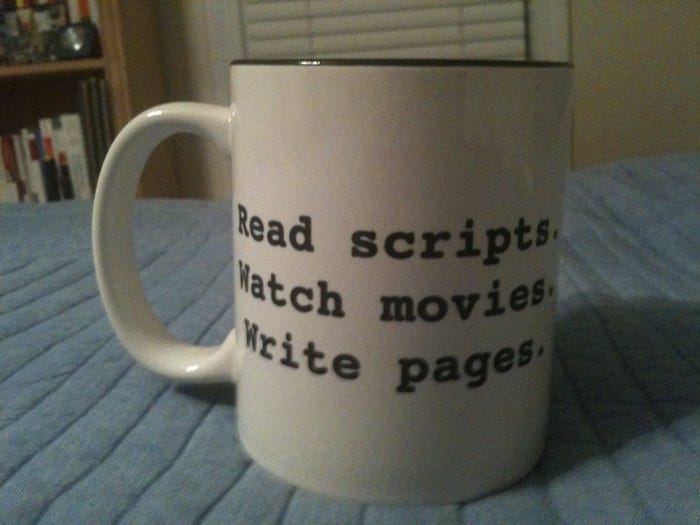
UPDATE #2: This is me in 2016. Little did I know when I came up with this advice — Watch movies. Read script. Write pages. — It would become a popular writing mantra. In fact, a GITS reader sent me a coffee cup years ago which I keep on my desk at my office, filled with pens (I don’t drink coffee) and turned so that any visitor, especially students, will have that tripartite message aimed squarely at them. So feel free to spread the word and you can link back to this post from 2009 as the source of the mantra.
Comment Archive