Interview (Part 2): Donald Margulies
Donald Margulies, one of America’s most widely-produced playwrights, won the 2000 Pulitzer Prize for Drama for Dinner with Friends (which was made into a Emmy Award-nominated film for HBO directed by Norman Jewison) and was a finalist twice before for Sight Unseen and Collected Stories. His many other plays, which include The Country House, Shipwrecked! An Entertainment, Brooklyn Boy, the Tony Award-nominated Time Stands Still and the Obie Award-winning The Model Apartment, have been produced on and off-Broadway and in theaters across the United States and around the world. Mr. Margulies has received grants from the National Endowment for the Arts, The New York Foundation for the Arts, and the John Simon Guggenheim Memorial Foundation. He was the recipient of the 2000 Sidney Kingsley Award for Outstanding Achievement in the Theatre by a playwright. In 2005 he was honored by the American Academy of Arts and Letters with an Award in Literature and by the National Foundation for Jewish Culture with its Award in Literary Arts. He was the 2014 recipient of the PEN/Laura Pels International Foundation for Theatre Award for an American Playwright in Mid-Career and the 2015 William Inge Award for Distinguished Achievement in the American Theater. He has developed numerous screenplays, teleplays and pilots for HBO, Showtime, NBC, CBS, Warner Bros., TriStar, Universal, Paramount, and MGM. He is an adjunct professor of English and Theater Studies at Yale University. The film of his screenplay, The End of the Tour (2013 Black List), directed by James Ponsoldt, premiered at the Sundance Film Festival and will be released in the fall of 2015.
Donald agreed to respond to some of my questions about writing The End of the Tour as well as his insights into the craft of writing.
Today in Part 2, Donald talks about the unique relationship he had with the film’s director, what it was like to have his script land on the 2013 Black List, and his experiences at the recent Sundance Film Festival.
Scott: Another challenge: Handling the end of Wallace’s life in 2008. By going back in time to the events of Lipsky’s book, there is that foreknowledge in the script hanging over everything like a ghost from the future. At one point, Wallace’s character says to Lipsky, “You’re gonna die. In a meaningful way, you’re going to die.” And then in scene description: “Silence. Lipsky mulls over the gravity of what David has said. David breaks the portentous silence when he pops a wad of tobacco in his mouth.” ‘Portentous silence’ would seem to be an acknowledgement of future real-life events. What was your thought process and approach when writing the script in dealing with Wallace’s death?
Donald: I was never interested in making this a bio-pic. This is based on a true story, a one-hour, forty-five-minute dramatization of a five-day footnote that might shed light on an entire life. Bio-pics of writers are mostly embarrassing; the obligatory typing scenes and crumpling of paper; the flashback to the traumatic childhood event that attempts to explain everything. There was to be none of that here. And I was not interested in exploiting mental illness and suicide. The DFW of The End of the Tour is at a healthy time in his life, not at its nadir; that was one of the things that attracted me to this story. However, I felt it was important to acknowledge Wallace’s death at the very beginning, which the script does, on page one, in a prologue that takes place in 2008 (the coda takes place in 2010, with Lipsky reading from the book we have just seen dramatized). There was no point in withholding that information or saving it for a title card before the closing crawl. In fact, I thought it was essential for the film to have the gravitas like that felt when reading the book. It was the news that prompted Lipsky’s reflection on his encounter with Wallace twelve years earlier, and it contextualizes — and ironizes — all that follows. Wallace talked about suicide — being “put down,” “leaving the planet”- a lot. The “portentous silence” you referred to characterizes the experience the reader and viewer has; it registers with us because we know what is going to happen.
Scott: There is a personal aspect to this project. You have been an adjunct professor of English and Theater Studies at Yale and one of your students there was James Ponsoldt (Smashed, The Spectacular Now), who ended up directing The End of the Tour. Could you describe how that came about and what it was like working with one of your former students?
Donald: It was a joy. Around the time the script was finished and directors were beginning to be discussed, I happened to have reconnected with a former student of mine whose directing career was on the ascent. James Ponsoldt was one of the most memorable undergraduates I have had the pleasure of introducing to dramatic writing (Elizabeth Meriwether, Stuart Blumberg and Zoe Kazan are some of the others). James and I had kept in touch since his graduation fifteen or so years ago and rekindled our acquaintance when I contacted him after I saw Smashed to tell him how impressed I was by it. Not long after, with the blessings of my producers (Kanter, Matt DeRoss and James Dahl), acting on a hunch that it would speak to him, I sent James my script. His enthusiastic response came overnight, things moved pretty quickly after that, and here we are. I had a real Mr. Chips moment when I saw an early cut of the film; I was so moved not only by the fine, mature film James had made but by the faithful and loving way he brought his old professor’s script to life. It was as if 25 years of teaching had brought me this incredible reward. On a purely artistic level, it was wonderful having a director who trusted the power of the language (I once had a director who brutally cut a long scene in half and placed the latter portion in a men’s room).
Scott: Were you at all involved during the film’s production for five weeks up in Michigan? If so, what was that experience like?
Donald: The cast and crew tolerated long days in crushing cold. I spent only four days on the set in Grand Rapids (wisely, all interiors), long enough to make a couple of Hitchcockian cameos, most notably, Businessman with Rolling Suitcase in Hotel Corridor. There were not many changes made to the script once we went into production. Some scenes were consolidated, some cuts were made, mostly by email from my home in New Haven.
Scott: You have written for TV and other movie projects, so I’m guessing you’re aware of the Black List wherein each year, they announce a group of the best unproduced original screenplays as voted on by Hollywood creative execs. The End of the Tour made the Black List in 2013. Did that have any special meaning to you?
Donald: As a writer-for-hire, I’ve worked on something like two dozen(!) unproduced screenplays. All kinds of interesting stuff, many of them biographical: Keith Moon for Mike Myers, Gertrude Berg for Bette Midler, John Callahan for Robin Williams, Robert Capa for Oliver Stone; adaptations of novels by Edith Wharton, Jeffrey Eugenides and Tom Wolfe. But none was the labor of love that was The End of the Tour. Maybe that’s why it was the one that actually got made, who knows? A few reviewers of the film mistakenly referred to me as a “first-time” screenwriter when really what I am is a first-time happy screenwriter. I was aware of The Black List but never imagined that I would land a script on it one day. I was delighted when I did. It was very validating. A “They like me, they really like me” moment. It certainly lent the script a little extra sheen and buzz which I think contributed to the impression that it was something special. So, yes, I was very grateful for that recognition.
Scott: At some point when the film moved into production, the David Foster Wallace estate raised objections to the project. Presumably you had already done the lion’s share of your writing on the screenplay, but during the scripting process, were you at all concerned about what the reaction would be, not only from Wallace’s family, but also his fans?
Donald: I set out to capture Lipsky’s impressions of his five days on the road with Wallace. The book was well-received and had the support of the family, who were aware that it had been optioned. My hope was that it would honor the spirit of a revered writer and perhaps inspire a new generation of readers.
Scott: For several years, you have been playwright-in-residence at the Sundance Playwrights Conference. Then this January, The End of the Tour premieres at the 2015 Sundance Film Festival. That must have been quite a contrast seeing Sundance in such a different light at the Festival.
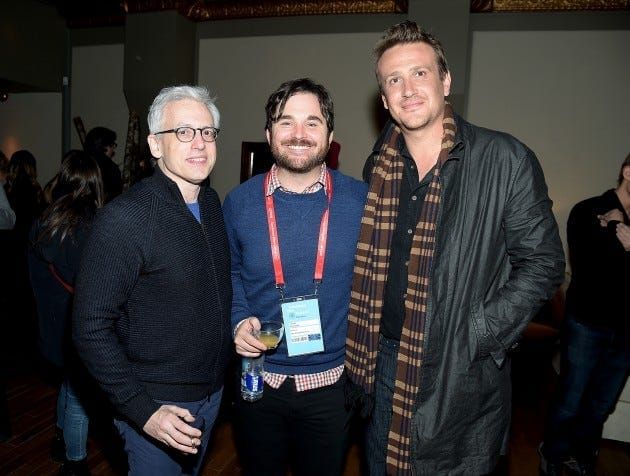
Donald: I participated in the Sundance Playwrights’ Institute in Provo back in the pre-historic eighties and nineties. I had never been to the festival before so I wasn’t quite prepared for the traffic and the celebrity-gawkers and the pandemonium, or the smiling sponsors insisting that you take their free merchandise. Oh, yeah, there are movies there, too, but I couldn’t get in to see any but my own.
Donald Margulies, James Ponsoldt, Jason Segal at Sundance
Scott: The movie has been picked up for distribution by A24, one of the most cutting edge independent movie companies to emerge in the last few years. Can you even begin to describe what it feels like to have traveled on your own creative road trip with this project and now see it all come to fruition?
Donald: I have said that The End of the Tour was a labor of love and I think everyone associated with it would describe it the same way. I take particular pride in having made this film with my longtime associate, David Kanter, and my former student, James Ponsoldt. We’re excited for a wider audience to finally see it.
Scott: What’s next for on the writing front for Donald Margulies?
Donald: I’m looking for a new screenwriting assignment. The older I get, the more I view a potential project as occupying a precious chunk of time and imagine how I would feel living with it for that long. Not too many things pass that test. For the stage, I’m writing a new play and working on my first book of a Broadway musical, for Disney Theatricals, Father of the Bride (based on the 1950 original with Spencer Tracy, not on the Steve Martin remake).
For Part 1 of the interview, go here.
Tomorrow in Part 3, Donald responds to some questions about the craft of screenwriting.
Donald is repped by WME and Anonymous Content.