Interview (Part 2): Jon Spaihts
A 6 part series featuring one of Hollywood’s most sought after screenwriters.
A 6 part series featuring one of Hollywood’s most sought after screenwriters.
I have been a fan of Jon Spaihts and his writing for years, so I was excited to have the opportunity recently to spend an hour talking with him about his career, his movies, and the screenwriting craft. His movie credits include Prometheus, Doctor Strange, and his latest Passengers, along with the upcoming films Van Helsing and The Mummy among many others.
Today in Part 2, on shares some thoughts about writing Doctor Strange, The Mummy, Van Helsing, and the inspiration for the movie Passengers:
Scott: Next, what about Doctor Strange, which came out this year, a big hit.
Jon: Yes.
Scott: What I’d like to explore on that is the central character, Doctor Strange. Because in the Marvel Universe of superheroes, he’s a pretty distinctive figure. He’s not like Iron Man or Captain America, which are more about brute strength. He’s more into the mystic arts. What particularly drew you to Doctor Strange?
Jon: I read a mountain of his comics when I was a kid — piecemeal, because I couldn’t afford to get to comic shops with any regularity. I was always piecing the story lines together from fragments like a lot of kids do, I think. I just loved the stories that he was engaged in.
His travel into psychedelic worlds, the gorgeous graphical representation of magic, the primary colored glyphs and runes hanging in the air, the mandalas and bands of light. I loved that vision of magic, and his garish costume with the cape floating around him. I was riveted by it visually.
But then I also loved the scale on which the stories were unfolding. I loved H. P. Lovecraft, where the stakes of short stories would often open up to the cosmic, and you’d be looking into the face of elder gods and primal forces that could mean the end of civilization or the loss of your soul forever.
Doctor Strange contended with enemies on that scale. He was often standing toe‑to‑toe with god‑like beings and, despite his own vast sorcerous powers, he was usually outmatched and forced to win by his wits, or by deception, or by exploiting some technicality of magic. I loved his cleverness and the fact that he was always punching above his weight in defense of his world.
Scott: There’s so many of these superhero stories. It’s like, “OK, the universe is in danger, in peril,” and there’s the kind of physicality to it, just the physical destruction.
What’s interesting about Doctor Strange is the idea there’s a transcendent issue, too. It’s the soul, this battle for the soul. That’s distinctive, isn’t it? Amongst the Marvel Universe superheroes, it’s pretty unique.
Jon: Yes, it is. There is a wider magical domain in the Marvel Universe. Doctor Strange is not the only hero in it, but he is the Sorcerer Supreme. He is the defender of the planet and the foremost sorcerous player.
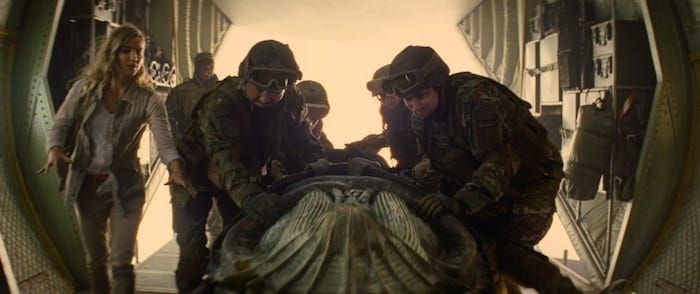
Scott: You did the Marvel thing. Then, also, you’ve been over at Universal with them working with their monsters. You’re involved with the reboot of The Mummy. The trailer just hit the other day and that looks awesome.
Jon: It really does. I wrote a bunch of early drafts of that movie by myself. I was the first writer on. Then I co‑wrote a number of drafts with the director, Alex Kurtzman. Then I parted ways with that project. He carried on and Tom Cruise became attached. I think, after that, a number of writers participated but Chris McQuarrie is the most notable.
Scott: We think of The Mummy as a masculine character, but in your movie, it’s Princess Ahmane. She looks pretty damn badass.
Jon: That change came late in the period when I was collaborating with Alex. We did have a male mummy for a while. Then he saw that the way to really elevate and distinguish our mummy movie was by flipping the gender of the mummy. Which has a lot of really fun consequences and effects.
Scott: Van Helsing is over there at Universal as well.
Jon: Yeah, I co‑wrote that with Eric Heisserer, who wrote Arrival.
Scott: How did you get involved with that project?
Jon: Well, there’s sort of a writer’s circle behind the Universal Monsters movies. Chris Morgan, of the “Fast, Furious” movies, and Alex Kurtzman are leading that team. Eric Heisserer and I are among the writers who are helping to shape the larger universe, which will hopefully lead to a number of interconnected movies and an underlying body of lore that will grow and grow.
Scott: Some of those Abbott and Costello movies, they’d have the Mummy and Frankenstein.
Jon: Yeah, they did. In some ways, the Universal monsters movies in their heyday of black and white film were the original cinematic universe, because they spun them all out and then the monsters started meeting each other.
You’d get Frankenstein versus the Wolf Man, and the monsters would begin to meet and battle in crossover films. Then you got the comical crossovers, the 21 Jump Street of their day, in which, as you say, Abbott and Costello would run into the monsters.
Scott: Finally before we dive into Passengers, I want to talk about “The Forever War.” That’s a Joe Haldeman novel. What can you tell us about that project?
Jon: Well, it’s easily in my top five sci‑fi novels of all time. One of the most seminal war novels in science fiction. It has the great distinction, in my mind, of being the only immensely successful war story I’ve ever read that is also an equally successful love story.
I’m a hopeless romantic. There’s nothing like a love story in a movie to make me lean in. The idea of being able to do the ultimate sci‑fi shoot‑’em‑up, this big, high‑concept war movie, but also do a story of star‑crossed love…that was an irresistible temptation to me.
I pursued this book for years and it finally came free. I leapt on it. I’m happily writing it right now, working on it today. Channing Tatum is attached to star, and that’s happening over at Warner Bros.
Scott: You optioned it yourself or the studio?
Jon: The option got loose and producer, Roy Lee, made me aware of it. He and I have worked together on a number of things. We rounded up Channing and his crew and made a run at it.
Scott: That’s actually a good segue because, if you’re a hopeless romantic, you describe Passengers as being a science fiction love story, which I think is quite apt. The movie rolls out in theaters here in North America beginning December 21st and has these two huge movie stars in the lead roles ‑‑ Jennifer Lawrence and Chris Pratt.
The script made the Black List in 2007.
Jon: That’s right.
Scott: We’re talking about ten-plus years. You said this was the second script you wrote. 10 years from conception to hitting the silver screen, that’s quite a journey for you.
Jon: It is. It certainly, by no means, the only movie to have taken that long to get made. It’s a common tale, but ten years is a long time, even in Hollywood.
Scott: Here’s an IMDb plot summary. “A spacecraft traveling to a distant colony planet and transporting thousands of people has a malfunction in its sleep chambers. As a result, two passengers are awakened 90 years early.”
I’d like to go all the way back to the beginning. I seem to remember, when this project first percolated, that it arose from your association with Keanu Reeves. Is that right?
Jon: Yeah, Keanu would’ve been attached to “Shadow 19” when it was at Warner Brothers. We developed a version of the script that we loved and really wanted to make. We were unable to convince the studio to make the movie. We both walked away from that a little downhearted.
His producing partner reached out to me and said, “Hey, let’s find something else for you guys to do together. Let’s come up with a story.” I pitched an idea that I had in my notebook, a noir detective story that took a big sci‑fi hook in the late going. It prominently featured, toward the end of the movie, the image of a person stranded alone in space.
They were tempted and we talked about it for a little while. Finally, they said, “You know, this story isn’t the one for us, but we love this guy stranded alone in space. Is there a way to start a story there?” That was an interesting question I hadn’t asked myself.
Instantly, for some reason, the notion of long‑haul colony ships came to me ‑‑ sleeper ships with passengers in suspended animation. I thought of what it would be like for a person to wake up alone on a ship like that. I toyed with the notion of a custodian or caretaker who stayed up while everybody else slept and was doomed to grow old alone.
But, when it occurred to me that maybe, though some malfunction or error, a passenger could wake up too soon and find no way back to sleep, that caught my imagination. I started riffing on it. Over the course of a 45‑minute conversation riffed the entire spine of the movie as it now stands, including the title.
While there have been many, many refinements and evolutions over the intervening years, the spine of the story has never changed from that first riff, which is actually very much the same thing that happened with Prometheus.
Scott: The love story came out of that conversation, too?
Jon: That’s right.
Scott: And the story of survival, how it builds to a big, climactic action sequence?
Jon: Yeah, looking at it, the simple inciting incident — the guy waking up too soon — it had to be connected to however things end. Because the scale of the movie is as big as it is, it demands a climax of appropriate magnitude. You want a climax that’s about survival, not just about emotional issues.
So, I needed a way in which the problem that woke him up could ultimately put his entire world in danger. It was about searching for that connection, that sci‑fi detective story behind the scenes, but then also playing forward the character story: What happens if a couple of people find themselves alone on a spacefaring vessel?
Tomorrow in Part 3, Jon and I delve into the Protagonist figure in Passengers, the unique circumstance in which he finds himself, and a critical choice he makes which turns the story on its head.
For Part 1 of the interview, go here.
Passengers, which stars Jennifer Lawrence and Chris Pratt, opens today December 21 in North America and theaters around the world.
Visit the movie’s website here.
For more background on the movie’s decade long odyssey from script to screen, check out this Hollywood Reporter article: ‘Passengers’: The Long, Strange Trip to the Big Screen. And this Indiewire article: ‘Passengers’: Why It Took a Decade to Launch a Black List Darling.
Jon is repped by CAA and Circle of Confusion.
Twitter: @jonspaihts.