Interview (Part 3): Matt Manfredi and Phil Hay (“The Invitation”)
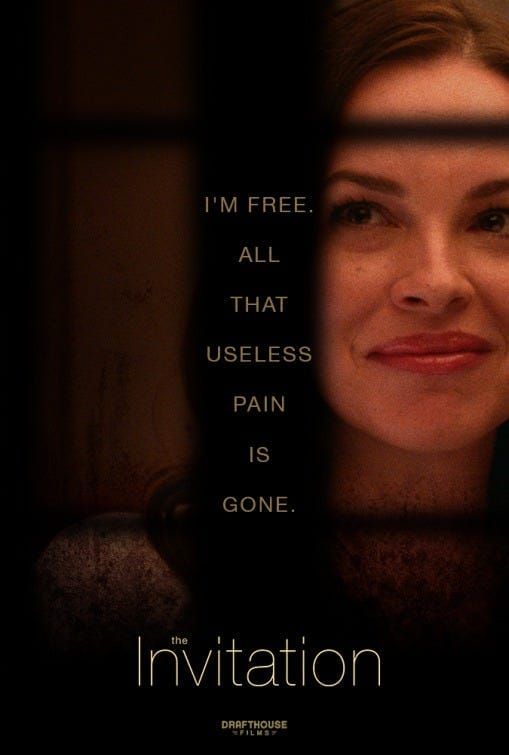
I’m a big fan of producer Mynette Louie and what she and her cohorts are doing at Gamechanger Films, a film fund for women directors, so when I saw their newest movie The Invitation was coming out in April this year, I made it a point to watch it on VOD the week it went into distribution. I loved it! So I got in touch with Mynette who connected me with the movie’s screenwriters Matt Manfredi and Phil Hay, and we ended up having a great conversation about their careers, the craft of writing and their thriller movie The Invitation.
Today in Part 3, Matt and Phil talk about three of the key characters in The Invitation and how those characters emerged in the duo’s writing process:
Scott: You mentioned that it’s deceptively hard to shoot, but also deceptively hard to write. You’ve got one location, this dinner party, 12 characters, and to build the tension and move the narrative forward, I thought what you do structurally was really strong.
I want to get into that in just a bit, but I’d like to introduce some characters. Let’s start with Will. Here’s how you introduced him in the script. “A young man, 30s, drives in silence. Linger on his face as he concentrates on the road. Behind his placid expression, you see something pulling at him. There’s a haunted quality to his eyes.”
Where would you describe Will as, psychologically, at the beginning of the movie, how would you describe him?
Phil: I would say the first thing that came to mind is that he’s a person who is struggling mightily, and who is emotionally an open wound, but who is committed to trying to keep himself together, as hard as that is. Who is working very hard. That’s the way that we’ve always imagined him, and I think the way Logan Marshall‑Green played him, beautifully.
It’s challenging to write, to direct, and certainly to play a character who is extremely internal, but who has to have a lot of potency within him. The capability of violence was a big part of his character that we always knew had to be there.
We have to question him a lot. We have to wonder if his perspective is the true perspective, or if his perspective is so filtered by his own grief and paranoia that he is at risk of becoming the antagonist.
Matt: That “haunted” was the right word for us, because I think that no matter what happens in the movie, no matter what happens once it gets to the house, or doesn’t happen, the house is haunted for him. It’s so loaded with memories, and people, and images, both past and present. Everything is loaded for him.
Scott: I’ll jump ahead to that, the haunted thing. You have these wonderful bits of business in the script, you call a flash. It’s like a flashback. Of course, that’s the standard so-called screenwriting ‘rule’ about don’t use flashbacks, but I think they’re done beautifully here.
You use these spots in the house Will’s familiar with, he hasn’t seen in two years since this tragedy in his past, to evoke these little flashing memories. How early on in the writing process did you realize, “We need to do that. We need to go inside his mind, and see what he’s remembering.”
Matt: I would say from the beginning, if I remember correctly, because it was a process over a number of years to get into this script. It was kind of a start and stop writing experience. Some of the flashes were written quite early, and as Karyn came on, we added more, in the hope that it wouldn’t be, the intent was never to cut to this sepia toned vision of the past.
It was really to have a seamless transition between reality and those flashes, again, so that we’re never quite sure if his point of view is accurate. Also, there was a need for, in some moments, brightness against the somber mood.
You want to see what has been lost, and what was possible in the past throughout this tragedy, and where they’re coming from. It was a place of joy. You’re beginning to see a little bit of that.
Phil: I think what Matt was saying, that was really important to us, is that there were different functions for these flashbacks — I might call them “intrusions” — and that some of them were about showing what was lost. Also, I’d add that I think that Will, is obviously suffering from some sort of PTSD.
From what I understand, a truth about some who are dealing with that condition is that the traumatic events of the past may feel as though they’re happening right now, in the present moment. They are not “past:” they are continuous. So there’s no place for Will to escape. There’s no ability for him to put the events that happened in the past. They are very live for him, and so they’re triggered by places, or they’re triggered by sounds, or they’re triggered by his own path, his mental path through the house.
As Matt said before, it’s a ghost story. Those things are very alive, and very current, and very present, to the point where they can overcome him, can overcome what is the supposed present of the movie.
Scott: I’ve written in the marginalia of the script about the flashes, One, unreliable narrator. It adds to that quality of, you’re not exactly sure what he’s, where he is in a given moment. Two, that it’s keeping that ghostly specter, and three, that he’s still processing. He’s actively engaged, while his trying to keep it together, the grieving process. He’s still in that. Four, there’s a narrative to them. They stitch together and they tell a little story revealing finally, at the end of the day, the nature of the tragedy. I think they’re quite effective.
Let’s contrast him to his ex‑wife, Eden, who as you describe her as she’s introduced. “We see Eden. She’s intimidatingly beautiful. She walks across the room towards them with a grace that’s almost ethereal. She practically floats across the room.”
She’s dressed in this white gown. It really reinforces that. Is it fair to say that whereas Will is struggling and actively still involved in this, that the touchstone word for her might be “denial?”
Phil: Absolutely.
Matt: I don’t think this is a spoiler, but I think that her trying to do what Will is doing, which is actively cope with this darkness every day and try to hack her way through it, was destroying her. She found something in the Invitation that allowed her, in her mind, to dispel all of it and be free of all of it.
She is in a blissful place and one that is hopefully charismatic. It’s not the kind of thing where you react to her and say, “That’s kind of dumb. I would never do that.” There has to be an appeal to her point of view.
Phil: We always imagined her, and certainly Tammy evoked this…I think that she, in a way, has been center of this group and that she is a form of California royalty, that she has this timeless power. Her struggle is obviously very wrapped up in denial, but as Matt said, between her and David, her new husband, we were trying to present something that really, on its surface, seemed to be working for them to some degree.
Obviously, her role in her performance is all about showing the damage, the woundedness, and the true terror underneath a very placid demeanor or a very…”Placid” is the wrong word. I’d say a very beatific and calm demeanor.
That was the tension in that character, to show her struggle to live the life she’s talking about, her struggle to portray the letting go and the beautiful lack of pain that she’s found. She has to portray it because it’s still there.
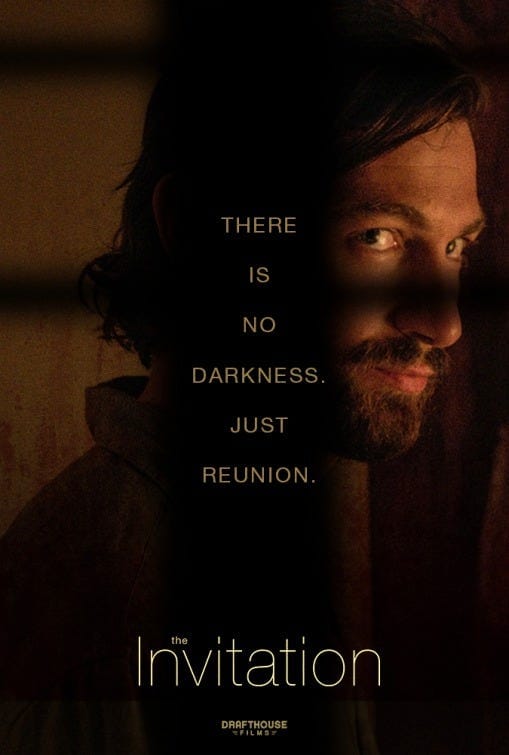
Scott: That struggle is manifest in a rather startling moment with Ben in the kitchen, where she just suddenly slaps him. You can tell there’s something going on underneath. Of course, she’s now with another guy, David, who is also part of this group called The Invitation. You describe David this way when you introduce him. “Eden turns and beckons a very fit, very good‑looking man.” That’s all in caps, that last part. “He comes towards them, eyes shining…”
Phil: Michiel deserves that. His looks deserve caps.
Scott: “Eyes shining with powerful life. A strong focus. He wears a distinctive, leather bracelet on his wrist.” What were you going for with this character, David?
Matt: He has to be intimidating in some ways, just the base fact that this is the man now who’s with your wife and he seems better than you. [laughs] He seems better looking.
Phil: His beard is tidier.
Matt: He’s incredibly good‑looking. He seems powerful and confident and sure of himself. That’s not something Will has at this point in the movie. He’s intimidating in his comfort and his confidence. I wouldn’t say you’re setting him up as a villain, but he has to be antagonistic at some point, in some ways.
Scott: Intimidating. That’s a great word, because he’s smart, he’s charming, he’s provocative, but you just know that there’s something going on with this guy.
Phil: He has a good answer for everything, which is important. Every suspicion that Will raises, he has an answer for. In some ways, he plays innocently, and in some ways, it’s obvious that he is a very powerful manipulator as well. I think that, and I say this for all the other characters who are members of The Invitation, the weapon they use against you is to call you distant, closed off, or…Basically, anything that has a decent boundary, they’re against.
David is an extremely good manipulator of people, good at drawing them in. You can see that in the way he’s constantly offering people things to drink, constantly offering it to Will, who refuses for a while and finally takes it. He’s like a great salesman. He just has to get you to say yes to one thing, then maybe he can get you to say yes to other things.
For Part 1 of the interview, go here.
For Part 2, here.
Matt and Phil are repped by UTA.
Twitter: @phillycarly, @MattRManfredi
Here is a Q&A with The Invitation director Karyn Kusama which took place at the DGA in April, 2016 in conversation with director Jonathan Levine.
The Invitation website.
Rent or purchase The Invitation here.