Interview (Part 4): Andrew Friedhof (2015 Nicholl Winner)
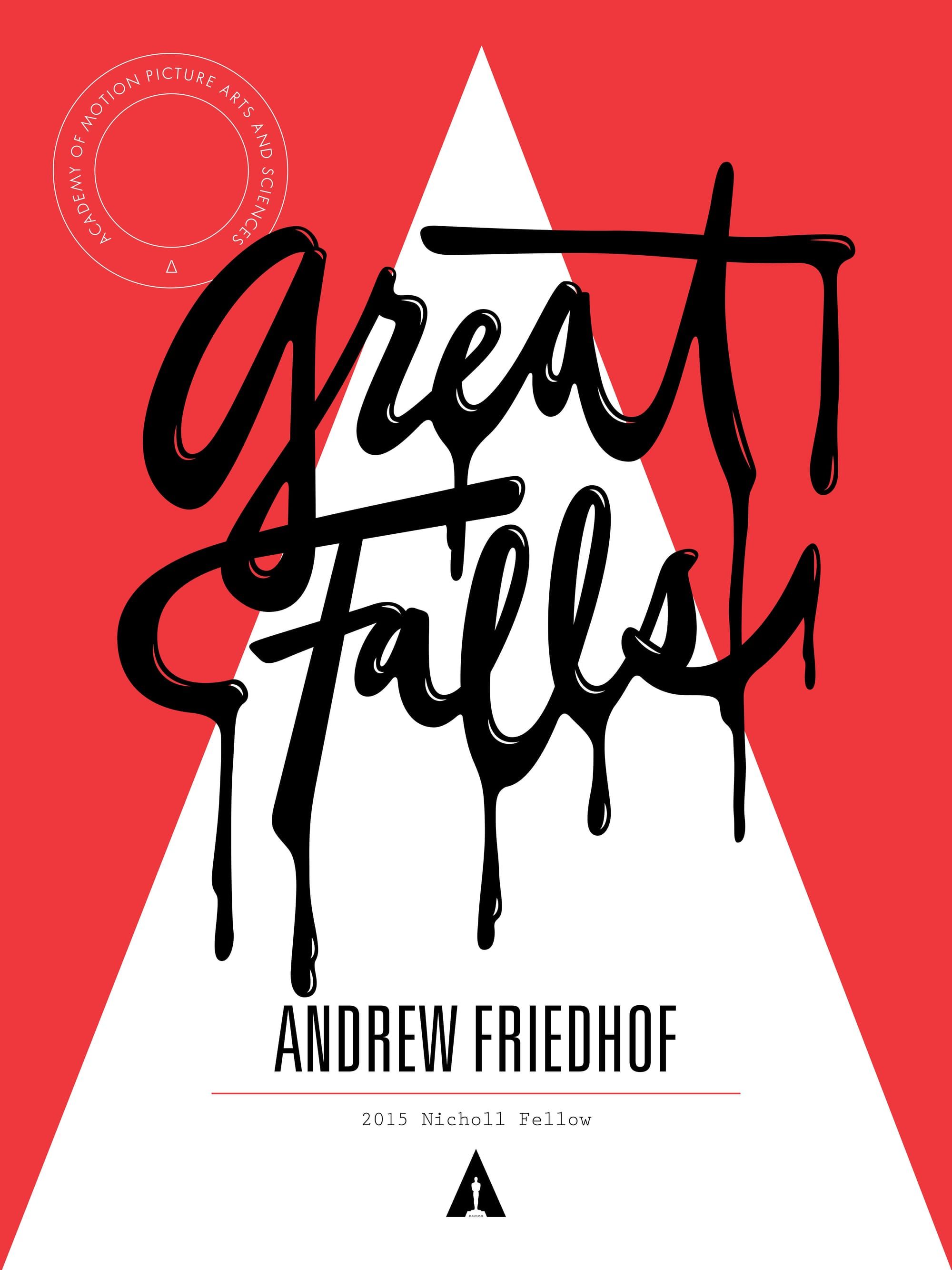
Andy Friedhof wrote the original screenplay “Great Falls” which won a 2015 Nicholl Fellowship in Screenwriting. Recently I had the opportunity to chat with Andy about his background as a writer and his award-winning screenplay.
Today in Part 4, we continue our exploration of Andy’s script “Great Falls”:
Scott: That’s an interesting point. If we truly do believe that the prison system, the intent of it is, at least in part, is to rehabilitate prisoners, then you have to believe in the idea that they can change.
At one point Bernie says to Kyle, who is Josie’s brother who gets roped into the situation. He says, “This ain’t the same mind that thought to do it. That’s the only shame in it. They give you time to change, and then they kill you.”
Andy: That’s the critical moment for me. If the death penalty is about punishment then they’re not even punishing the same person he was at that time. Often decades have passed before the sentence is carried out. For me that heightens the immorality of it. It might also stem a little bit from the fact that I’m an atheist and I don’t believe people go to hell or whatever after they die. I think once they die they just stop existing.
One of the characters in the script, Josh, makes this point, as well. He says that death eliminates any opportunity for redemption or resolution. I totally understand there are circumstances where people are remorseless or psychopathic, and will never change. If someone really feels that way, it’s probably worse for them to have to live as that person.
Even if there’s only a 10 percent chance that someone expresses remorse or reaches out to the family of the victims to say, “I finally have the clarity of mind to understand what I did to you,” or whatever else, I still think there’s a huge value in that, and it’s something that should be protected.
Scott: You’ve got these characters. You set this thing into motion. At the beginning it seems like a fairly clear moral universe. There’s good guys and bad guys, basically Stan’s take on things. Then there’s this incident whereby there’s an accident and Stan, and to a certain degree Josie, are culpable. They’ve got to try and take care of this person that gets killed in a car incident.
Stan says, “With him,” being Bernie, “as a witness this is vehicular homicide. We’ll get two years minimum for this.” Now you grey the moral environment here, in which the two law enforcement officers are brought a little more into Bernie’s world. Now they’re having to deal with the crime.
One of those “in a moment life changes drastically” stories. Where did that idea come from, “OK, I need to put these people in a situation where now they’re pulled more into the sort of gravitational pull of a Bernie, criminal type of a life”?
Andy: I’ve read a lot of scripts over the years and I think one of the things I learned from that was that you really need to let your reader know what your story is about as early as possible.
I’ve read a lot of meandering 35‑, 40‑page first acts. To me it’s really important to get to that inciting incident as early as possible so the reader can say, “Okay, I understand what this script is going to be about…”
I needed something to provide that narrative thrust to the story. Regardless of whether you agree with where Great Falls ended up going, you probably can’t help think, once you’ve read that moment with the car accident, “I need to find out what’s going to happen here.”
As you said, it brought those characters out of that clear moral universe they inhabited and dropped them into this grey universe.
That’s exactly what an inciting incident should do. Rock your protagonist’s world and ultimately force them to make a decision about how they’re going to respond. That was really important to me.
I’m not someone who’s rigid about structure. I don’t think, “Inciting incident, page 12,” “End of the first act, page 30,” or whatever else. I do think there is value in structuring the scripts in a way to let the reader know what they’re going to be reading. That realization came out of having read a lot of scripts where I was still wondering on page 40 or 50 what the story was about, which is an incredibly frustrating feeling.
Scott: That’s absolutely right. I think that that’s a really good point. I tell my students by the end of Act One, a reader should know what the story is.
In your script Stan says, “Look, he’s going to die anyway, what’s the difference how it happens? What if we do it, just like we’re going to go down to Deer Lodge where they’re going to take him to be executed. Same day, same time, same method.”
You literally are telling the reader, “Look, this is the central conceit of the story. these characters, these civilians, are going to take on, essentially, the task of execution in an ad hoc fashion.” That’s the central conceit, and you do that by the end of Act One.
Andy: One of the incredible things that I came across were pictures of Montana’s death row facility. As I said earlier, for decades it was little more than a temporary trailer. I’m not sure if that’s changed since. It was basically a mobile home where they execute these people. It looked so unprofessional, un‑medical and ad hoc.
As you’re probably aware, medical practitioners aren’t allowed to participate in the death penalty process because it’s against the Hippocratic Oath. So they essentially have trained prison guards carrying out these procedures.
It’s not a huge moral leap for the characters in my script to think, “If my friend who I’ve known for 30 years and isn’t very smart can do it, then maybe we can do it, as well. The outcome will effectively be the same.”
I guess that’s the question the script asks. Is it actually the same thing, or is there a difference? In my opinion there’s no real difference in the morality of that decision, other than, as I said, the legal framework that people often hide behind.
Scott: You have an interesting contrast there, because in describing the facility in Montana, the official facility where the capital punishment would take place, “Our overwhelming feeling should be this is tacky. This is cheap, this amateurish, and, most of all, this is no better place to die than Stan’s cabin.” That’s the cabin for this ad hoc form of capital punishment.
Interestingly enough, there’s this Paula character, who’s Josie’s mom, who basically suffers from dementia. She’s got an obsession or a fixation on Canada.
She mentions, “Oh, it’s a wonderful country, so clean, so civilized compared to the trash you find in Great Falls.” Does that come from your sense that because Canada has a more humane view about prison life compared to the United States?
Andy: That wasn’t a conscious thought when I wrote that line. It was more a dig at her son Kyle, who she didn’t remember because of her illness and the fact that she hadn’t seen him for nearly a decade.
I don’t want people to feel like I’m making a moral judgment about one country or the other from the outside. It tends to annoy me when people do that. There are some areas of difference between the policies of the two countries but it’s not like the death penalty’s legal throughout the United States, either. She could equally have made the point about a neighboring state that didn’t have the death penalty.
It was more the fact that she accidentally identified a potential solution to the seemingly intractable problem Josie and Kyle were faced with. That sparked the idea in their minds. The proximity of Canada was the reason for that more than Canada being so much more morally pure than the United States or anything like that.
Scott: That’s one of the things that really interested me about the script because it obviously brings up a lot of these deeply philosophical, moral questions about capital punishment. There have been movies which have done this in the past, Dead Man Walking, The Life of David Gale.
Yet this script, you hit this really delicate balance where it doesn’t come across as preachy. The experience feels more, in some ways, almost like a Coen brothers’ movie. Like Blood Simple, that there’s this incident that happens, like a pebble in a pond, and this ever‑widening circle of implications and consequences.
You get more caught up in that sort of thing. There’s lot of plot twists and turns. Lots of subplots that come interweaving back and forth, and some very surprising results, and whatnot. I think the reader tends to get more caught up in that, and so you’re able to convey these philosophical questions about the death penalty amidst the entertainment of this crazy set of circumstances which emerges.
Andy: That’s one of the greatest benefits of taking this issue out of the prison and out of the death chamber. I think if you say to someone, “This film is about the death penalty,” they expect a po-faced and teary drama with Susan Sarandon or someone like that as an advocate for someone on death row.
They know what to expect in some ways and therefore approach the material with their guard up. It’s also a very static way of exploring the issue. It’s often people sitting in rooms discussing the issue and coming to a realization.
Whereas the majority of the action in Great Falls takes place outside of death row and outside of the prison system. That allows breathing space for the characters to explore this issue within their own moral universe, rather than the prison system or legal framework in which they’re operating.
Scott: Let’s jump to the ending here, what happens to Bernie, and to Kyle, and Josie, and Docherty, and to Stan. Docherty is basically the sheriffs boss. That ending, you tie up everything in a very sophisticated manner. Every single subplot has its own resolution. It’s satisfying in that respect, but it’s also disquieting.
It’s not a happy ending, per se. Josie does come out of it transformed, but it’s a pretty dark ending. How early on in the process, or how did that evolve, where you knew that that was the ending you wanted?
Andy: That was pretty firm from the beginning from memory. I think for me the most important part of Josie’s journey was realizing that it’s not just a decision. It’s also circumstances that drive immoral acts.
By the end of the film she is ready to accept responsibility for her participation in this immoral act because she realizes that circumstances played a role in her downfall and therefore she isn’t defined by that single moment. There’s this temptation that the sheriff holds out to her saying that we can sweep this under the rug.
He says to her “There’s no reason that we need to prosecute this. I can help you cover this up.” But she refuses to evade accountability because she can now see a pathway back to a morality which she couldn’t before.
Ultimately, it was probably the most satisfying resolution for the arcs of each of the characters. The ending of the script is one of those things I love to hear people talk about and debate. In questioning the ending you are in a way questioning the theme itself. Should Bernie have survived in the end? Should Josie have avoided responsibility for her actions? Why do you feel that way? The sort of things that you can think about after the film, once you walk out and it stays with you for the next few days. Did the character make the right choice? Would I have made that choice?
I love it when you there’s conflict about these things. When you understand the reasons for a character’s choices, but then say, “If I was in their position I would have done this,” or “I would have done that.” I love to hear people’s feedback on that sort of thing.
Scott: I think it’s great. You literally present dozens of forks in the road for characters, including one at the end. This Liza character who you talk about. She’s someone whose parent was killed by Bernie. She insists on bringing her newborn infant to the execution. Wow, that’s a powerful, powerful image.
Andy: I think she says to Josh, “I want to be able to tell my child that they were there when they ask me, ‘Why don’t I have a grandparent?’”. Obviously there’s a schism between her and Josh, because of that decision. The implication in the end is that it’s such a huge schism that it will end up driving them apart completely.
As I mentioned, that came out of the research, that wedge that’s often driven between families by this process.
Tomorrow in Part 5, Andy talks about his experience winning the Nicholl Fellowship in Screenwriting.
For Part 1 of my interview with Andy, go here.
Part 2, here.
Part 3, here.
Andy is repped by ESA and Circle of Confusion.
Twitter: @andrewfriedhof.
Comment Archive