Interview [Part 4]: Lisa Joy
![Interview [Part 4]: Lisa Joy](https://storage.ghost.io/c/8f/29/8f29b0a7-49e5-431c-a9bb-3ade9c0a785e/content/images/size/w2000/2026/08/0_AStakktwXH2pDG2J.jpg)
“Scott, you are the only screenwriting teacher I’ve ever had.” This is what Lisa Joy shared with me when we had dinner together in L.A. last fall to celebrate the recent sale of her spec script “Reminiscence” which Legendary Pictures acquired in a deal worth a reported $1.75M. In addition to her screenwriting, Lisa has been on staff and written for TV (“Pushing Daisies,” “Burn Notice”), created a graphic novel “Athena” which has been developed for TV, and co-wrote the pilot with her husband Jonathan Nolan for a TV series adaptation of the classic 1973 science fiction movie Westworld for HBO in association with J.J. Abrams and Bad Robot, and producer Jerry Weintraub.
I was thrilled when Lisa agreed to an interview, not only because of the mark she is making in Hollywood, but also because she is a genuine human being: smart and insightful, but also grounded and generous in spirit. Yes, there are people like that in Hollywood… and Lisa is one of them.
In Part 4, Lisa and I dig into her script “Reminiscence”:
Scott: The central idea of “Reminiscence”, that there’s this technology which exists in the near‑future where people can experience a startlingly real re-experience of events in the past, was that the very first thing you had for the story?
Lisa: Yeah, that was the core of the idea, the high‑concept hook. It came from a place where I’ve always been fascinated by memory. I think some poet said this, maybe, Billy Collins, I’m not sure, but he said that his biggest sins are cynicism and sentimentalism.
I believe the same thing could probably be said for me in that I honestly sometimes wake up at night so full of nostalgia for random things and moments in my life. Nostalgia’s its own kind of drug. There’s something beautiful about thinking back on a moment, and yet so tantalizingly frustrating about it, too…
It’s like when you look back at memory, you’re seeing things only in peripheral vision. Everything’s a little bit hazy, and you remember how special that moment was, but you can’t quite grasp it again with the same solidity you once experienced it. I thought, “What if you could?” I remember back in high school reading about the brain, and psychology has always been something that’s fascinated me.
I remember somebody told me when people have their brains operated on, sometimes when you touch certain parts of it with an electrical charge, it triggers memories. I don’t know how real that is. But for me it was an evocative enough thought.
What if every moment you ever experienced is still there locked inside you? Not just the thought of that moment, not just the memory of it, but the actual sensation of being in that moment. What if your own brain could be a time machine and take you back to a moment and immerse you fully in it?
What would you do with that power? How would you use it? How would you abuse it? What would the world look like? How would the world change? Out of those questions grew the script.
Scott: What’s fascinating about it is we always look for high concepts, strong concepts, and this one for a science‑fiction story is a terrific one. But also, it has an innate emotional and psychological element to it.
The idea that people would choose to pay money to have these reminiscing experiences, some of them even preferring to live in the past, suggests they are fundamentally connected to regret, or grief, or lust, or nostalgia, whatever. So what starts off as a technological idea really is a very human one.
Lisa: Yeah. For me, I’m always so interested in the emotional core and the character work of anything I write. I’ve written in a lot of different genres, I would say. But the thing that is first and foremost to me is, “Do I love the character? Do I empathize with them?” I even think you have to love and empathize with the villains you write, especially them, in a way. Otherwise it just becomes caricature.
For me it would be hard to write something where there wasn’t an emotional core to it. Memory has so much of that built into it. It’s a very ubiquitous human trait — to wonder about the past… the people you left behind… the things that could have been.
In physics they talk about time as being just another dimension. We think of it as very linear because that’s how we experience it. But what if you didn’t have to experience it in a linear fashion?
If you could go back as an old man to relive holding your child for the first time, or your wedding night, or talking to your parents again. If you could just relive that moment in all its fullness, would it be any less real or any less valuable than say sitting at the kitchen table eating some Cheerios in the present day? That’s one of the things that I wanted to explore.
Scott: One of the interesting themes of the story is time. You have the protagonist, a man called Bannister, and that’s the way in which he’s an archaeologist, he’s skilled in guiding clients into their memories and digging back through these layers of time back into their past. In fact, at one point he says, “I’m just a keeper of lost moments.” How would you describe Bannister as a character? What are his core issues?
Lisa: Bannister is a character who is a kind man, but it’s hard to see that kindness because he’s so buttoned up. Because of his job, because he’s so good at what he does…there’s an art to being an archaeologist, you have to give people the right prompt to lead people back into their memories.
But because he’s so good at that, and he’s seen so many people and the reasons that they go back in time to experience things, it’s given him a cynicism. It’s kept him at arm’s length from the rest of the world.
When he sees young lovers walk down the street, he knows that probably in five years they’ll be in the tank one of them thinking about the other. It’s made him a little bit jaded because he knows how ephemeral joy can be, how ephemeral love can be, and because of that he keeps life at a distance.
You get the feeling there’s something broken in him, something a little disconnected with the rest of the world, and something achingly lonely. He’s looking for a memory that’s worth keeping.
Scott: That dovetails right into the Mae character who becomes the object of Bannister’s rather obsessive pursuit. How would you describe her character?
Lisa: I was heavily influenced by classic noirs for the script and Mae’s character is no exception. Many noirs create very strong nuanced roles for women; but some noirs still have a bit of that femme fatale / damsel or sinner / saint dichotomy.
I wanted to work within the noir style, but subvert it a bit and flesh out the nuances in the female character to portray a complex and modern portrait of a woman.
I wrote this movie from Bannister’s perspective, a male perspective. This is a unique opportunity to write as a man observing a woman, to literally study the kind of masculine gaze it’s from. Bannister is an archaeologist and “archaeology” I think is the right word for how we find Mae’s character. It’s a dig. You have to search for who she really is.
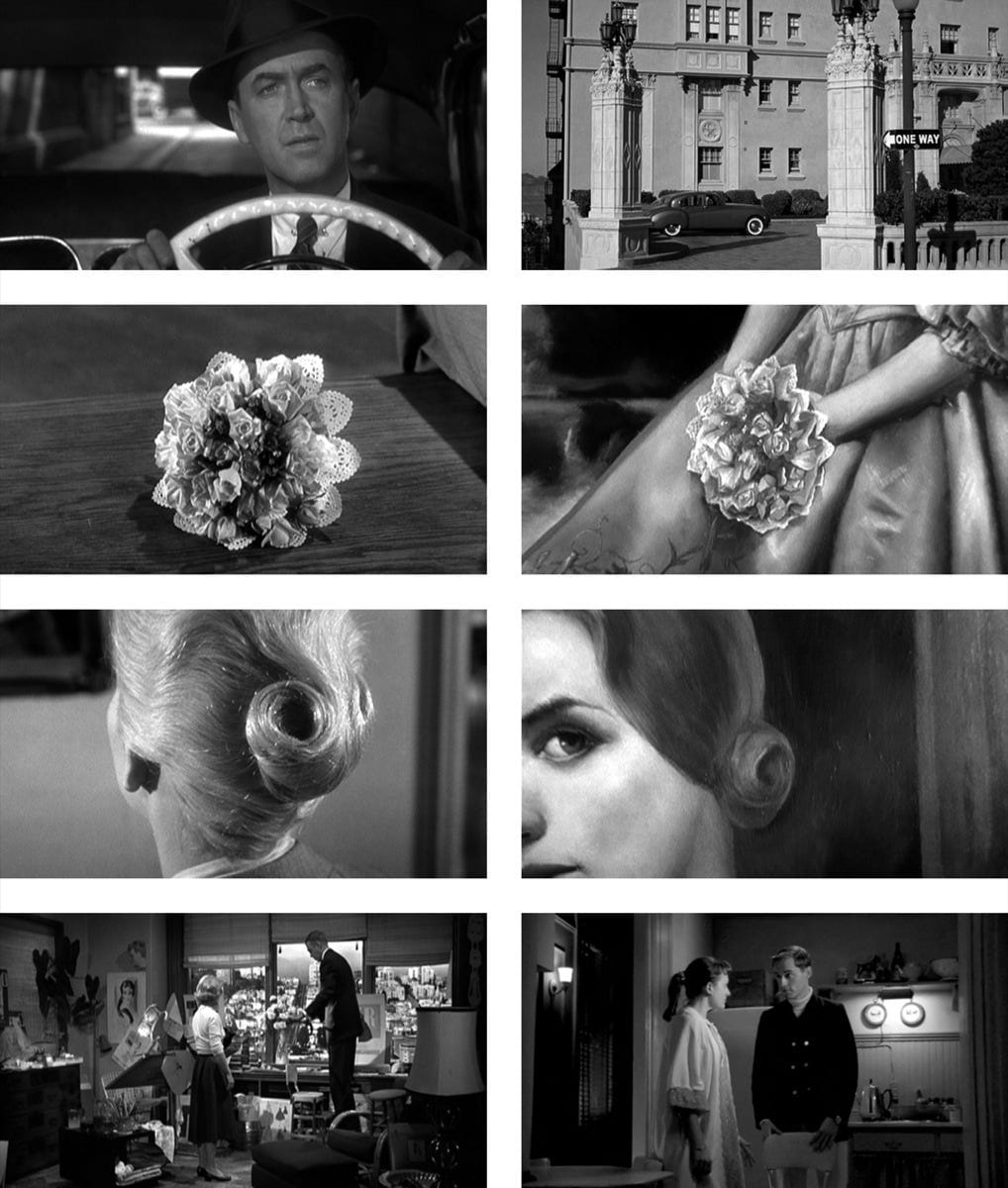
I remember thinking about that in Vertigo, Alfred Hitchcock had explored some of those themes. This is my meditation on that. You see her through Bannister’s eyes, and you see her as one thing. But what I wanted to do was to give her, her full depth as a character too. To peel back layer after layer and to go on this discovery with him, and as we learn more and more about Mae, we also learn more about Bannister — and the somewhat unreliable lens through which he views the world and Mae.
As a female screenwriter a lot of people say, “It’s harder for a female protagonist to open movies,” or “women can’t write men” or whatever. In my mind, that’s just all nonsense. You should ignore all that. What you should do is just write a character. Write a full, beautiful character that you fall in love with, man or woman. That’s how you get something true. Something that resonates.
Scott: In any science fiction story set in a different time or a different planet, there’s a certain amount of world‑building the writer needs to do. You’ve got that going on in “Reminiscence” with driverless cars, designer drugs, memory‑tank technology and whatnot.
But there’s a whole culture you develop around all of those technologies which is really interesting. Businesses like that Memorabilia Inc., a kind of chain store where people can go and get their memories fix. You’ve got these odd sort of New Orleans style funeral practices. Advertising in the sky, all this stuff. It feels very real and it’s quite entertaining. How did you go about creating that world?
Lisa: I had the luxury of time, in a way, where I sat down and I was writing the script spec, I was writing it to my own taste. Honestly, before I went into any theme, I would just close my eyes and sit there for quite awhile and think, “What is it like to move through this world?”
If it was boring me, I would say, “That’s not good enough.” I think the world that was created has bits of things that I love and find fascinating.
I’ve just taken little bits of culture that I witnessed when I traveled to Asia, or when I look at different parts of the United States, or when I’m in Europe, or anywhere, and I just take tons of things that seem strange to me at the time and just follow them through, strange but beautiful. That’s what I did.
I read this thing recently about how New York is built on the rubble of blasted European cities from World War II, and that if you were to dig down beneath say, FDR Drive, you’d find the landfill was composed of fragments of cathedrals, buildings and homes destroyed in the Blitz.
That’s how the archaeology of scripts sometimes works is that you have all these little pieces of the cities you’ve been to and the people you’ve seen. That part of creating the world of screenplays is to piece them back together, these broken Lego bits and create something all your own.
Scott: From a nuts and bolts perspective, much of the story is about creating a thread of clues Bannister has got to follow which in effect constructs the plot. I’m wondering how much of that came intuitively and how much do you think derived from your time working on TV with a series like “Burn Notice,” going from clue to clue, commercial break to commercial break.
Lisa: The most important one of the things about TV is it goes at such a pace that sometimes it can become predictable in some ways because you even know when the ad break is coming and what’s going to happen. You can just feel those rhythms. A part of it is it become intuitive.
But you also want to subvert that a little bit and make sure you throw in some surprises in TV and in film, keep things experimental a little bit and moving forward. I would say that from TV I learned the rigors of keep the story moving. Make sure something new is happening. Make sure you’re discovering new things at each turn. But not exactly in the same six act structure that TV would have necessarily.
To me, I wanted it to be more organic so there would be room for surprises that would surprise me. That I’d, if I stumbled across something and it seemed like a little bit of a digression, in TV I would normally cut that out, because frankly, you just don’t have time for network TV specifically. You have 52 pages.
Unless it’s really important, you just don’t have time for it on network TV. In the feature, you have a little more time to explore things and take small digressions, which you might not immediately understand the importance of those digressions, but later on I think they add to the fullness of the universe and help take a script to new level.
I tend to think that part of structure is learned. After writing and reading a lot of scripts, you start to get a feeling for: “Oh, God, the hero needs to be driving something forward at this point. He’s meandering around too much.” I guess its craft, and you just keep practicing until it becomes intuitive.
But I also think that part of it is like music. Not everybody’s a musician, but when you first hear a song, there’s a kind of “a priori” sense for the rhythm and flow of it. How things crescendo into a peak. Decrescendo into conclusion. When the chorus will come back and give you something to hang onto. When it’s going to really get going and have you swaying or clapping along.
Screenplays and music have that in common. Sometimes I don’t know why it doesn’t work, but I just know it doesn’t sound right. It’s not singing right, if that makes sense.
Tomorrow in Part 5, Lisa talks about making the Black List, balancing a writing career and being a new mother, and what it’s like being a woman writer in Hollywood.
For Part 1 of the interview, go here.
For Part 2, go here.
For Part 3, go here.
Lisa is repped by UTA.
Please feel free to stop by comments with any questions you may have. Lisa has kindly agreed to answer some of them. I’ll pass along the best of the bunch.
Comment Archive