Interview (Part 4): Spencer Harvey and Lloyd Harvey (2016 Nicholl Winners)
My conversation with the brother and sister writing duo from Australia.
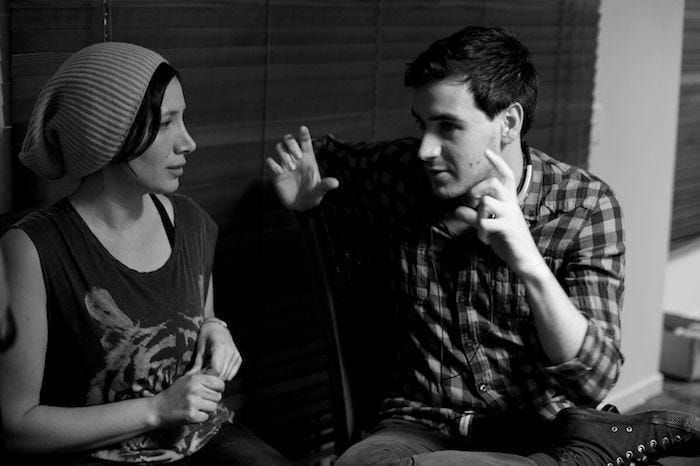
My conversation with the brother and sister writing duo from Australia.
Spencer and Lloyd Harvey wrote the original screenplay “Photo Booth” which won a 2016 Nicholl Fellowship in Screenwriting. Recently I had the opportunity to chat with the pair about their background as writers and filmmaker, and their award-winning screenplay.
Today in Part 4, we continue our exploration of the duo’s Nicholl winning script “Photo Booth”:
Scott: Do it upfront. Exactly. Do it upfront. It seems like almost, in a way, fate. I think that’s how Ben sort of takes it. Then they do have this arrangement where they invite her in to live with Ben and Jean and provide her money ‑‑ of course that would make sense they would do that to make sure she’s healthy and all that ‑‑ if she’ll agree to give up the baby.
Talk about the chronology of these characters. First was Jean and then Eileen. Is that right, in terms of emerging from your creative imagination? Were those the first two characters?
Spencer: They were the first two characters.
Lloyd: Yes.
Scott: Who was next? Was it Millie or Ben?
Lloyd: It definitely would have been Ben. It was about the nexus of this relationship between these two characters, the husband and wife. The element of the affair and the child actually came a little bit further into the process for us, which was is a funny thing, considering it is now the part that defines it. [laughs]
It was originally more a Ben‑and‑Jean relationship study, then we decided that…I think it was Spencer who came up with the idea of bringing in the child, the adopting the unborn child element that brought in this Millie character, and suddenly, all the pieces shifted and came together. It really became about the relationship of these three characters at that point.
Scott: It makes it so much more combustible because Ben cannot hide his, I guess you could say, rather lustful feelings toward Millie. Then there is an interesting twist that goes on with Jean, where at first she’s rather cold toward Millie, even hostile to her.
Then there’s a really interesting sequence where the two women bond. It feels like, in that short period of time, you’re touching on something that goes directly back to Jean’s relationship, or lack thereof, with Eileen.
Jean gets to act like the surrogate mother for Millie and gets to be the kind of mother she, Jean, wishes she herself could have had. Is that a fair representation of what goes on there?
Spencer: Absolutely. You definitely get a sense that these two, in this period of their lives, are giving each other something that they both need. Someone who “needs to be a mother” meets someone who “needs to be mothered”.
Scott: This is a very clean setup and you’ve got this mix of people, so that in the middle of the story, you’ve got all these little subplot relationships bouncing into each other.
You’ve got Millie living with Jean and Ben. You’ve got Ben with his lustful approaches toward Millie, even though he is trying to restrain himself for the most part. You’ve got Millie curious about the art these two people are doing. She reaches out to both of them to visit each of their respective creative worlds.
You’ve got Jean’s developing relationship with Millie. You’ve got Eileen who re‑enters Jean’s life. As it turns out, she is now sober and basically wants to reconnect with her daughter. How tricky was it for you managing all those subplot relationships, juggling all those different balls in the air, during Act Two especially?
Spencer: It’s always tricky.
Lloyd: Definitely, particularly when we’re navigating whose story we’re telling. That’s what we had to keep coming back to. “Whose story is this? What’s the most important information? Whose mouth do we put it in?” Answering these questions is how we understood where the subplots would come together.
Scott: Let’s talk about these performance art pieces. I thought that was fascinating. I’m going to list them here. There is the photo booth.
There is the mirror. There’s the screen. The tempest. The table. The preacher, which I guess was an early one on videotape, where she drinking a shot of vodka every time the bell would ring and videotaping her performance.
The eye test, the screen part two, and then the photo booth thing. First of all, when did the idea come about, “Hey, let’s come up with a bunch of these and use them as a narrative device?”
Lloyd: We knew we would have to come up with them at some point, because if we were to be fortunate enough to make the movie, these pieces would have to exist in a retrospective exhibition.
Spencer: It was actually after the first draft.
Lloyd: Yeah, after the first draft.
Spencer: We finished the first draft, and we went, “We want to punctuate things.” Lloyd’s idea, he said we should punctuate the scenes with these artworks, so we can get a sense of what she’s feeling without having to say it.
We can show it in this interesting way, in a way that’s specific to performance art. We’ve got this gift of the performance art medium. We should use it in a unique way.
Lloyd: As part of the visual storytelling.
Scott: That’s really smart, because I tell my students all the time, movies are primarily…It’s an externalized reality. In a novel, you can go inside a person’s head for 20 pages. You can’t do that in a script, so you need to figure out ways to visualize, either through dialogue or action, what’s going on inside. You’re right. Performance art. That’s perfect.
Lloyd: We were wondering why we didn’t use it in the first draft, really. [laughs] “Why did we not start with this?” Luckily we…
Spencer: We cottoned on.
Scott: Let me ask you a question. It struck me that, at least a few of these, they almost serve like chapter headings. “The Tempest” sets up when the mother re‑enters Jean’s life. “The Preacher, Part Two,” on page 80, caps off Eileen’s relapse, her relapse into drinking. Were you thinking about that at all?
Spencer: When you are ready with your first draft, you’re putting it in after having a full draft ready to go, you can feel instinctively where those chapters fall. You know what they should be. It’s a beautiful…What do you call it? Bird’s‑eye view you can utilize. “Here’s where we need it. Here is the breath. Here’s another breath.”
Scott: I read so many scripts and oftentimes, you can tell where thing are going pretty early on. One thing that’s really great about your script is the twists and turns with the characters. Even in the final act, I really had no idea where things were going to turn out.
Yet, the way that they do turn out, while I guess you could say rather melancholy in a way, or squarely in that arena of the gray nature of existence, the resolutions each feel…As you said, Spencer, you allowed them to live honestly, these characters, and fully in the world of the story. That must feel quite satisfying to you.
I think you’ve said it took you three years to write this script, but by the time you got done with it, it feels like all the…This iteration of the story feels quite complete. Does it feel satisfying to you?
Spencer: Thank you.
Lloyd: That is a lovely compliment.
Spencer: A lovely compliment. It does. A lot of it was about homing our story down to the thing we wanted to say. I was wrong in saying that, the thing we wanted these characters to say or these characters needed to say.
Because we were allowing them to live fully, we wanted them to realize, in a succinct way exactly why these three people needed to meet, what they needed to learn from each other…
Scott: And what they needed to take away at the end.
Spencer: Once we got that nice and clear, it really did feel complete for us.
Scott: That final image, the last thing. How far into the process was it that you came up with that? The very, very last scene?
Lloyd: That has been there from draft one, the very last scene is identical, minus a few tweaks, from its first incarnation.
Spencer: We’ve re‑rewritten a lot in the script, but the first scene and the last scene have survived pretty much unchanged.
Scott: You knew the broad parameters of her arc, if you will, from the very beginning.
Spencer: That felt like the most honest start and end for her. What she needed and what she wanted were two different things. The film couldn’t address all of it without it feeling too convenient. We felt like we needed to make sure she got what she needed first, and that’s what we did — she has the rest of her life, after the fade to black, to work on the rest.
Lloyd: Yes, we see the end as hopeful for Jean as a character.
Scott: Absolutely. It feels like it’s the start of a new story. A new chapter, really. Three years to write the script. Is that right?
Lloyd: On and off. We’d get to the end of a draft, put it away in drawer thinking it was done, and then we’d look at it a month or two later and realize how much work it needed. We had a lot of trusted readers and friends who were happy to read it for the second, third, or fourth time. Over the course of the three years, somehow we got to this version of this draft.
Here is a stage reading of a script excerpt from “Photo Booth” performed at the official Nicholl ceremony in December 2016:
Tomorrow in Part 5, Spencer and Lloyd talk about their Nicholl Fellowship experience.
For Part 1, go here.
Part 2, here.
Part 3, here.
Spencer and Lloyd are repped by UTA and The Gotham Group.
Twitter: @SpencerandLloyd.