Movie Analysis: “Inside Out” — Themes
Another in our bi-weekly series in which we analyze movies currently in release. Why? To quote the writing mantra I coined over 5 years ago: Watch movies. Read scripts. Write pages. You will note which one comes first. Here are my reflections from that post about the importance of watching movies:
To be a good screenwriter, you need to have a broad exposure to the world of film. Every movie you see is a potential reference point for your writing, everything from story concepts you generate to characters you develop to scenes you construct. Moreover people who work in the movie business constantly reference existing movies when discussing stories you write; it’s a shorthand way of getting across what they mean or envision.
But most importantly, you need to watch movies in order to ‘get’ how movie stories work. If you immerse yourself in the world of film, it’s like a Gestalt experience where you begin to grasp intuitively scene composition, story structure, character functions, dialogue and subtext, transitions and pacing, and so on.
Let me add this: It’s important to see movies as they get released so that you stay on top of the business. Decisions get made in Hollywood in large part depending upon how movies perform, so watching movies as they come out puts you in the same head space as reps, producers, execs, and buyers.
This week’s movie: Inside Out, screenplay by Meg LeFauve & Josh Cooley and Pete Docter, story by Pete Docter & Ronaldo Del Carmen, additional dialogue by Amy Poehler & Bill Hader.
Our schedule for discussion this week:
Monday: General Comments
Tuesday: Plot
Wednesday: Characters
Thursday: Themes
Friday: Takeaways
For those of you who have not seen the movie, do not click MORE as we will be trafficking in major spoilers. If you have seen Inside Out, I invite you to join me in breaking down and analyzing the movie.
My principle for Theme is this: Theme = Meaning. And often, it’s more specific: What is the emotional meaning of the story?
When it comes to Inside Out, the story is all about emotions. So why not pose a question I ask of my writing students as they develop their stories: What do you want the audience to feel when they emerge from the movie theater?
It’s easy to say, “Hey, I want them to feel good.” But why? And how? What are the narrative elements which will make them feel good?
In Inside Out, we have the proverbial ‘happy ending’. Riley reunited with Mom and Dad. She reconnects with a part of her Midwest self — visualized through her involvement in hockey. Notably she does not head out onto the ice and immediately become a goal-scoring machine. In fact, she messes up a few times. But in the end, that’s okay. The message seems to be, life isn’t perfect. Our emotions are fluid, organic, and have a vitality of their own. They are powerful agents capable of steering us here and there.
However as unruly as they are, it’s okay to have them. To feel them. This is a lesson which all the key players learn:
* Mom and Dad learn to allow Riley room to have her sad feelings about the move.
* Riley learns not to run away from her feelings, but have the courage to share them with others.
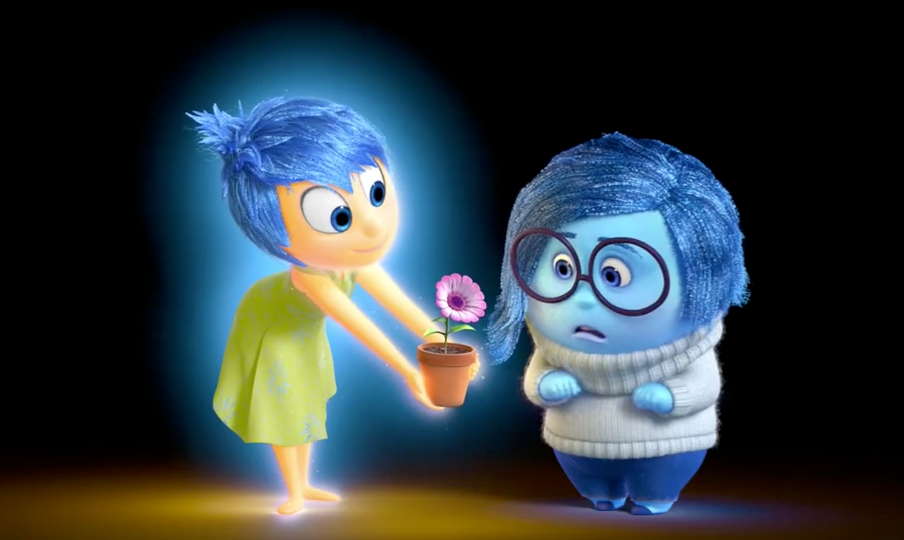
* The Emotions — and especially Joy — learn each of them has a legitimate place in Riley’s life, not just dominated by Joy, but sharing Riley’s psychological space.
So one theme is this: Your feelings exist and deserve to be recognized. Indeed, if you don’t acknowledge them, they can cause havoc in your life.
What other themes do you see in play in Inside Out? I look forward to seeing your observations in comments.
Comment Archive