Screenwriting Lessons: “True Grit” — Part 5: Mentor
Five-part series exploring lessons from the Coen brothers screenplay.
Five-part series exploring lessons from the Coen brothers screenplay.
One of five primary character archetypes, the Mentor provides a critical narrative function, the focus of which is their connection to the Protagonist intellectual development. In addition to insights they have into the Protagonist’s metamorphosis, they also typically have knowledge about the New World into which the Protagonist ventures, helping them to circumnavigate the many obstacles faced along the way.
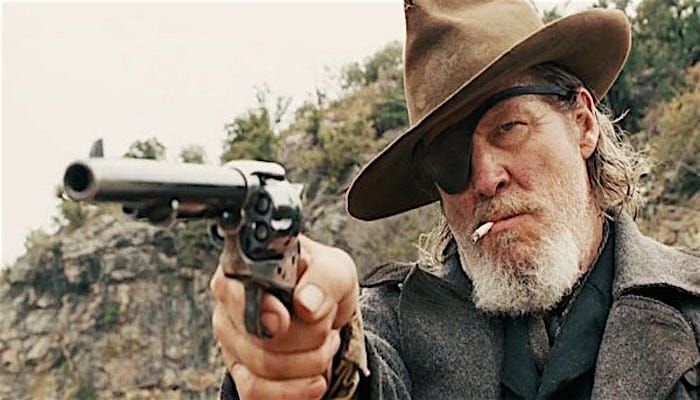
In True Grit, the Mentor is Rooster Cogburn. Here are some of the reasons why:
- He’s a tracker of criminals and therefore has knowledge Mattie needs to achieve her goal of finding her father’s killer Tom Chaney.
- He knows the area and its criminal elements, again essential knowledge for Mattie.
- He has a wisdom about life and the world in general arising from his long, adventurous past.
- He knows how to kill a man.
And there’s this: Mattie lost her father. Perhaps Mattie never really felt like she had a father, at least not one who she understood — or more importantly understood her. Through Mattie’s voice-over narrative and interchanges with other characters, we learn her father was a kindhearted individual, a generous man, trusting in the goodness of others. Does that sound like Mattie? On the other hand, how would we describe Rooster Cogburn: ornery, stubborn, loner, defiant, willful. Doesn’t that sound more like Mattie? Thus into the void created by her father’s death, Cogburn steps in as a surrogate father.
This Mentor as father figure dynamic is capped off by the remarkable sequence [P. 109–114] where Cogburn rescues Mattie from the pit and the venomous snakes, then transports the girl suffering from the poisonous bite she received in her hand across miles and miles of wilderness, first on horseback, then after Little Blackie breaks down, literally carrying Mattie in his arms to safety.
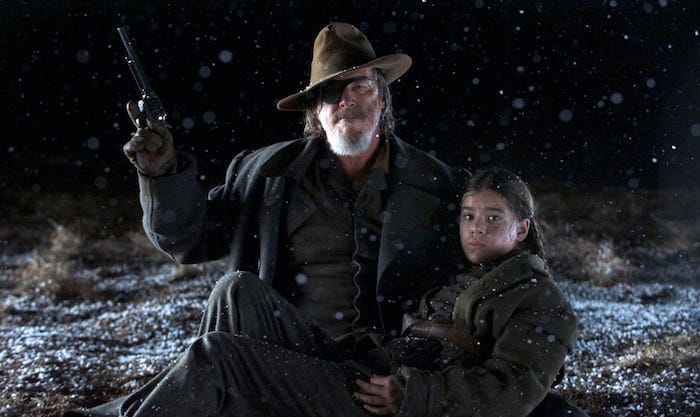
This is a beautiful end point of Mattie’s innocence-to-experience journey: She starts off cocksure and assertive, lots of head-learning but minimal knowledge of the ‘real’ world. She leaves the Ordinary World and ventures into the New World, represented by the hunt for her father’s killer. Over time, she opens up — slowly — to the help of others. In the end, she actually needs help. And help she gets from Cogburn who symbolically becomes her surrogate protector-father.
That last image — carrying Mattie in his arms — recalls a hymn that begins the movie, is recalled several times during the story, and again one last time as the credits first roll. The title of the hymn: “Leaning on the Everlasting Arms.” Here are the lyrics:
What a fellowship, what a joy divine,
leaning on the everlasting arms;
what a blessedness, what a peace is mine,
leaning on the everlasting arms.
Refrain:
Leaning, leaning,
safe and secure from all alarms;
leaning, leaning,
leaning on the everlasting arms.
O how sweet to walk in this pilgrim way,
leaning on the everlasting arms;
O how bright the path grows from day to day,
leaning on the everlasting arms.
(Refrain)
What have I to dread, what have I to fear,
leaning on the everlasting arms?
I have blessed peace with my Lord so near,
leaning on the everlasting arms.
Thus in Rooster, Mattie finds someone who is as distinctive an individual as she herself is, someone who shares many of the same qualities as she does, someone with the unique knowledge and skill-set she needs to achieve her goal, and someone who in the end through his courageous salvific act cements his role as Mattie’s protector-father — a fitting resolution to his role as her Mentor.
Here is the wonderful version of the hymn featured in the Coens brother movie performed by Iris DeMint:
Takeaway: Consider the story you are writing. Are there one or more characters who most intimately connected with the intellectual development of the Protagonist? Do they possess special knowledge about life and understanding about the New World? Do they perhaps play the role of surrogate father or mother? If so, you are likely looking at your story’s Mentor characters.
I confess when I first heard the Coen brothers were going to remake True Grit, I didn’t get it. Why? Then I read the novel. The tone is substantially different than the 1969 version with John Wayne. The Coens in my view nailed it in wonderful fashion and as with each of their movies provide ample wisdom for writers, filmmakers, and storytellers.