Interview (Part 3): Jon Spaihts
A 6 part series featuring one of Hollywood’s most sought after screenwriters.
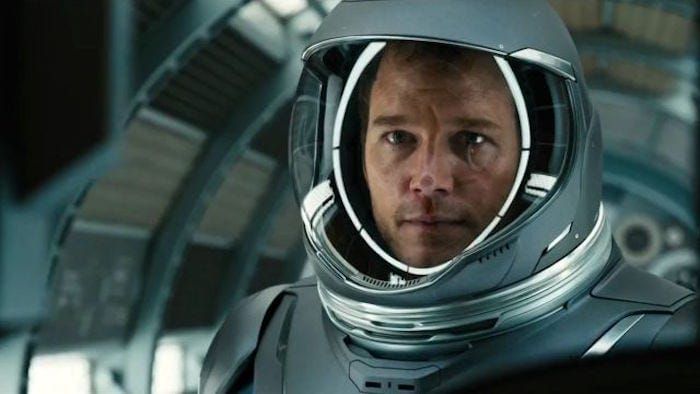
A 6 part series featuring one of Hollywood’s most sought after screenwriters.
I have been a fan of Jon Spaihts and his writing for years, so I was excited to have the opportunity recently to spend an hour talking with him about his career, his movies, and the screenwriting craft. His movie credits include Prometheus, Doctor Strange, and his latest Passengers, along with the upcoming films Van Helsing and The Mummy among many others.
Today in Part 3, Jon and I delve into the Protagonist figure in Passengers, the unique circumstance in which he finds himself, and a critical choice he makes which turns the story on its head:
Scott: I read an interview some time ago, you said somebody asked you, “Do you work from a character?” You said, “Predicament.” It was an interesting use of that word. Whatever the predicament the character’s in, that informs the direction you take the character. In Passengers, Jim, who’s played by Chris Pratt, he’s a mechanic. Right? That’s his gig.
Jon: Yes.
Scott: Mechanics fix things, so I was thinking that’s interesting that he’s got into a situation where he literally does have to fix some things, but more metaphorically he’s got this situation that’s gone awry which needs repair. Maybe you could walk us through how you developed Jim’s character.
Jon: He’s a guy on a long‑haul starship gone wrong. He’s having technical difficulties in the grandest sense. It seemed right to me that he should be a mechanic so he could begin to tinker and work on the problems, but it seemed equally important that he be a completely inadequate mechanic. If he were a starship engineer, that would be a wild coincidence, and also lead to far too swift and easy a resolution. So he’s just a handyman. He repairs robots and refrigerators.
That makes him an interesting guy to watch thinking about the problems because he’s going to ask intelligent questions, but he’s not going to be capable of getting quick and easy answers. He’s out of his depth, which is a great trait for a character to have, but he’s competent, skilled at what he does and has a can‑do attitude that I think is immensely appealing in a protagonist.
Scott: You did something really very clever, just riffing off what you were just saying there — that he can’t get answers. He’s calling and getting these frustrating responses. Every single person can relate to that. That’s like the cable company, medical insurance, whatever. Was that just a fun bit of business, or was that really to help ground his experience in something that everybody could relate to?
Jon: I did want to keep the audience close to him and close to the story.
I think in science fiction it’s very important to decide what the big idea is that you want to investigate and shine a spotlight on that. Here’s the great point of difference between our world and the story-world that I’m going to tell you a tale about. Everywhere outside that spotlight of attention, you want the world to be as digestible for the audience as possible. You want to use cues of familiarity to settle people in.
If you’re telling a story about the army of the future, it should look and feel like we expect an army to look and feel. Think about what Jim Cameron did in “Aliens.” Those marines were marines. We understood their uniforms. We understood the way they joked with each other, their haircuts. There’s no reason the military needs to look like that centuries in the future. They could have had shoulder‑length hair, and pink uniforms, and a completely different way of speaking but, if you show us the design cues that we associate with the military, then we get who those guys are at once. We can move past that piece of scenery and get into the meat of the story.
For Passengers, what I decided to do was to use the design cues from traveling experiences that we all have when we are passengers on cruise ships, in airports and hotels, on airplanes and trains; and populate this science-fictional world with reminders of the world of travel that we know.
It instantly makes us connect to the passengers moving through that world. When they try to ask for help and they get a series of artificial intelligences and automated voices who don’t really understand their problem, we’ve all been there.
When they want to talk to a real person, and they find out the wait for a real person is going to be cosmically long, and that’s just an exaggeration of experience we’ve all had, and so on and so forth with any time your luggage has been lost, or going through a casino, or hotel, or cruise ship. Before you can do what you want, people try to sell you products three different times. There’s a tiered product system: you can have the low‑level stuff, but they make you pine for the high‑level stuff, so you buy a fancier ticket next time. All of those commercial gimmicks and hurdles that we run into when traveling I tried to evoke in this luxury starship.
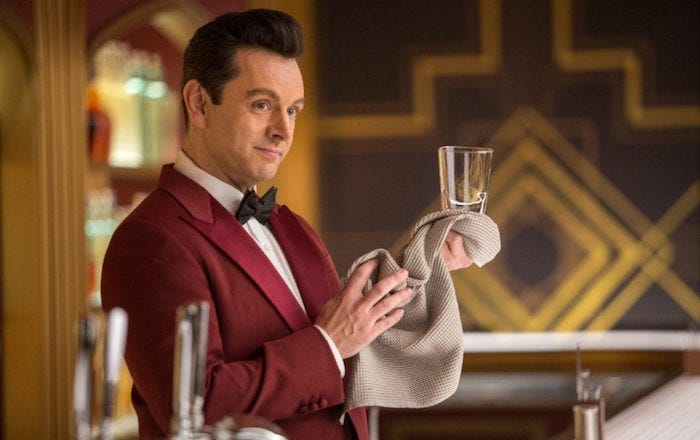
Scott: It’s a smart way of shrinking that distance between the audience and the characters in your story. Jim’s alone among these 5,000 hibernating humans. There’s this robot character who serves as sort of a mentor figure. Arthur, played by Michael Sheen. What was the inspiration for that character?
Jon: I needed a way for Jim to externalize his dilemma. Somebody for him to talk to. Among the cheerful idiots that all the other artificial intelligences on the ship represent, there’s one robot optimized for human conversation.
He would very naturally be the bartender in the showpiece bar on the ship. The finest watering hole on board. Like Jim, who is a barely adequate mechanic for the difficulties he’s having, Arthur the bartender is a barely adequate friend. More human than any other machine on the ship, but still less than human.
There’s something both endearing and tragic about watching this poor, lonely, stranded guy cozying up to this robotic companion to get the closest thing he can get to company.
Scott: You made a really interesting choice in that you spend, basically, an entire year of Jim’s life on his own. It’s not until page 26 that he intersects with Aurora, the Jennifer Lawrence character, and really until 32 that she’s awakened. On the one hand, you have to sell the solitude. That’s one of the themes you’re exploring here, so you need time and, practically speaking, page count to do that.
On the other hand, were you at all concerned that you’re going to lose the audience, which nowadays just seems to want the things happen now, now, and now? Was that ever a concern for you?
Jon: It’s funny. I think I was not. I found the first act of the script vastly entertaining, reading it myself. I thought it worked beautifully and was a kind of existential comedy I’d never seen before. Truth be told, it was a few pages longer in earlier drafts and I’m not sure it wasn’t better that way. I’m not sure I believe audiences need things to happen now, now, now. I know that studio executives think they do and, therefore movies are often shaped that way.
One of the great beauties of cinema, still, is that it comes with a captive audience. People buy a ticket and sit down in a theater and I think they automatically extend you a certain patience.
If you want to do something edgy in the first 20 minutes of the film, as long as it’s not so off‑putting that people walk out of the theater or walk away from their TV sets after renting the movie, you’ve got them — and you can take them somewhere challenging as long as you get them somewhere rewarding by the time you’re done.
I think film offers the possibility of a challenging and divergent first act, and that we should be brave enough to exploit that. In the world of television, every executive is trying to make their show sticky in the first 60 seconds to make sure that somebody wandering by might choose to stay, or that somebody who starts there won’t get bored and check the next channel over.
They’re right to have that concern, but so far, for now, cinema still has a kind of isolation and commitment associated with viewing that permits us a little experiment. I’m glad that we were allowed to try that experiment on this film. I can say, having seen it with a number of large test audiences, that people spend the first half‑hour of the film laughing.
Tomorrow in Part 4, Jon shares his thoughts on the Aurora character, played by Jennifer Lawrence, and the “ethical dilemma” at the center of the plot.
For Part 1 of the interview, go here.
Part 2, here.
Passengers, which stars Jennifer Lawrence and Chris Pratt, opens this week in North America and theaters around the world.
Visit the movie’s website here.
For more background on the movie’s decade long odyssey from script to screen, check out this Hollywood Reporter article: ‘Passengers’: The Long, Strange Trip to the Big Screen. And this Indiewire article: ‘Passengers’: Why It Took a Decade to Launch a Black List Darling.
And this: The Science Of ‘Passengers’ According To Screenwriter Jon Spaihts.
Jon is repped by CAA and Circle of Confusion.
Twitter: @jonspaihts.