Interview (Part 3): Robin Swicord
Prolific Hollywood screenwriter whose latest movie is Wakefield.
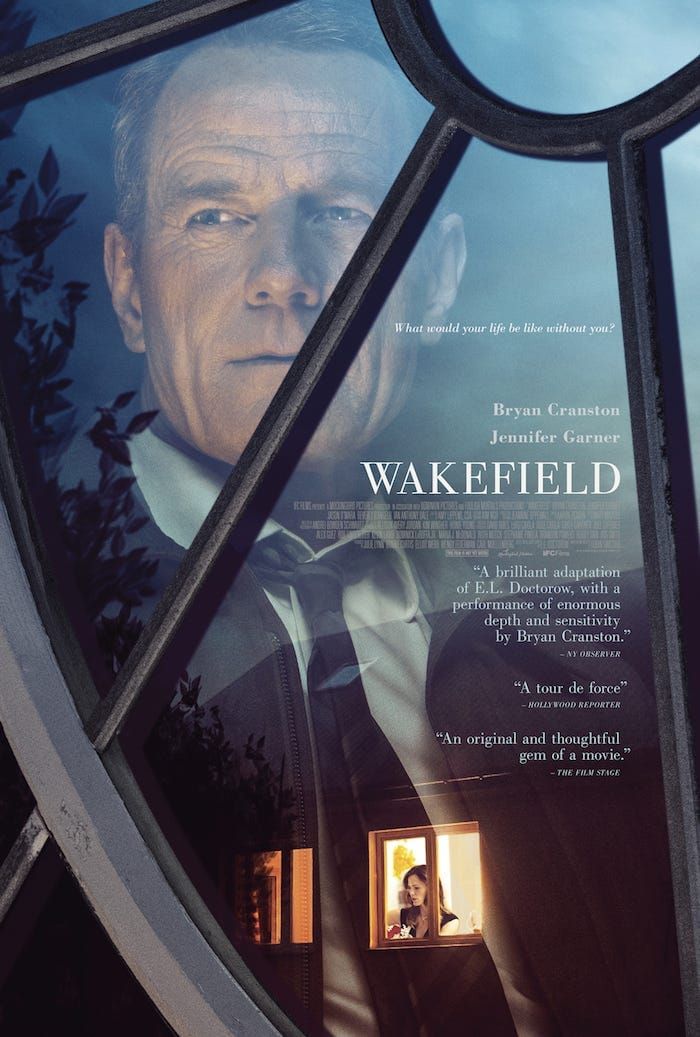
Prolific Hollywood screenwriter whose latest movie is Wakefield.
Robin Swicord is a writer, producer, and director whose movie credits include Little Women, Matilda, Memoirs of a Geisha, The Jane Austen Book Club, and The Curious Case of Benjamin Button. Her latest is Wakefield which Robin wrote and directed, and stars Bryan Cranston and Jennifer Garner. The movie premiered in New York this past Friday and rolls out to more theaters this week.
I have known Robin for many years as our children attended the same school in Los Angeles. In fact in 2013, I moderated an Austin Film Festival panel called “Deconstructing Dog Day Afternoon” in which Robin, screenwriter Peter Craig, and I broke down and analyzed that classic 1975 crime drama.
Recently I interviewed Robin about her lengthy and successful career in Hollywood. It was an hour-long conversation covering a wide range of subjects related to screenwriting and filmmaking. You will find Robin’s observations insightful, informative, and entertaining.
Today in Part 3 of this six-part series, Robin and I dig into the fascinating story of Howard Wakefield, the protagonist of the new movie Wakefield, the role played by Bryan Cranston.
Scott: Before we move to discussing your newest movie “Wakefield,” I’d like to talk about how involved you are in the Hollywood filmmaking community. The board of the Writer’s Guild Foundation, a trustee at the WGA Health and Pension Group, USC Scripter Award Selection Committee, the Academy of Motion Pictures Arts and Science Governors Board since 2012, the Nicholl Screenwriting Fellowship Committee Chair. Clearly you see being involved at this level to be important. Why is that?
Robin: First of all, some of those commitments I’m no longer involved in. When I became a Governor for the Academy, which is a very time‑consuming job, I stopped being involved in the Health Fund. And although I’m still a supporter of the Writer’s Guild Foundation, I don’t sit on their board. But I do a lot of mentoring in addition to that.
I work with Film Independent. I help teach their writing lab and I’m involved in their Global Media Makers program. I also mentor with Sundance. I go to that lab and I mentor whoever Michelle Satter and Ilyse McKimmie put in front of me.
I do believe that it is essential to remain engaged with the world, not just be in my little room writing. I also think that service to others is important, just in terms of your own development as a human being.
Scott: One last thing I want to talk about, the Nicholl Fellowships in Screenwriting competition. I’ve interviewed every Nicholl winner since 2012 and I think it’s fair to say for each of them it has been a life‑altering experience. What are your thoughts on the Nicholl Fellowships and its role in helping to provide an avenue for writers outside of Hollywood into the system?
Robin: Well, thank God for the Nicholl. Nicholl is one of the few launch pads for emerging writers. There are a few screenplay writing contests that also get attention for writers, besides the Nicholl Fellowship. The Austin Film Festival is one really good example. But there’s nothing like winning the Nicholl Fellowship to make people pay attention to you.
Before the Black List — also an excellent way for people to get to know a writer — the Nicholl was one of the very few ways that anyone could see the work of someone who had no Hollywood contacts, no agent, no representation, who did not know how to get their script to the right person.
The Nicholl gave emerging writers something to strive for. Because they could look at who won last year, and measure themselves against those scripts and know how much further they had to go. I think this Fellowship been essential for many years, and it remains extremely relevant and essential now, because we have not been great, as an industry, in building bridges to newcomers, in any branch.
As we try to change the face of Hollywood, the Nicholl becomes a natural place for people to enter, who don’t look like the people who have traditionally worked in Hollywood. It’s an important doorway.
Scott: Let’s talk about Wakefield, a terrific movie you adapted from an E.L. Doctorow short story which appeared in “The New Yorker” in 2008. You also directed the movie. Here’s a plot summary I got from IMDb:
“Howard, played by Bryan Cranston, has a loving wife, Jennifer Garner, two daughters, adolescents, a prestigious job as a Manhattan lawyer, and a comfortable home in the suburbs. But inwardly he’s suffocating, and eventually he snaps and goes into hiding in his garage attic, leaving his family to wonder what happened to him. He observes them from his window, an outsider spying in on his own life as the days of exile stretch into months. Is it possible to go back to the way things were?”
What about this story drew you to it as a filmmaker?
Robin: Well, initially I was drawn to it as a reader, when I saw the short story in The New Yorker. It’s hard to explain attraction to material. You know that you’ve had this feeling yourself as a creative person, that sometimes you’ll read something, or see something, and you’ll feel a kind of hook go in, sort of in the solar plexus. You feel a connection there. I had that with the short story.
Later, when I pursued it to make a film I realized that my own connection to it had to do with my childhood fantasies of leaving where I was. Of just being able to step out of my life. No one would know, and I would be perfectly safe, but I could just leave where I was and do what I wanted to, and everybody else would be frozen exactly where they were, so that I could come back any time. But meanwhile, Time had stopped. I could just do what I wanted. That feeling of being in an interstitial place was something that came back to me. The thought of Howard Wakefield kind of living in that interstitial space, trying to become something.
Scott: I don’t want to give away too much of the plot, especially the resolution of the story, so let’s focus on the two primary characters — the married couple, Howard and Diana. How would you describe Howard Wakefield, his state of being at the beginning of the story?
Robin: I think he’s living an unexamined life. He doesn’t know what he’s feeling as he’s feeling it. He has achieved a lot of external success, but there is trouble in his marriage and he can’t quite articulate that to us or to himself at the beginning. He is territorial. And he’s filled with these unexamined impulses, like his impulse to follow this raccoon up into the attic of the garage and get that raccoon out of there.
A sane person might say, “What does it matter if there’s a raccoon in your yard?” But Howard has a kind of controlling personality at the beginning. In that moment, with his territorial feelings on alert, he goes to shoo that raccoon out of there. From the garage attic, he looks down and he sees his family.
There’s been a power outage. Now the lights come on, and Howard can see that they’ve all been waiting for him to come home. She’s kept his dinner warm for him. He’s been almost petulantly ignoring her calls, even though he’s quite late, because his train has stalled and so forth. As he’s watching her, he begins recalling the fight they had the night before, a fight about jealousy.
Jealousy was a game they would play in their marriage, based on some atavistic idea of possession Howard had. His wife got the best of Howard in that argument. He mulls this over as he watches her. Then Howard sees her leave the house and throw his meal away in the garbage bin outside.
His mindset is, “I’m unloved, I’m misunderstood. If I go in that house, we’re just going to get into another big fight where I’ll be on the losing end. I’m just going to wait here for her to go to sleep.” This state of anger and resentment and game playing and trying to figure out where the power lies in their relationship — this is kind of where Wakefield and his wife been living for a while.
When he steps out and begins to look at himself, and at the marriage, and at her, when he really examines his life, things begin to shift for him. He goes through a lot of different stages, almost like stages of development. Bryan Cranston’s very funny doing all of that, but essentially he’s in pain for a lot of the film without ever really realizing it, initially. Gradually, and quite late in the story, he comes to a different state of mind.
Scott: That raccoon who leads Howard into the attic functions as a kind of Herald and that first night in the attic feels like a Call To Adventure. In fact, Howard says, “I never left my family. I left myself. I stepped into the wild.” Even though Howard travels no further than, basically, his own property or the town, it’s fair to say this is kind of a Hero’s Journey.
Robin: He’s on kind of a walkabout for himself. Again, it’s all unconscious. He’s not strategic about any of his plans. He doesn’t know what’s going to happen. He’s just following an instinct. He takes small incremental steps which lead him, unknowing, far from his original path.
Scott: I have a theory that in almost every movie there’s a question that lies at the heart of the protagonist journey and it’s this: Who are you? That question of self‑identity is clearly at the heart of Howard’s journey.
Robin: Oh, completely. It is very much a film about a man becoming a man.
Scott: It’s interesting how oftentimes we see a protagonist go through a metaphorical deconstruction and emerge at the end in a different state of being. In “Wakefield”, Howard’s deconstruction is not only metaphorical, it’s quite physical. He transforms before our eyes from season to season — the beard, his clothes, his behavior. What do you think is going on there with Howard where he is willing to go through this self‑absence from society and the psychological and physical transformation?
Robin: I think he’s trying to be not what he used to be, in that he’s not very focused on his appearance. Really, probably for the first time in his life he’s not thinking about, “What does this look like to others?” He’s just trying to be where he is; to survive, enjoy his flights of fancy, do the deep thinking he needs to do, and stand vigil over his family.
His appearance is just the accidental accretion of hair and fingernails that happens [laughs] to anybody that doesn’t groom themselves for nine months. But there is something self‑punishing in his choice to live as he does, to sleep on the floor of that attic, scrounging food at night from…There were scenes that are cut now, where Wakefield would occasionally break into people’s houses through the doggy door and take food.
He would forage in his own family’s garbage containers. He would go to the bakery garbage bins downtown at night. It is self‑punishing to make yourself live in this way. It takes a little while in the film for us to find out what he’s punishing himself for.
Scott: It’s a tricky bit of business because you’ve got to make the viewer buy that Howard would commit to this pretty irrational course of action. How much of a concern was that?
Robin: I thought about that constantly. I thought about it all the way through the editing process, too. We never stopped being a little bit worried about people not connecting to Howard because the things that he does are so extreme by standards of most people.
At the writing level I kept building in moments of alignment. I don’t think so much about whether the characters are likable. In some of my favorite movies, the protagonist starts out being very unlikable. But if I feel that the protagonist is human, and that I have felt the same things that they’ve felt, and that I might be driven to do the same kinds of things that they do, I take the journey.
I had to trust that if I built in those moments for us, for the audience early in the film, that the story would end up being a kind of wish fulfillment for the audience. “So this is what it would look like if I just walked out.” “I can’t believe this guy really is doing this! But, okay, yeah, I can kind of see how he would.”
Keeping that sense of alignment came up in editing as well. We’d be trying to cut for length, like, “Let’s see if we can get out of this scene faster.” But we’d realize, “We can’t cut this moment — this is one of the moments where we anchor the audience to Howard.” So it got built in during the writing, and then it got rebuilt in, during the editing process.
We were still making discoveries, though, in the last two weeks of editing, about how to tie us in a little more.
Tomorrow in Part 4, Robin and I discuss some of the key themes in Wakefield and key choices she made as a writer-director on the project.
For Part 1 of the interview, go here.
Part 2, here.
I have seen Wakefield. It is an engrossing tale of a man deconstructing his life in a fascinating fashion. You may learn more about Wakefield here.
Declare Your Independents! See Wakefield in a movie theater near you!